There is a lot more to eating plants than adding a side of broccoli to dinner. Vegetables, fruits, beans, lentils, whole grains, nuts, and seeds bring different combinations of fiber, vitamins, minerals, and other compounds to the table. They don’t all do the same job, and you don’t need to eat them all in the same way to benefit.
Fiber deserves particular attention because it does something many other nutrients don’t: much of it travels through the small intestine without being digested. Along the way and farther down the digestive tract, different types of fiber can influence how quickly food moves, how full we feel, how cholesterol and blood glucose are regulated, and what our gut microbes have available to feed on.
For women navigating perimenopause and menopause, these everyday functions matter. Changes in sleep, activity, body composition, and digestion can make familiar routines feel less predictable. Fiber isn’t a fix for hormonal changes, but getting enough of it can support several aspects of health that become especially relevant in midlife.
And here’s the encouraging part: improving your fiber intake doesn’t require a complete dietary overhaul. It often begins with ordinary foods you already recognize, eaten a little more regularly or combined in ways that make meals more satisfying.
The goal isn’t to build a perfect plate or chase an impressive number. It’s to understand what different plant foods offer, recognize where fiber fits, and find practical ways to include more of both in your everyday life.
Plants and Fiber Aren’t the Same Thing
We often hear the advice to eat more plants and get more fiber as though those two things are interchangeable. They’re closely related, but they’re not quite the same.
Plant foods include vegetables, fruits, beans, lentils, whole grains, nuts, and seeds. They provide a wide range of nutrients and naturally occurring compounds, including vitamins, minerals, and, in many cases, dietary fiber. Different foods offer different combinations, which is one reason variety matters.
Fiber is a type of carbohydrate found in plant foods that our digestive enzymes cannot fully break down. Unlike carbohydrates that are digested and absorbed in the small intestine, fiber moves through the digestive system largely intact or is fermented by microbes in the large intestine. What happens along the way depends on the type of fiber and the food it comes from.
And here’s where the distinction becomes useful: not all plant foods are particularly high in fiber. A serving of lettuce contributes water, vitamins, and other beneficial compounds, but relatively little fiber. Lentils, on the other hand, provide a substantial amount of fiber along with plant protein, minerals, and other nutrients. Both belong on the table, but they contribute differently.
Even the way a plant food is prepared can change how much fiber remains. A whole orange contains fiber that orange juice has largely lost. Refined grains generally contain less fiber than their whole-grain counterparts because portions of the grain have been removed during processing.
This doesn’t mean we need to rank foods as good or bad or insist that every plant food be a fiber powerhouse. It means we can appreciate plant foods for the different things they offer while being a little more intentional about including reliable sources of fiber.
Eating a variety of plants supports dietary quality. Getting enough fiber is a related, but more specific, goal.

What Does Fiber Actually Do in the Body?
Fiber is sometimes described as the part of food that helps keep us regular. That’s true, but it’s only one piece of a much bigger picture. Different types of fiber interact with the digestive system in different ways, influencing everything from stool consistency and digestion to cholesterol levels, blood glucose responses, and the environment in which our gut microbes live.
One important distinction is that fiber doesn’t behave like a single nutrient with a single job. Some fibers absorb water and form a gel-like substance in the digestive tract. Others add bulk to stool and help move material through the intestines. Certain fibers are fermented by gut microbes, producing compounds that can influence the health of the intestinal environment.
These properties often overlap. A food can contain several types of fiber, and an individual fiber may behave differently depending on how it’s processed, prepared, and eaten.
Digestion and Regularity
Fiber helps support normal bowel function, although different types contribute in different ways. Fibers that hold water can help soften stool, while others increase stool bulk and support movement through the digestive tract. For many people, a consistent intake of fiber, along with adequate fluids, makes bowel movements easier and more predictable.
That doesn’t mean more fiber is always better. Increasing intake too quickly can lead to bloating, gas, or discomfort, especially when the digestive system hasn’t had time to adjust. Gradual changes tend to be more comfortable than suddenly doubling the amount of fiber on your plate.
Blood Glucose Responses
Certain fibers, particularly those that become viscous when mixed with water, can slow the digestion and absorption of carbohydrates. This may help moderate the rise in blood glucose after a meal.
But the effect depends on the type and amount of fiber, the food containing it, and the composition of the meal. Eating a high-fiber food doesn’t make blood glucose responses disappear, and not every fiber affects them in the same way.
This is one reason whole-food combinations can be useful. Beans, lentils, and intact whole grains provide fiber alongside other nutrients, making them valuable additions to meals rather than ingredients we need to treat as special supplements.
Cholesterol and Heart Health
Some soluble, viscous fibers can help lower LDL cholesterol by affecting how bile acids are handled in the digestive system. Oats, barley, and certain legumes are familiar food sources of fibers associated with this benefit.
Fiber-rich eating patterns are also associated with better cardiovascular health overall. That relationship reflects more than fiber alone, since people who regularly eat these foods may also consume different combinations of fats, minerals, and other nutrients.
For women approaching and moving through menopause, cardiovascular health deserves attention. Changes in estrogen levels are associated with shifts in cholesterol patterns and other cardiovascular risk factors, making supportive everyday habits especially worthwhile.
Fullness and Satisfaction
Fiber can also contribute to how satisfying a meal feels. Depending on the food and type of fiber, it may add volume, slow aspects of digestion, or influence signals involved in appetite and fullness.
This doesn’t mean fiber automatically prevents hunger or causes weight loss. Hunger is influenced by many things, including total food intake, protein, sleep, activity, and individual physiology.
Instead, think of fiber as one part of building meals that leave you feeling comfortably fed. A bowl of lentil soup, an apple with peanut butter, or oatmeal with berries may offer a different eating experience from foods that contain little fiber.
Your Gut Microbes
The large intestine is home to a diverse community of microorganisms, many of which can use certain fibers as fuel. When microbes ferment these fibers, they produce substances called short-chain fatty acids, including acetate, propionate, and butyrate.
These compounds participate in several processes, including supporting the intestinal environment and providing energy for cells lining the colon. Scientists are continuing to study how microbial activity connects with metabolism, immune function, and health more broadly.
Not every fiber is fermented, and different microbes prefer different substrates. That’s another reason eating a variety of fiber-containing foods can be more useful than relying on a single source.
The Bigger Picture
Fiber doesn’t send one simple message to the body. Its physical properties, the foods it comes packaged in, and the way it interacts with digestion and gut microbes all influence the responses that follow.
In the language of The Signals Project, choosing fiber-rich foods is an input. Changes in digestion, blood glucose responses, cholesterol regulation, and fullness are among the physiological responses that input can help influence over time.
The goal isn’t to control every response or turn every meal into a science experiment. It’s to understand why ordinary choices—beans in a soup, berries with breakfast, vegetables alongside dinner, or a switch to whole grains—can matter when they’re repeated consistently.

How Much Fiber Do You Actually Need?
If you’ve ever looked up how much fiber you should eat, you’ve probably encountered several different numbers. Twenty-five grams. Thirty grams. Fourteen grams for every thousand calories. It can feel like one more nutritional target to keep track of, especially when you’re already trying to figure out what works for your changing body.
The good news is that these recommendations aren’t as contradictory as they might seem. They’re simply different ways of estimating an appropriate daily intake.
The National Academies established an Adequate Intake for total dietary fiber based on approximately 14 grams per 1,000 calories. That translates to about 25 grams per day for women ages 19–50 and 21 grams per day for women 51 and older, using the calorie intakes assumed for those age groups.
The distinction matters because the recommendation doesn’t drop at 51 due to some sudden change in how fiber works. The age-based targets reflect differences in estimated energy needs. Fiber continues to support digestive and cardiovascular health throughout midlife and beyond.
These numbers are useful reference points, not rigid limits. Some women will benefit from eating more fiber than the age-based target, particularly when their overall calorie intake is higher. Others may need to increase gradually or adjust their choices because of digestive conditions or individual tolerance.
What Does 25 Grams Actually Look Like?
Twenty-five grams of fiber can sound like a lot when you’re thinking about it as a number. It becomes more manageable when you start recognizing how ordinary foods contribute throughout the day.
Consider a breakfast of oatmeal topped with raspberries, a lunch that includes lentils or beans, and a dinner with vegetables and a whole grain. Add a piece of fruit or a handful of nuts somewhere along the way, and the fiber from those foods begins to accumulate without requiring any single meal to do all the work.
The important thing is that fiber comes from the whole day’s eating pattern. You don’t need a special high-fiber breakfast, a perfectly balanced lunch, and an enormous serving of vegetables at dinner. Smaller contributions from several foods can add up.
And because foods vary considerably in their fiber content, appearances can be misleading. A large salad made mostly from lettuce may provide less fiber than a modest serving of lentils. Both can be worthwhile choices, but they contribute differently.
Do You Need to Track Every Gram?
Not necessarily.
If you’re curious about your current intake, checking nutrition labels or looking up the fiber content of foods you eat regularly can be a useful learning exercise. Even a few days of paying attention may reveal patterns you hadn’t noticed.
You might discover that breakfast contains almost no fiber, that you rarely eat beans or lentils, or that most of your grain choices are refined. Those observations can give you somewhere practical to begin.
But you don’t have to turn that awareness into permanent tracking. Once you recognize reliable fiber sources, you can begin including them more consistently without calculating every meal.
A useful question is simply: Where is the fiber in this meal?
Sometimes the answer will be obvious. Other times, you may notice an opportunity to add berries, beans, vegetables, seeds, or a whole grain. And sometimes a meal won’t contain much fiber at all. That’s okay, too. Your overall pattern matters more than making every plate meet an imaginary standard.
More Isn’t Always Better
It’s tempting to assume that if some fiber is beneficial, dramatically increasing it must be even better. But the digestive system doesn’t always appreciate sudden changes.
A rapid increase in fiber can cause bloating, gas, abdominal discomfort, or changes in bowel habits. This is particularly common when someone goes from eating relatively little fiber to adding large portions of beans, bran, or high-fiber products all at once.
Instead, increase your intake gradually. Add one fiber-containing food or adjust one familiar meal, give your digestive system time to adapt, and build from there. Drinking adequate fluids is also important, particularly as you increase fiber intake.
If you have a gastrointestinal condition, a history of bowel obstruction, or persistent digestive symptoms, your ideal fiber intake and the types you tolerate may differ from general recommendations. In those situations, individualized guidance from a qualified healthcare professional is more useful than simply aiming for a higher number.
A Target, Not a Test
Fiber recommendations are meant to help guide eating patterns that support long-term health. They’re not a daily pass-or-fail test, and they don’t tell the whole story of your diet.
For women in perimenopause and menopause, the goal is to build meals that support the body through changing circumstances. Fiber is one useful part of that picture, alongside adequate protein, nourishing fats, carbohydrates, movement, sleep, and recovery.
Start with the foods you already enjoy. Notice where fiber is missing. Make changes you can comfortably repeat.
Consistency will take you much further than chasing a perfect number for a few days.
Where Do You Actually Find Fiber?
Once you understand what fiber does and roughly how much you need, the next question becomes much simpler: where do you find it?
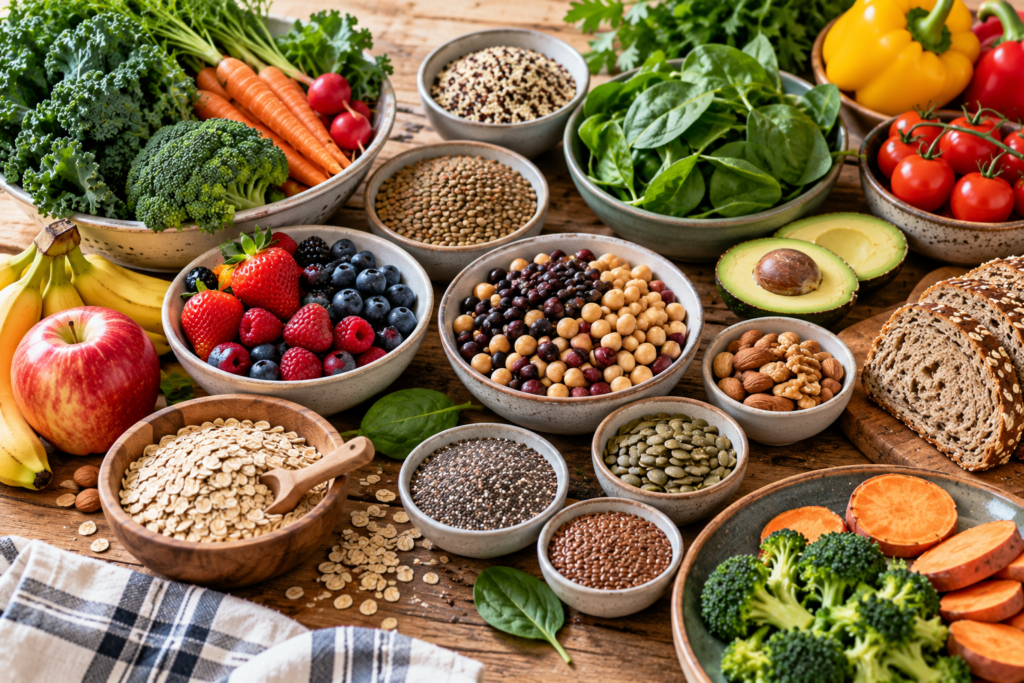
The answer isn’t limited to bran cereal, enormous salads, or foods marketed as high-fiber products. Fiber is naturally present in a wide range of everyday plant foods, including beans, lentils, whole grains, vegetables, fruits, nuts, and seeds. Some provide substantial amounts in a relatively small serving, while others contribute a little at a time.
The most useful approach is to recognize which foods are particularly reliable sources and which ones offer other nutritional benefits without contributing quite as much fiber. Both can belong in a nourishing eating pattern.
Beans, Lentils, and Other Legumes
If you’re looking for foods that deliver a meaningful amount of fiber without requiring enormous portions, beans and lentils are an excellent place to begin.
Black beans, kidney beans, chickpeas, white beans, split peas, and lentils provide fiber alongside plant protein, complex carbohydrates, and minerals. Depending on the variety and preparation, a half-cup serving of cooked beans or lentils can contribute roughly six to nine grams of fiber.
That’s a substantial portion of a day’s recommended intake from a food that can fit into soups, salads, grain bowls, tacos, pasta dishes, and familiar family meals.
You don’t need to become someone who eats a giant bowl of beans every day. Adding a few spoonfuls to soup, mixing lentils into a meat sauce, or including chickpeas in a salad can make a difference over time.
And canned beans absolutely count. Rinsing them can reduce some of the sodium, and their convenience makes them particularly useful when time or energy is limited.
Whole Grains
Whole grains provide fiber along with vitamins, minerals, and other nutrients found naturally in the grain.
Oats, barley, bulgur, whole wheat, brown rice, quinoa, and other whole grains can all contribute, although the amount of fiber varies considerably. Barley and bulgur, for example, generally provide more fiber per cooked cup than brown rice.
This is also where the distinction between whole and refined grains becomes useful. Refining typically removes portions of the grain that contain fiber, leaving products such as white flour and white rice with less fiber than their whole-grain counterparts.
That doesn’t mean white rice or sourdough bread needs to disappear from your kitchen. It simply means those foods may not contribute as much toward your fiber intake, so other foods can help fill the gap.
A bowl of oatmeal at breakfast, barley added to soup, or whole-grain bread used for a sandwich can provide opportunities to include more fiber without reinventing the way you eat.
Vegetables
Vegetables are valuable for far more than their fiber content. They provide water, vitamins, minerals, and a wide variety of naturally occurring plant compounds, with different vegetables contributing different combinations.
But not all vegetables are particularly high in fiber.
Green peas, artichokes, Brussels sprouts, broccoli, carrots, and sweet potatoes can make useful contributions. Leafy greens, cucumbers, and lettuce generally provide less fiber per typical serving, although they offer other nutritional benefits.
This is why a large salad isn’t necessarily the same thing as a high-fiber meal. A bowl of lettuce and cucumber may be refreshing and nutritious, but adding chickpeas, roasted vegetables, or another fiber-rich ingredient changes what that meal provides.
Frozen vegetables count, too. They’re often picked and frozen soon after harvest, and they’re a practical way to keep vegetables available without worrying about fresh produce spoiling before you can use it.
Fruit
Fruit is another easy place to find fiber, particularly when you’re eating the whole fruit rather than drinking its juice.
Raspberries, blackberries, pears, apples, oranges, and avocados are examples of fruits that can contribute meaningful amounts of fiber. Berries are particularly useful because a relatively modest serving can provide several grams.
The edible skins of some fruits contribute fiber, too. You don’t need to peel an apple or pear unless you prefer it that way or have a reason to do so.
Juice is a different story. Although it may provide some vitamins and other nutrients, much of the fiber found in whole fruit is removed during juicing. A whole orange and a glass of orange juice therefore don’t offer the same nutritional package.
Fresh, frozen, and unsweetened canned fruits can all have a place in your kitchen. Choose the forms that work for your budget, preferences, and routine.
Nuts and Seeds
Nuts and seeds often get discussed primarily as sources of healthy fats, but many also provide fiber.
Chia seeds, ground flaxseed, almonds, pistachios, sunflower seeds, and pumpkin seeds contribute varying amounts. Chia seeds and flaxseed are particularly fiber-rich for their size, although the portions people typically eat are relatively small.
A spoonful of ground flaxseed stirred into oatmeal, chia seeds added to yogurt, or a handful of almonds alongside fruit can contribute to your daily total.
These foods also bring different combinations of fats, protein, and minerals, which is another reminder that we don’t need to evaluate an ingredient by a single nutrient.
What About Plant-Based Foods That Don’t Contain Much Fiber?
This is worth mentioning because the word plant-based can sometimes create the impression that a food must be high in fiber.
Olive oil comes from plants, but it contains no dietary fiber. Most plant milks provide little fiber unless they’re made or formulated to retain it. Tofu contains relatively little fiber compared with whole soybeans or edamame. Refined grain products can also be plant-based while contributing only small amounts.
None of that automatically makes these foods poor choices. Olive oil provides unsaturated fats, tofu can be a useful source of protein, and fortified plant milks may provide important nutrients.
It simply means that plant-based and fiber-rich describe different things.
Variety Matters More Than Finding One Perfect Food
You could get a substantial amount of fiber from beans alone, but that wouldn’t mean beans should be your only plant food.
Different plant foods provide different types of fiber, micronutrients, and naturally occurring compounds. They also offer different flavors, textures, and ways to build satisfying meals.
A practical pattern might include oats or berries at breakfast, vegetables and beans at lunch, fruit or nuts as a snack, and another combination of vegetables, legumes, or whole grains at dinner. Not every food needs to be especially high in fiber. Together, they contribute to a broader and more varied eating pattern.
And if you’re starting from a relatively low-fiber diet, you don’t need to add all of these foods at once. Choose one or two familiar options and build from there.
The goal isn’t to eat every plant food on a checklist. It’s to have enough reliable options that getting fiber becomes a natural part of eating rather than another daily project.

How to Add More Fiber Without Making Your Stomach Miserable
You’ve learned why fiber matters, you’ve identified some foods that contain it, and you’re ready to start eating more. So you add beans to lunch, switch to high-fiber cereal, sprinkle chia seeds over breakfast, and double the vegetables at dinner.
By the next afternoon, your stomach feels like an overinflated balloon.
It’s a surprisingly common experience, and it doesn’t necessarily mean fiber is bad for you or that your digestive system can’t handle plant foods. Often, the problem is simply that you’ve changed too much, too quickly.
Fiber affects the digestive system in several ways. Some types absorb water and change stool consistency. Others increase bulk, while certain fibers are fermented by bacteria in the large intestine. That fermentation can produce beneficial compounds, but it also produces gases. When you suddenly introduce much larger amounts of fermentable material, bloating and discomfort can follow.
The solution usually isn’t to abandon fiber altogether. It’s to approach the change more gradually and pay attention to how your body responds.
Start Where You Are, Not Where You Think You Should Be
If you’re currently eating relatively little fiber, jumping straight to 25 or 30 grams a day may be uncomfortable. Your digestive system has been working with one pattern of food intake, and now you’re asking it to handle something substantially different.
Instead of overhauling every meal, begin with one manageable change. Add a small serving of berries to breakfast, replace part of your usual grain with a whole grain, or include a few spoonfuls of beans in a familiar meal.
Stay with that change for several days and see how you feel before adding another. There isn’t one perfect schedule for increasing fiber, and some people need more time than others.
This is one of those situations where consistency matters much more than speed. A gradual increase that you can comfortably maintain is more useful than an ambitious plan you abandon after three uncomfortable days.
Give Your Digestive System Enough Fluid
Fiber and fluid work together, particularly when you’re increasing your intake of fibers that absorb water.
Some fibers help retain water in stool, which can make it softer and easier to pass. But increasing fiber without adequate fluid intake may contribute to constipation or make existing symptoms worse for some people.
You don’t need to force yourself to drink enormous quantities of water. Pay attention to thirst, your usual activity level, the weather, and any medical guidance you’ve been given about fluid intake. Water, other beverages, and fluid-rich foods can all contribute to hydration.
The important point is that fiber doesn’t work in isolation. When you change one part of your eating pattern, it helps to consider the conditions your digestive system needs to respond comfortably.
Not All Fiber-Rich Foods Feel the Same
Two foods can contain similar amounts of fiber and produce very different digestive experiences.
Beans, lentils, onions, wheat, certain fruits, and other plant foods contain different combinations of fibers and fermentable carbohydrates. Some of these carbohydrates are commonly called FODMAPs, and they can cause more gas, bloating, or discomfort in people who are sensitive to them.
That doesn’t mean these foods are unhealthy. It means that individual tolerance varies, and the amount eaten can make a difference.
If a large serving of chickpeas leaves you uncomfortable, you might tolerate a smaller portion mixed into a meal. If raw vegetables consistently cause discomfort, cooked vegetables may be easier to manage. If a particular high-fiber cereal causes bloating, another fiber source may suit you better.
The goal isn’t to push through significant discomfort in pursuit of a nutrition target. It’s to find foods and portions that support your health while allowing you to feel comfortable.
Preparation Can Make a Difference
How you prepare fiber-rich foods may influence how easily you tolerate them.
For dried beans, soaking and discarding the soaking water before cooking may reduce some of the fermentable compounds that contribute to gas. Cooking beans thoroughly is important, both for digestibility and, in the case of certain beans such as kidney beans, food safety.
Canned beans are a convenient alternative. Draining and rinsing them removes some of the liquid containing fermentable carbohydrates, and starting with a small portion can help you assess your tolerance.
Cooking vegetables can soften their texture and make them easier for some people to eat comfortably, although it doesn’t necessarily remove their fiber. Peeling certain fruits or vegetables can reduce some fiber, which may be useful temporarily when particular textures or foods are difficult to tolerate.
These aren’t rules everyone needs to follow. They’re options you can experiment with if discomfort is getting in the way.
Watch Out for the High-Fiber Shortcut
Foods advertised as high in fiber can be convenient, but some contain large amounts of added isolated fibers, such as inulin or chicory root fiber.
These ingredients can contribute to total fiber intake, but they may also cause substantial gas or bloating in sensitive people, particularly when eaten in larger amounts.
A protein bar or high-fiber snack containing 10 or 15 grams of added fiber may look like an efficient way to reach your daily target. But if your usual intake is low, that single product could introduce a considerable amount of fermentable material all at once.
Read labels, notice serving sizes, and remember that a bigger fiber number doesn’t automatically make a product a better choice for your digestive comfort.
Whole foods aren’t guaranteed to be symptom-free either, but they offer fiber alongside other nutrients and allow you to build intake through a variety of familiar foods.
What If You’re Still Bloated or Constipated?
Mild gas or bloating can occur when increasing fiber, especially at first. But persistent or worsening symptoms shouldn’t automatically be dismissed as something your body just needs to get used to.
Constipation, abdominal pain, diarrhea, and bloating can have many causes, including medications, digestive conditions, changes in activity, and other health factors. Some people with irritable bowel syndrome or other gastrointestinal disorders may benefit from particular types of fiber while finding others difficult to tolerate.
If symptoms continue despite gradual changes, interfere with daily life, or are becoming worse, speak with a healthcare professional rather than continuing to increase fiber on your own. Severe abdominal pain, persistent vomiting, blood in the stool, or an inability to pass stool or gas accompanied by significant abdominal swelling warrants prompt medical evaluation.
More fiber isn’t always the right answer, and the right type and amount can be different when an underlying digestive condition is involved.
Let Comfort Be Part of the Goal
It’s easy to become so focused on what a food is supposed to do for your health that you overlook how eating it actually feels.
But digestive comfort matters. Being able to enjoy your meals, move through your day without constant bloating, and maintain predictable bowel habits is part of a healthy relationship with food.
In the language of The Signals Project, increasing fiber is an input. Your body’s digestive response provides useful information about the amount, type, and pace of that change. Discomfort doesn’t automatically mean you’ve made a bad choice, but it may mean the approach needs adjusting.
Start small. Drink enough fluids. Experiment with different foods and preparations. Give yourself time to adapt.
You don’t need to win a fiber-eating contest. You need an eating pattern that supports your health and works in your actual life.
Putting Plants & Fiber on Your Plate
Knowing which foods contain fiber is useful. Figuring out how to eat them regularly is where that knowledge becomes a habit.
Fortunately, you don’t need an entirely new collection of recipes, a complicated meal plan, or a refrigerator full of unfamiliar ingredients. Many of the easiest ways to increase fiber involve adding something to a meal you already enjoy, changing one ingredient, or keeping a few convenient foods available.
It also helps to remember that fiber is only one part of a meal. Protein, fats, carbohydrates, and a variety of micronutrients all contribute to nourishment. The goal isn’t to build the highest-fiber plate possible. It’s to put together meals that satisfy you, support your needs, and fit the way you actually live.
Breakfast: Start With What’s Already Familiar
Breakfast offers plenty of opportunities to include fiber without making the morning more complicated.
If you enjoy oatmeal, adding berries, chopped nuts, or ground flaxseed can increase the fiber while bringing different flavors and textures. If eggs are your usual breakfast, you might pair them with whole-grain toast, fruit, or vegetables. Greek yogurt or cottage cheese can be combined with berries, nuts, or seeds to add fiber to foods that are naturally rich in protein but contain little or none themselves.
Even a familiar breakfast sandwich can include fiber through whole-grain bread, vegetables, or a piece of fruit on the side.
And if you don’t eat breakfast, you don’t need to start simply to create another opportunity for fiber. The goal is to work with your existing eating pattern, not add a meal you don’t want.
Lunch: Give Your Usual Meal Something Extra
Lunch is often whatever can be assembled between everything else happening in the day. That’s exactly why simple additions are useful.
A sandwich can include whole-grain bread and vegetables. A salad can become more substantial with chickpeas, lentils, or another bean. Leftover soup can gain fiber from vegetables, barley, or legumes. A rice bowl can include edamame, roasted vegetables, or a mixture of grains.
You don’t have to make every lunch from scratch. Canned beans, frozen vegetables, precooked grains, and leftovers can all help make fiber-containing foods easier to include.
If lunch is usually light and you’re hungry again soon afterward, consider the whole meal rather than focusing on fiber alone. Adding protein, an appropriate amount of fat, and enough overall food may be just as important for satisfaction.
Dinner: Build Around the Meal You’re Already Making
Dinner doesn’t have to become a separate project for the person who wants more fiber.
If you’re making tacos, add black beans or serve them alongside the filling. If pasta is on the menu, include vegetables or lentils in the sauce. If you’re having chicken, fish, or steak, pair it with a vegetable and a fiber-containing carbohydrate such as potatoes with the skin, barley, or another whole grain.
Soups, stews, and casseroles are particularly convenient places to include beans, lentils, and vegetables because they can be incorporated into dishes the family already recognizes.
You can also keep the familiar version of a meal and make a small adjustment to your own serving. Not everyone at the table needs to eat exactly the same combination of foods.
And there is no requirement that dinner contain a certain number of vegetables or that half your plate always look a particular way. Visual plate guides can be helpful starting points, but they aren’t laws of nutrition.

Snacks: Small Contributions Count
Snacks don’t need to be miniature meals, and they certainly don’t need to be engineered to contain every nutrient.
But if you’re hungry between meals, there are easy ways to include fiber. An apple or pear with peanut butter, berries with yogurt, hummus with vegetables, or a handful of nuts alongside fruit can all contribute.
Popcorn is another whole-grain option that people sometimes overlook. Prepared in a way you enjoy, it can provide fiber in a familiar, inexpensive snack.
And sometimes you’ll want a snack that doesn’t contain much fiber. That’s fine. One food doesn’t determine the quality of your entire eating pattern.
What If Your Family Doesn’t Eat the Same Way?
This is one of the practical challenges that gets overlooked in nutrition advice. You may be interested in eating more beans, vegetables, or whole grains while the rest of your household has very different preferences.
You don’t necessarily need to prepare separate dinners.
Try adding fiber-rich ingredients that can be served individually: a bowl of beans for tacos, roasted vegetables alongside the main dish, fruit at breakfast, or a grain that can be mixed into your portion. Keep convenient options available for meals you assemble yourself.
Over time, some changes may become part of the family’s usual routine. Others may remain personal preferences. Neither outcome means you’ve failed.
The most useful eating pattern is one you can maintain without making every meal a negotiation.
Think in Additions, Not Restrictions
One of the easiest ways to make nutrition feel overwhelming is to begin with everything you’re supposed to remove.
Fiber offers a different starting point.
Instead of asking whether you should stop eating white rice, consider whether you could add beans or vegetables to the meal. Instead of replacing a breakfast you love, see whether fruit or seeds would fit alongside it. Instead of abandoning a favorite pasta dish, experiment with adding lentils or vegetables to the sauce.
Sometimes a substitution makes sense, too. You might genuinely prefer whole-grain bread or enjoy barley in a soup. But those changes can come from curiosity and preference rather than a rule that familiar foods are suddenly off-limits.
Adding fiber-rich foods may naturally change the balance of your meals, but you don’t need to make restriction the central strategy.
Let Your Meals Evolve
You don’t need to implement every idea in this section. In fact, if you’re currently eating relatively little fiber, doing so all at once could leave you feeling pretty uncomfortable.
Choose one meal that offers an easy opportunity. Maybe breakfast needs a little more fruit. Maybe canned beans would make lunch easier. Maybe you could keep frozen vegetables available for dinners when fresh produce isn’t an option.
Try the change, see how it fits, and give your digestive system time to adjust.
Once that feels ordinary, consider another.
In The Signals Project, we talk about how repeated inputs influence the body’s responses. This is what that idea looks like in everyday life: not one perfect meal, but a pattern of choices that becomes easier to repeat.
You don’t have to eat perfectly to eat more plants and fiber. You just need somewhere reasonable to begin.
What Matters Most in Midlife?
By the time many women reach their 40s and 50s, nutrition advice can start to feel like a moving target. Foods that once seemed to work well may no longer leave them feeling as satisfied. Changes in digestion become more noticeable. Cholesterol numbers may begin moving in an unfamiliar direction, and maintaining a comfortable body composition can feel more complicated than it used to.
It’s tempting to look for one nutritional adjustment that will solve all of these problems. More protein. Fewer carbohydrates. Less fat. More fiber. Each new recommendation can sound like the missing piece.
But perimenopause and menopause involve more than one physiological change, and no single nutrient can address all of them.
Fiber is valuable during this stage of life not because it resets hormones or reverses menopause, but because it supports several systems that remain important as our bodies change.
Cardiovascular Health Deserves More Attention
The menopausal transition is associated with changes in cardiovascular risk factors, including shifts in cholesterol levels and body fat distribution. Aging, genetics, activity, sleep, and other health conditions also influence those changes.
Certain soluble, viscous fibers can help lower LDL cholesterol, while dietary patterns that regularly include whole grains, legumes, vegetables, fruits, nuts, and seeds are associated with better cardiovascular health.
This doesn’t mean a bowl of oatmeal can counteract every change associated with menopause. It means that including fiber-rich foods is one practical way to support cardiovascular health as part of a broader pattern of eating and living.
For women who have spent years thinking primarily about calories and weight, that shift in perspective matters. Health is about more than the number on the scale.
Blood Glucose Regulation and Metabolic Health
Some women notice changes in body composition or metabolic health during midlife, although individual experiences vary considerably. Aging, changes in body fat distribution, physical activity, sleep, and the menopausal transition can all play a role.
Fiber-containing foods can contribute to metabolic health in several ways. Certain fibers slow carbohydrate digestion and absorption, helping moderate blood glucose responses after meals. Fiber-rich foods can also contribute to satisfying meals, particularly when combined with adequate protein and other nutrients.
But fiber doesn’t eliminate the need to consider the rest of the meal, and it isn’t a treatment for insulin resistance or diabetes on its own.
Rather than viewing carbohydrates as something to fear, it can be more useful to look at the foods providing them. Lentils, berries, oats, and whole grains offer different nutritional packages from refined carbohydrates with little fiber.
The distinction isn’t simply how many carbohydrates a food contains. It’s what else comes with them and how that food fits into your overall eating pattern.
Digestive Changes Are Worth Paying Attention To
Bloating, constipation, and changes in bowel habits can become more noticeable during midlife. Hormonal fluctuations may contribute to digestive symptoms for some women, but medications, activity levels, hydration, stress, dietary changes, and gastrointestinal conditions can also play a role.
Adequate fiber can support regular bowel function, particularly when the types and amounts are appropriate for the individual. But adding more fiber isn’t always the answer to every digestive complaint.
If you’ve noticed changes, pay attention to what you’re experiencing rather than automatically assuming they’re a normal part of menopause. Persistent symptoms deserve evaluation, especially when they’re new or significantly different from your usual pattern.
Supporting digestive health includes eating enough fiber, drinking adequate fluids, moving regularly, and recognizing when individualized medical guidance is needed.
Fullness, Appetite, and Body Composition
For women frustrated by changes in weight or body composition, fiber is sometimes promoted as a simple appetite-control strategy. That framing misses much of its value.
Fiber-containing foods can contribute to fullness and meal satisfaction, but appetite is influenced by many factors, including protein intake, total energy intake, sleep, stress, medications, and individual physiology.
A satisfying meal isn’t necessarily the one with the fewest calories or the most fiber. It’s one that provides enough nourishment and leaves you comfortably fed.
During midlife, maintaining muscle through resistance training and adequate protein intake is also important. Fiber-rich carbohydrates can fit comfortably alongside those priorities.
You don’t need to choose between eating enough protein and eating enough plants. Both can contribute to an eating pattern that supports your needs.
You Don’t Need a Special Menopause Diet
There is no single menu that every woman needs to follow during perimenopause or menopause.
Some women prefer three substantial meals. Others eat smaller meals more frequently. Some enjoy beans and lentils regularly, while others get most of their fiber from grains, fruits, vegetables, nuts, and seeds. Food preferences, cultural traditions, digestive tolerance, medical needs, and budgets all influence what makes sense.
The goal isn’t to find the one perfect combination of foods. It’s to build an eating pattern that provides enough nourishment, includes a variety of fiber-containing foods, and can be maintained without turning daily life into a nutritional obstacle course.
And if your current intake is low, you don’t have to fix everything this week.
Begin with one change that makes sense for you. Let it become familiar. Then consider another.

The Bigger Picture: Small Inputs, Repeated Over Time
It’s easy to underestimate ordinary food choices because their effects aren’t always dramatic or immediately visible.
Adding beans to a familiar soup doesn’t necessarily produce a noticeable change that afternoon. Choosing oatmeal for breakfast won’t erase the effects of a difficult night’s sleep. Eating more vegetables won’t make the hormonal changes of menopause disappear.
But those choices still provide information and materials your body responds to. Fiber influences digestive processes, certain blood glucose and cholesterol responses, and the environment available to gut microbes. Other components of plant foods contribute their own nutrients and physiological effects.
In The Signals Project, we call these choices signals: inputs we send through what we eat, how we move, how we sleep, and the conditions we create for recovery. The body receives those inputs and responds according to its physiology, circumstances, and needs.
We don’t control every response, and we shouldn’t expect to. But we can make informed choices about many of the inputs we repeat.
That’s what makes plants and fiber worth understanding. Not because they’re magical, and not because every meal needs to be perfect, but because they offer practical ways to support health through ordinary eating.
You can start with the foods you already enjoy. Add a little variety. Include reliable fiber sources. Pay attention to how your digestion responds, and make adjustments when you need to.
You don’t need to change everything on your plate. Sometimes you just need to give your body a little more of what it can use.
Explore more in the Plants & Fiber Kitchen →
Sources
The following resources provide additional information about dietary fiber, digestive health, cardiovascular health, and the changes associated with the menopausal transition.
American Heart Association. Menopause Transition and Cardiovascular Disease Risk: Implications for Timing of Early Prevention. Scientific statement examining changes in cardiovascular risk factors during the menopausal transition.
https://professional.heart.org/en/science-news/menopause-transition-and-cardiovascular-disease-risk-implications-for-timing-of-early-prevention
National Academies of Sciences, Engineering, and Medicine. Dietary Reference Intakes: The Essential Guide to Nutrient Requirements. Reference values and scientific background for dietary fiber.
https://nap.nationalacademies.org/skim.php?act=nap&chap=110-121&record_id=11537
National Library of Medicine — MedlinePlus. Fiber. An overview of dietary fiber, its health effects, food sources, and recommended intake.
https://medlineplus.gov/ency/article/002470.htm
National Institute of Diabetes and Digestive and Kidney Diseases (NIDDK). Eating, Diet, & Nutrition for Constipation. Guidance on fiber, fluids, and gradually increasing intake.
https://www.niddk.nih.gov/health-information/digestive-diseases/constipation/eating-diet-nutrition
American Heart Association. 8 Ways to Focus on Fiber. The relationship between fiber, cholesterol, blood glucose, digestion, and everyday food choices.
https://www.heart.org/en/healthy-living/healthy-eating/cooking-skills/meal-planning/8-ways-to-focus-on-fiber