Not all plant foods provide the same amount of fiber. And if you’ve ever wondered whether your salad, morning oatmeal, handful of almonds, or serving of vegetables is actually contributing much toward your daily intake, you’re asking a useful question.
We often hear that we should eat more fiber, but the advice tends to stop there. We’re told to choose whole grains, eat more vegetables, and add beans to our meals without much explanation of how those foods compare.
The differences can be surprisingly large.
A cup of lettuce and a half-cup of lentils are both plant foods, but they contribute very different amounts of fiber. A whole apple offers something different from a glass of apple juice. And a food labeled whole grain doesn’t necessarily contain as much fiber as you might expect.
That doesn’t make one food good and another bad. It simply means that understanding what foods actually provide can help you make more informed choices.
This guide is designed to be a practical reference. We’ll look at familiar fiber-containing foods, compare realistic serving sizes, and identify some of the easiest ways to get meaningful amounts of fiber from everyday meals.
You won’t need to memorize every number or start weighing everything you eat. The goal is to recognize reliable sources, understand where smaller contributions come from, and make choices that fit your preferences, appetite, and routine.
What Counts as a Meaningful Source of Fiber?
Before comparing foods, it helps to understand what the numbers actually mean.
For most women, commonly cited daily fiber recommendations are approximately 25 grams through age 50 and 21 grams from age 51 onward. Those are reference targets, not strict limits, and individual needs can vary.
With those numbers in mind, a food providing six or seven grams of fiber in an ordinary serving can make a substantial contribution to the day. A food providing one or two grams still contributes, but you’ll generally need several other sources to reach an appropriate daily intake.
Food labels can offer another useful reference. In the United States, the Daily Value for fiber is 28 grams for adults and children ages four and older, based on a 2,000-calorie diet. Under FDA labeling rules, a food can generally be described as a good source of fiber when it provides 10–19% of the Daily Value per serving, or approximately 2.8–5.3 grams. An excellent source provides at least 20%, or 5.6 grams or more.
Those labeling terms are useful, but they don’t tell the whole story. A food doesn’t need to qualify as an excellent source to belong in your diet, and a higher fiber number doesn’t automatically mean a food is more nutritious overall.
Serving size matters, too. Comparing a full cup of one food with a tablespoon of another can make the numbers look misleading. We’ll use common household portions throughout this guide so the comparisons reflect amounts people might reasonably eat.
And remember that fiber isn’t the only reason to choose a food. Lettuce, cucumbers, olive oil, tofu, and many other foods can contribute to a nourishing eating pattern even when they provide relatively little fiber.
The question isn’t whether every ingredient earns its place through fiber.
It’s simply: Which foods can I count on when I want to get more of it?
Beans, Lentils, and Other Legumes
If you’re looking for foods that deliver a meaningful amount of fiber in an ordinary serving, beans and lentils are an excellent place to start. They’re among the more concentrated sources of dietary fiber in everyday meals, and they also provide plant protein, carbohydrates, and a variety of vitamins and minerals.
One of the useful things about legumes is how easily they fit into foods you may already eat. Black beans can become part of a taco bowl, chickpeas can be tossed into a salad, lentils can be stirred into soup, and white beans can be added to pasta dishes. You don’t have to build an entirely new way of eating around them.
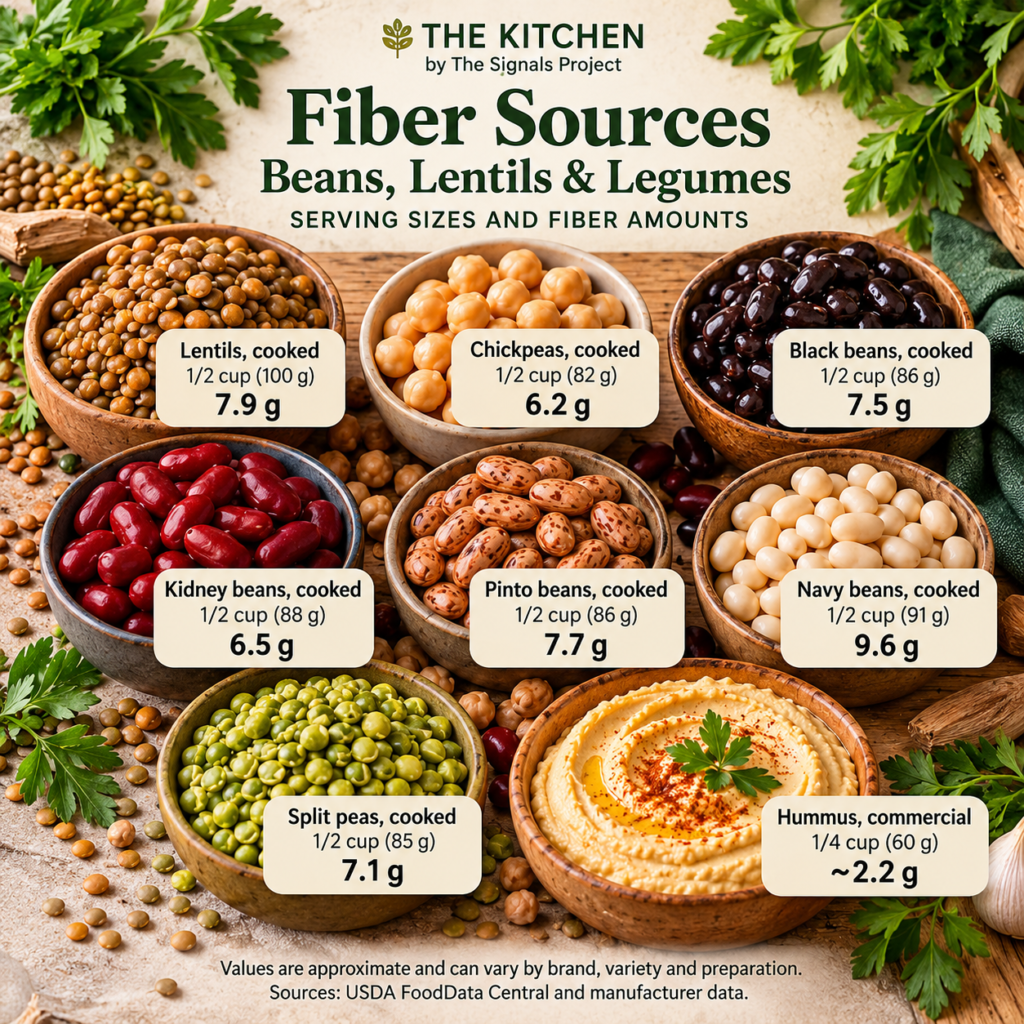
But the amounts aren’t identical. Different beans and legumes provide different quantities of fiber, and the serving size makes a difference. A half-cup of cooked lentils, for example, contributes substantially more fiber than a small spoonful of hummus.
The chart below compares several familiar choices using approximately half-cup servings, unless otherwise noted. These are general reference values rather than exact measurements; varieties, brands, and preparation methods can affect the numbers.
What These Numbers Mean in Everyday Meals
The first thing worth noticing is how much fiber beans and lentils can contribute in relatively modest portions. A half-cup of many cooked legumes provides roughly six to eight grams of fiber, making them particularly useful when you’re trying to increase your intake without dramatically changing the way you eat.
That doesn’t mean you need to eat a bowl of beans at every meal. A scoop of black beans added to a taco bowl, lentils stirred into a familiar soup, or chickpeas tossed into a grain salad can make a meaningful difference. These foods also provide plant protein, which makes them useful for building satisfying meals rather than simply adding fiber for the sake of reaching a number.
Hummus illustrates why serving sizes matter. Although it’s made primarily from chickpeas, a typical small serving provides considerably less fiber than a half-cup of whole cooked chickpeas. It’s still a useful addition to a snack or meal, but a few tablespoons of hummus won’t contribute the same amount as a generous serving of beans.
If you aren’t accustomed to eating legumes regularly, start with amounts that feel comfortable. Even a few spoonfuls added to a meal can be a reasonable beginning. Canned beans are convenient, and rinsing them can help reduce sodium. Lentils often cook relatively quickly without soaking, while frozen or canned options can make other legumes easier to incorporate into busy days.
There’s no need to choose the single highest-fiber bean or treat these foods as interchangeable. Taste, texture, digestion, cost, and the meals your family already enjoys are all reasonable considerations. A food you enjoy and eat regularly is often more useful than one you buy because it looks impressive on a nutrition chart but never actually use.
Whole Grains: The Type and Portion Both Matter
Whole grains are another important source of dietary fiber, but this is where labels and assumptions can become especially confusing. Foods described as multigrain, wheat, or made with whole grains don’t necessarily contain the same amount of fiber, and two products that look nearly identical can have very different nutrition profiles.
The amount of fiber also varies considerably between grains themselves. Cooked barley, bulgur, oats, brown rice, and quinoa all contribute fiber, but not in equal amounts. Whole-grain breads and cereals can be useful choices, although the amounts depend heavily on the recipe and brand.
This is one reason the Nutrition Facts label can be more informative than the front of a package. Look at the fiber grams per serving and consider how much of that food you would ordinarily eat. A cereal advertised as wholesome may contain relatively little fiber, while a less heavily marketed option may provide considerably more.
It’s also worth remembering that grains contribute more than fiber. They can provide carbohydrates for energy, B vitamins, minerals, and other nutrients. You don’t need to avoid white rice, regular pasta, or sourdough bread simply because another option contains more fiber. Instead, think about where higher-fiber choices fit naturally into the meals you already enjoy.
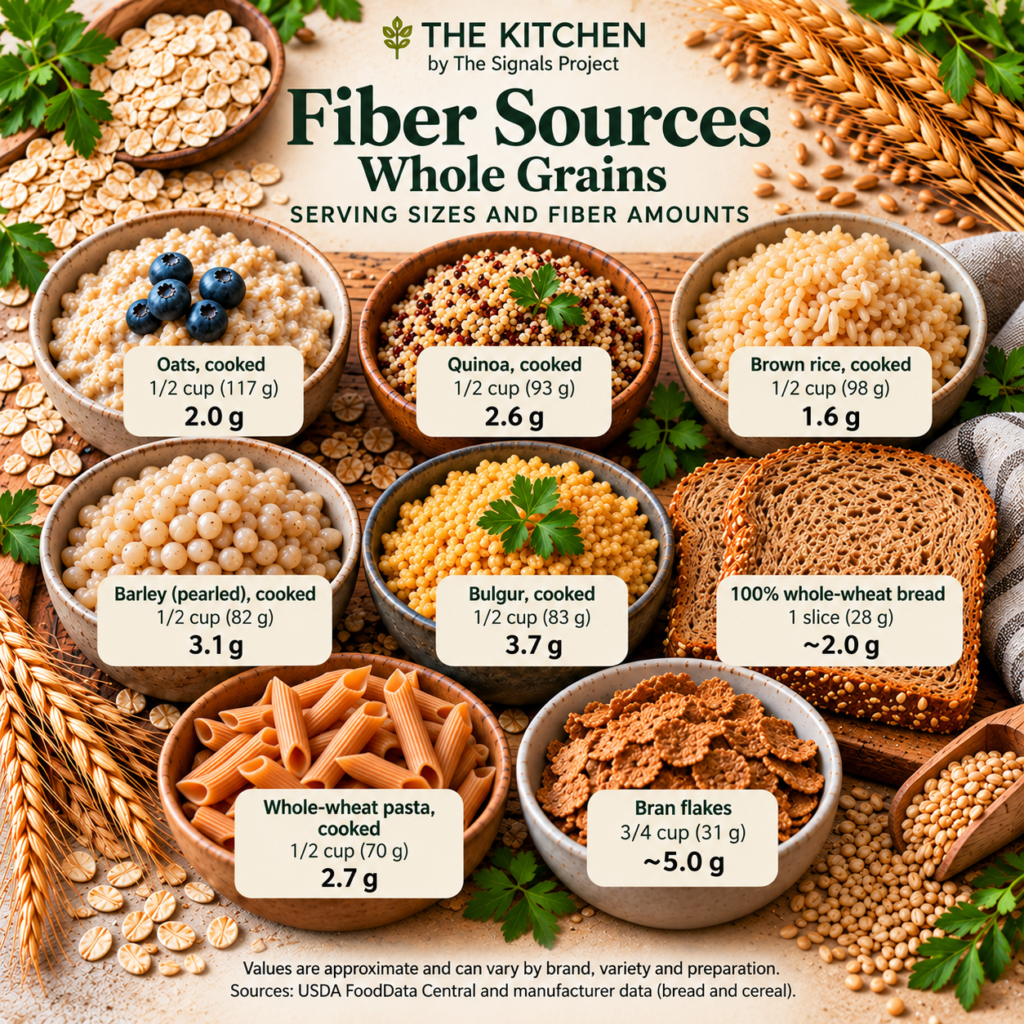
The next chart compares several familiar grains and grain-based foods using practical serving sizes. For packaged products, the values are approximate examples rather than guarantees; checking the label on the version you buy will give you the most accurate information.
What These Numbers Mean in Everyday Meals
One of the most useful things to notice about whole grains is that the fiber amounts can vary considerably, even among foods we tend to group together. Brown rice, quinoa, oats, barley, and bulgur can all be part of a nourishing eating pattern, but they don’t contribute identical amounts of fiber.
That distinction matters when you’re trying to make practical changes. If you enjoy brown rice with dinner, there’s no reason to stop eating it simply because another grain contains more fiber. You might choose to add beans or vegetables to the meal instead. Or, if you enjoy experimenting with different grains, you might occasionally swap in barley or bulgur for a different texture and a little more fiber.
Breakfast is another easy place to notice these differences. Oatmeal can contribute fiber, particularly when paired with berries, nuts, or seeds. Some bran-based cereals provide considerably more fiber per serving, although the amount varies by product. A slice of whole-grain toast can contribute as well, especially when it’s part of a meal that includes other fiber-containing foods.
Packaged foods deserve a closer look because their names aren’t always reliable indicators of fiber content. A bread labeled multigrain may contain several different grains without providing much fiber. A cereal marketed as natural or wholesome may be relatively low in fiber. Checking the Nutrition Facts panel gives you a clearer picture than relying on the front of the package.
The practical takeaway isn’t that you need to replace every grain you eat with the highest-fiber option. It’s that whole grains can contribute to your overall intake, and some choices offer more fiber than others. Understanding those differences gives you more flexibility when putting meals together.
Vegetables: Valuable for More Than Their Fiber
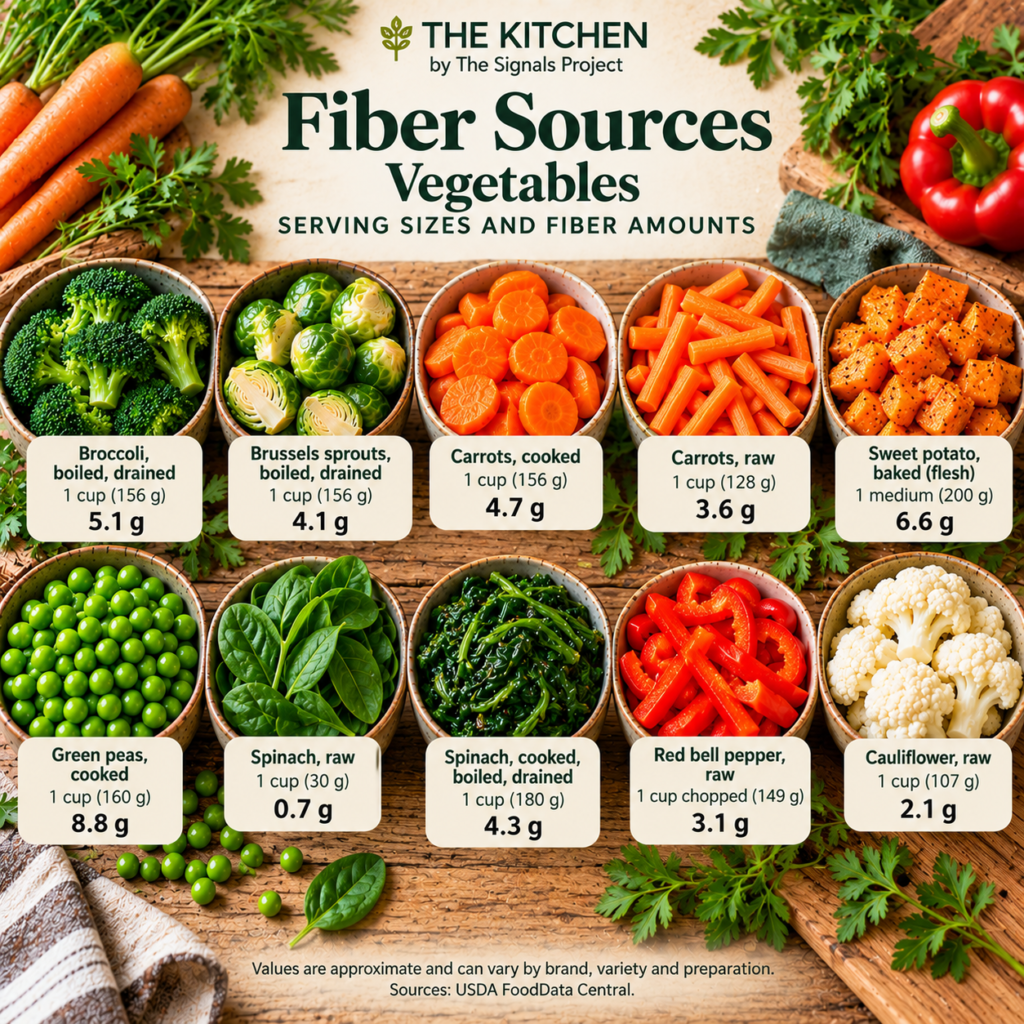
Vegetables are often the first foods people think of when they hear advice to eat more fiber. And while vegetables certainly contribute, the amounts can be surprisingly different depending on what you’re eating and how much of it is on your plate.
A cup of leafy lettuce, for example, generally provides much less fiber than a serving of cooked green peas. Broccoli, Brussels sprouts, carrots, sweet potatoes, and other vegetables fall somewhere along that spectrum, with preparation and portion size affecting the final amount.
This doesn’t make lettuce or cucumber less worthwhile. Vegetables provide a wide range of vitamins, minerals, water, and other beneficial plant compounds. A colorful salad can be a useful part of a meal even if its fiber contribution is relatively modest. The point is to understand what different foods bring to the table rather than expecting every vegetable to serve the same nutritional purpose.
Cooking also changes the way we measure portions. A cup of raw spinach takes up considerably more space than the same amount after cooking, when the leaves have wilted and become compact. Comparing foods by volume alone can therefore be misleading. That’s why it’s important to pay attention to whether a reference value describes a vegetable as raw or cooked.
You also don’t have to eat vegetables raw to benefit from them. Roasting, steaming, sautéing, and adding vegetables to soups or stews are all useful ways to include them. Frozen vegetables can be just as practical as fresh ones, and canned vegetables can be convenient when time or cost matters.
The following chart compares several familiar vegetables using common serving sizes. Some are stronger fiber contributors than others, but all can have a place in an eating pattern built around variety, enjoyment, and everyday practicality.
What These Numbers Mean in Everyday Meals
The vegetable comparisons illustrate an important point: eating more vegetables and eating more fiber are related goals, but they aren’t quite the same thing. Some vegetables contribute substantial amounts of fiber, while others offer smaller amounts alongside valuable vitamins, minerals, and other nutrients.
Green peas, broccoli, Brussels sprouts, and sweet potatoes can be particularly useful when you’re looking for vegetables that contribute meaningfully to your fiber intake. Lettuce, cucumber, and raw spinach generally provide less fiber in typical portions, but that doesn’t make them less deserving of a place on your plate.
The difference between raw and cooked spinach is especially interesting. A cup of raw spinach is mostly a generous handful of leaves. Once cooked, those leaves shrink dramatically, allowing much more spinach to fit into the same measuring cup. The higher fiber amount in a cup of cooked spinach reflects the greater quantity of spinach you’re eating, not the cooking process somehow creating additional fiber.
This is why it helps to think about portions as well as food choices. A few slices of bell pepper in a sandwich contribute something, but they won’t provide the same amount of fiber as a generous serving of cooked vegetables. Neither choice is wrong; they simply serve different purposes.
Vegetables can also be easier to include when they’re incorporated into meals rather than treated as a separate obligation. Frozen peas stirred into rice, roasted broccoli alongside dinner, carrots added to soup, or leftover vegetables folded into an omelet can all contribute without requiring an entirely new meal plan.
And if raw vegetables cause digestive discomfort, there’s no requirement to force yourself to eat large salads. Cooked vegetables may be easier for some people to tolerate, and choosing preparations you enjoy is a perfectly reasonable part of building sustainable habits.
The goal isn’t to identify the one vegetable that wins the fiber competition. It’s to recognize which vegetables contribute more, appreciate the benefits of the others, and find ways to include a variety of them regularly.
Fruits: Whole Fruit Makes a Difference
Fruit is another useful source of dietary fiber, and it offers something that can be especially helpful in everyday eating: convenience. Many fruits require little or no preparation, making them easy additions to breakfast, snacks, lunches, and desserts.
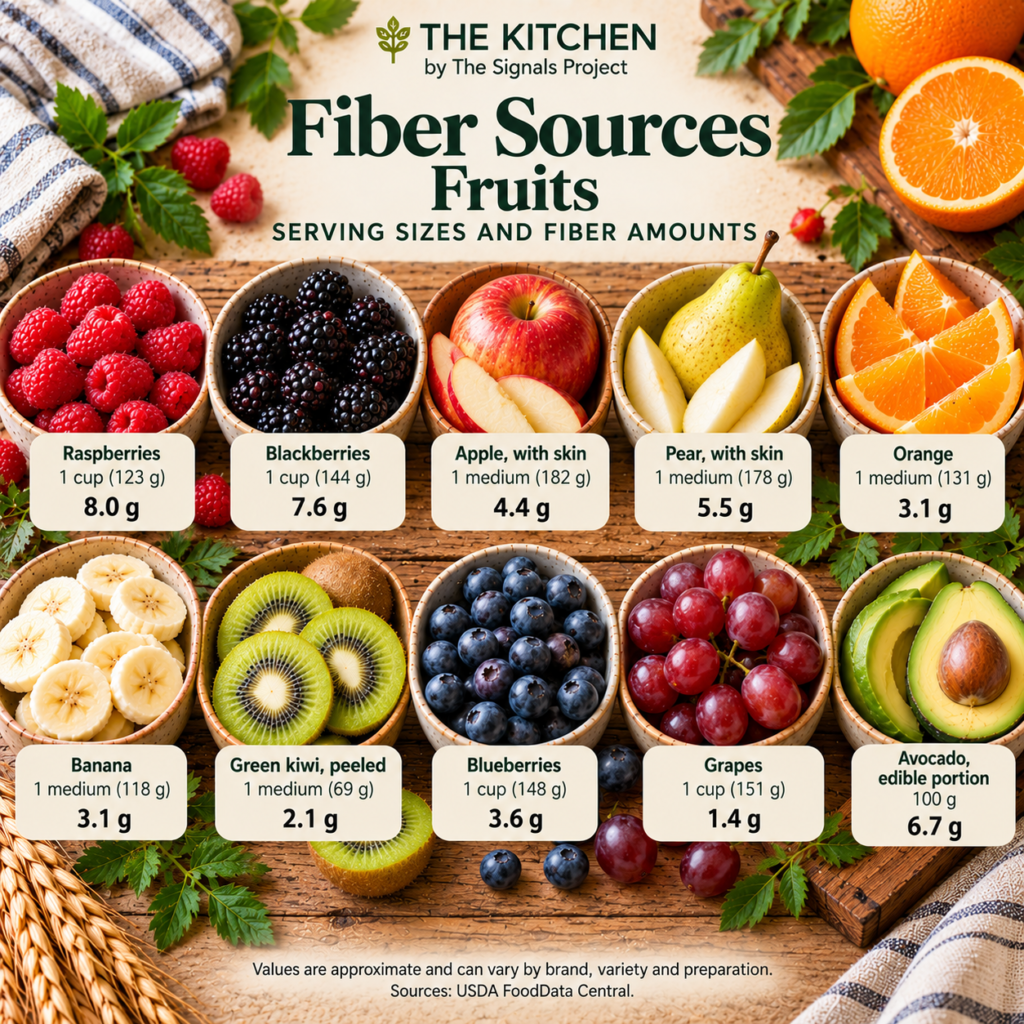
But just as with vegetables, the fiber amounts vary considerably. Raspberries and blackberries provide relatively generous amounts for their serving sizes, while grapes and watermelon contribute much less. Apples, pears, oranges, bananas, and other familiar fruits fall at different points along that range.
Whether you eat the skin can matter, too. The skin of an apple or pear contributes fiber, although the flesh contains some as well. Peeling fruit doesn’t eliminate all its fiber, but it can reduce the amount.
Another important distinction is the difference between whole fruit and juice. When fruit is juiced and the pulp is removed, much of its fiber is left behind. A whole orange, for example, provides fiber that a typical glass of pulp-free orange juice does not. Both can contribute nutrients, but they aren’t nutritionally identical.
Smoothies are a little different. Blending whole fruit generally retains its fiber, provided the pulp and other solid portions remain in the drink. Straining the mixture or using juice as the main ingredient can change that. The ingredients and quantities matter more than whether the fruit is eaten with a spoon or consumed through a straw.
Fresh, frozen, and canned fruits can all be useful choices. Frozen berries are convenient for oatmeal and yogurt, while canned fruit can be practical when fresh options are expensive or unavailable. Choosing fruit packed in water or juice rather than heavy syrup may help limit added sugars, but the fiber contribution depends primarily on the fruit and portion.
The chart below compares familiar fruits using common serving sizes, with skins included where specified. As always, the numbers are approximate, and natural variation in fruit size and variety can affect the final amount.
What These Numbers Mean in Everyday Meals
The fruit comparisons show just how much fiber can vary between foods that otherwise share many nutritional benefits. Raspberries and blackberries are particularly generous sources, providing several grams of fiber in a single cup. Apples, pears, oranges, and bananas also make useful contributions, especially because they’re convenient, familiar, and easy to incorporate into everyday meals.
Avocado deserves a place in this conversation, too. Although we usually think of it as a savory food, it’s botanically a fruit and provides a substantial amount of fiber along with predominantly unsaturated fats. Adding avocado to toast, a sandwich, a grain bowl, or a salad can contribute more fiber than many people realize.
One important consideration is how much fruit you’re actually eating. A handful of berries on yogurt contributes less fiber than a full cup, just as a few slices of apple provide less than the whole fruit. There’s nothing wrong with smaller portions, but understanding the difference helps put the numbers into perspective.
Fruit also offers flexibility. Frozen berries can be stirred into oatmeal, sliced pears can accompany a snack, and bananas can be added to breakfast without requiring much preparation. Keeping a few varieties you enjoy available may be more helpful than buying unfamiliar fruits solely because they rank highly on a nutrition chart.
And remember that fruit doesn’t have to be fresh to count. Frozen fruit generally retains its fiber, while dried fruit can provide a concentrated source in smaller volumes. Dried fruit portions are often smaller because much of the water has been removed, so comparing them directly with fresh fruit requires some attention to serving size.
The larger lesson is that whole fruits can contribute meaningfully to fiber intake without requiring special products, complicated recipes, or strict food rules. Choose varieties you enjoy, take advantage of what’s affordable and available, and let those contributions add up across the day.
Nuts and Seeds: Small Portions, Useful Contributions
Nuts and seeds are easy to overlook when thinking about fiber because we tend to associate them primarily with fats, protein, or convenient snacks. But several varieties provide meaningful amounts of fiber, particularly when they’re included regularly as part of meals.
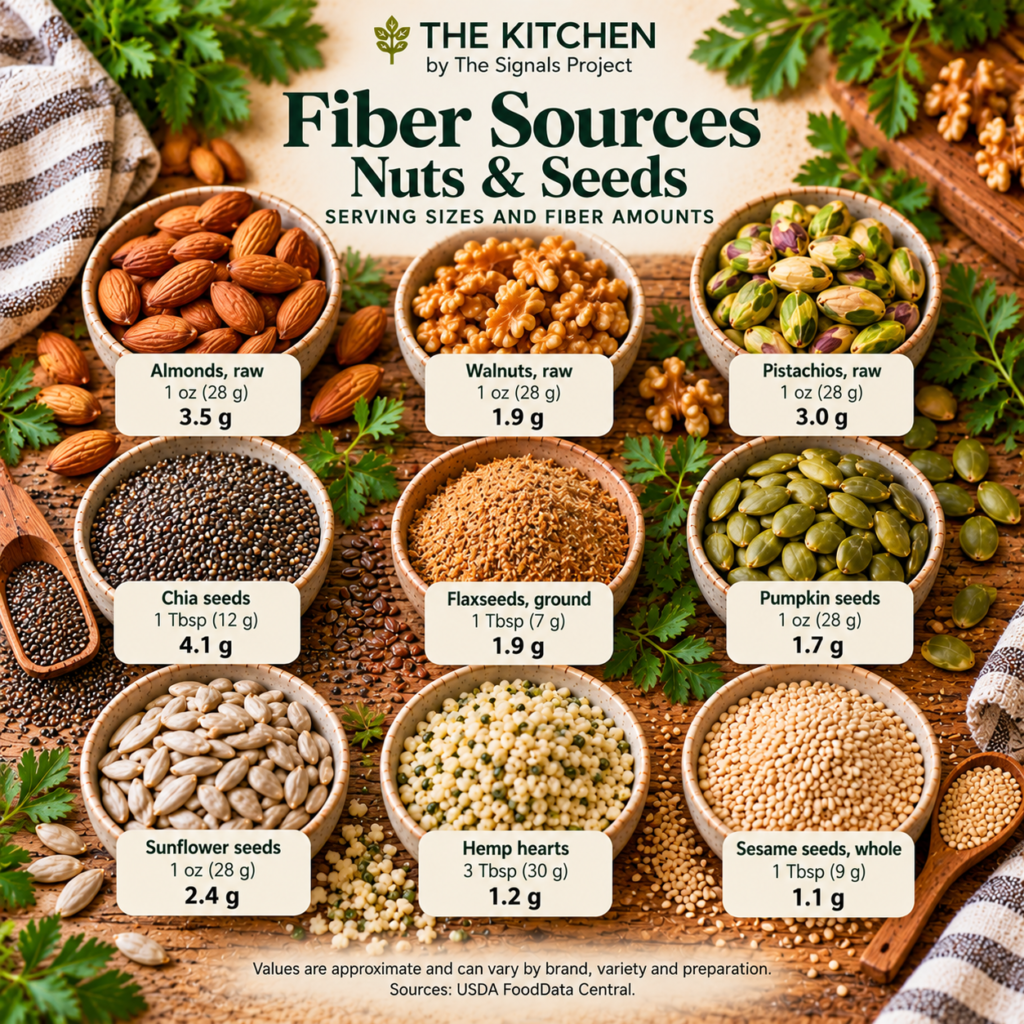
Chia seeds and ground flaxseed are especially useful examples. Both can be stirred into oatmeal, yogurt, or other foods, and their fiber contributions can be substantial relative to their small serving sizes. Chia seeds also absorb liquid and develop a gel-like texture, which some people enjoy in puddings or overnight oats.
Almonds, pistachios, walnuts, sunflower seeds, and pumpkin seeds contribute varying amounts of fiber alongside unsaturated fats and other nutrients. The differences are worth understanding, but they don’t mean you need to choose nuts and seeds based on fiber alone. Taste, texture, allergies, cost, and how you use them all matter.
Serving sizes are particularly important in this category. A tablespoon of seeds isn’t equivalent to a quarter-cup of nuts, and a sprinkle added to breakfast won’t necessarily provide the same fiber as a measured serving. Small amounts still contribute, but the chart helps show what those contributions actually look like.
There’s also no requirement to eat nuts and seeds by themselves. They can be added to foods you already enjoy: chopped walnuts over oatmeal, almonds alongside fruit, pumpkin seeds scattered over a salad, or ground flaxseed mixed into a breakfast bowl.
If you’re increasing your fiber intake, particularly with chia or flaxseed, introduce them gradually and pay attention to fluids and digestive comfort. More isn’t automatically better, and there’s no need to add several tablespoons of seeds to every meal.
The following chart compares familiar nuts and seeds using realistic portions. As with our other food groups, the numbers are approximate and may vary by product, variety, and preparation.
What These Numbers Mean in Everyday Meals
The most noticeable difference in this category is how much fiber certain seeds can provide in relatively small portions. Chia seeds and ground flaxseed are particularly useful examples, while many familiar nuts contribute more modest amounts. That doesn’t make one choice automatically better than another. It simply means that nuts and seeds offer different combinations of nutrients, and fiber is only one part of the picture.
Hemp hearts are a good illustration of that distinction. Although they’re seeds, removing the outer hull also removes much of their fiber. Hulled hemp seeds are better known for their plant protein, unsaturated fats, and mineral content than for being a particularly concentrated source of fiber. They’re still a useful addition to oatmeal, yogurt, salads, or grain bowls, even if fiber isn’t the primary reason you’re choosing them.
Portion sizes also deserve attention. A tablespoon of chia seeds, a sprinkle of sesame seeds, and a handful of almonds represent different quantities of food. Comparing them by fiber alone doesn’t account for how they’re typically eaten or what else they contribute. Nuts and seeds also provide varying amounts of fats, protein, vitamins, and minerals, making them useful for reasons beyond their fiber content.
For everyday meals, small additions can be surprisingly practical. Ground flaxseed can be stirred into oatmeal, chia seeds can be added to overnight oats, and chopped nuts can bring texture to fruit or yogurt. Pumpkin or sunflower seeds can be scattered over salads, soups, and roasted vegetables. These additions don’t need to be large or elaborate to contribute something useful.
It’s also worth considering how your body responds. Chia seeds absorb substantial amounts of liquid, and increasing fiber-rich seeds too quickly may cause bloating or discomfort. Using them in moist foods, allowing them to hydrate when appropriate, and increasing portions gradually can make them easier to incorporate. Ground flaxseed is often more practical than whole flaxseed when you want to make use of its nutrients, since whole seeds may pass through the digestive tract largely intact.
If you have a nut or seed allergy, there’s no nutritional requirement to include these foods. Fiber can come from legumes, grains, vegetables, and fruits instead. Likewise, if certain seeds don’t agree with your digestion, there’s no reason to force them into your routine simply because they’re popular in wellness circles.
The takeaway is that nuts and seeds can make useful contributions to your overall fiber intake, particularly when they’re paired with other fiber-containing foods. But their value extends beyond fiber, and choosing the varieties you enjoy and tolerate is more important than chasing the highest number on a chart.
Putting the Numbers to Work
Looking across these five food groups, one thing becomes clear: fiber isn’t distributed evenly among plant foods. Beans and lentils can provide substantial amounts in relatively modest portions. Certain whole grains, vegetables, fruits, nuts, and seeds can also make meaningful contributions, while other foods offer smaller amounts alongside their own nutritional benefits.
That’s useful information, but it doesn’t mean every meal needs to be built around the highest-fiber options.
A breakfast of oatmeal with berries and a spoonful of ground flaxseed brings together several sources. A lunch with whole-grain bread, vegetables, and a piece of fruit can contribute throughout the meal. A dinner that includes beans, a grain, or a generous serving of vegetables can add more. None of these meals needs to be perfect, and no single food has to carry the entire day’s fiber intake.
It’s also important to remember that the numbers in these charts are estimates. The variety of food, its preparation, the serving size, and the specific product you buy can all affect the amount of fiber you actually eat. Packaged foods may differ considerably between brands, and natural foods aren’t perfectly uniform either.
You don’t need to memorize the charts or calculate every gram. Instead, use them to recognize patterns. Notice which foods tend to contribute more fiber, which ones offer smaller amounts, and where a simple addition or substitution might fit comfortably into your routine.
If your current fiber intake is relatively low, increasing it gradually is generally more comfortable than making a dramatic change overnight. Give your digestive system time to adjust, drink adequate fluids, and pay attention to what feels manageable for you.
And if you discover that you don’t particularly enjoy lentils, chia seeds, or another food that appears near the top of a chart, that’s perfectly fine. There are many ways to get fiber. Your preferences, budget, digestive tolerance, and everyday circumstances all matter.
The Bigger Picture
Fiber is one part of a nourishing eating pattern, not a scorecard for how well you’re taking care of yourself. These comparisons are meant to make nutrition advice more useful, not create another set of rules to follow.
The most helpful choices are often the ones you can repeat. Keeping frozen berries available, adding beans to a familiar recipe, choosing a whole grain you genuinely enjoy, or including vegetables in meals you already make can all become ordinary habits over time.
You don’t have to choose the highest-fiber food at every opportunity. You simply need enough reliable options to make fiber a regular part of how you eat.
Understanding what counts gives you more choices. What you do with those choices should still fit your life.
Sources
The fiber amounts in this guide are intended as approximate reference values. Nutrient content varies with food variety, preparation, portion size, and product formulation. For packaged foods, the Nutrition Facts label is the most useful source for the specific product you’re eating.
USDA FoodData Central
The U.S. Department of Agriculture’s comprehensive database of food composition information, including dietary fiber values for individual foods.
https://fdc.nal.usda.gov/
U.S. Food and Drug Administration — Daily Value on the Nutrition and Supplement Facts Labels
Explains how Daily Values and percentages are used on food labels, including the 28-gram Daily Value for dietary fiber.
https://www.fda.gov/food/nutrition-facts-label/daily-value-nutrition-and-supplement-facts-labels
U.S. Food and Drug Administration — The Lows and Highs of Percent Daily Value
A practical explanation of how to interpret the percentage of Daily Value shown on packaged foods.
https://www.fda.gov/food/nutrition-facts-label/lows-and-highs-percent-daily-value-nutrition-facts-label
For a broader explanation of what fiber does in the body, how much you may need, and how to increase your intake comfortably, visit our main guide, Plants & Fiber: What Counts, Why It Matters, and How to Eat More of It.