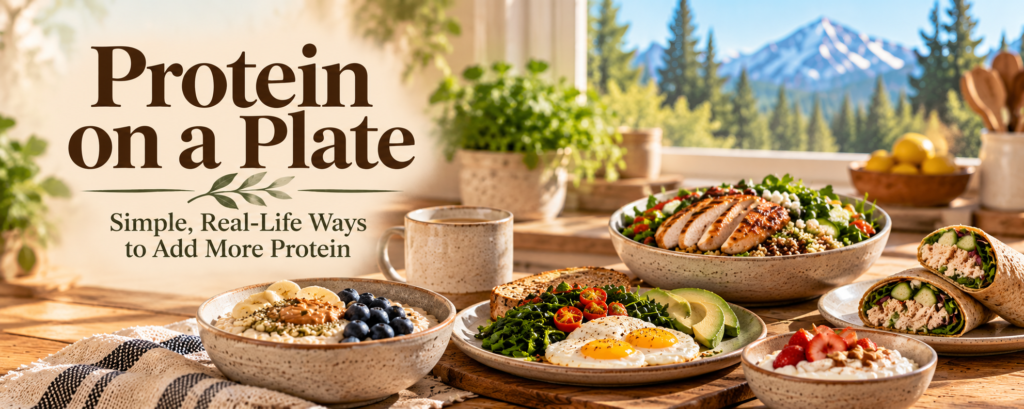
Knowing which foods contain protein is useful. But eventually, all that information has to become breakfast.
That’s where nutrition advice can get strangely complicated. You can know that chicken has protein, eggs have protein, beans have protein, and Greek yogurt has protein—and still look at an ordinary meal and wonder whether you’re actually getting very much.
The good news is that you don’t need to calculate every gram before you eat.
A more useful skill is learning to recognize what protein looks like on a plate: where the main source is, when several smaller sources are working together, and when a meal might benefit from a little more.
These aren’t meal plans or prescriptions. They’re simply examples of how protein can show up in real food and real meals.
Start With One Simple Question
When you look at a meal, ask:
Where’s my protein?
Not Is this meal perfect?
Not Did I hit the right macro ratio?
Not Should I be eating something completely different?
Just: Where’s my protein?
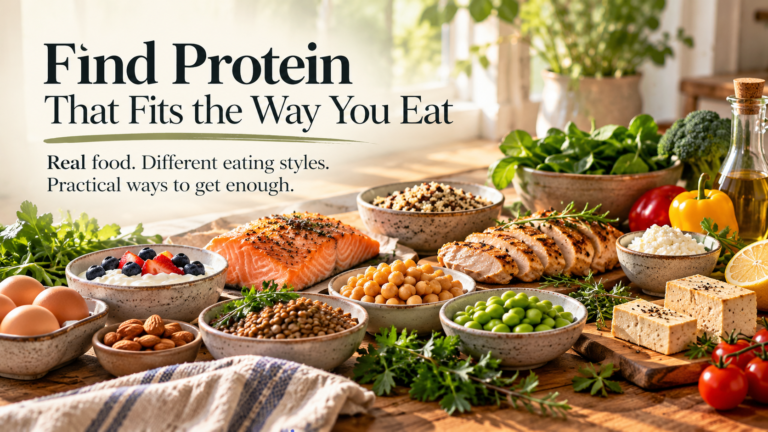
Sometimes the answer will be obvious. A piece of salmon, chicken, tofu, or a bowl of Greek yogurt can provide a substantial amount on its own.
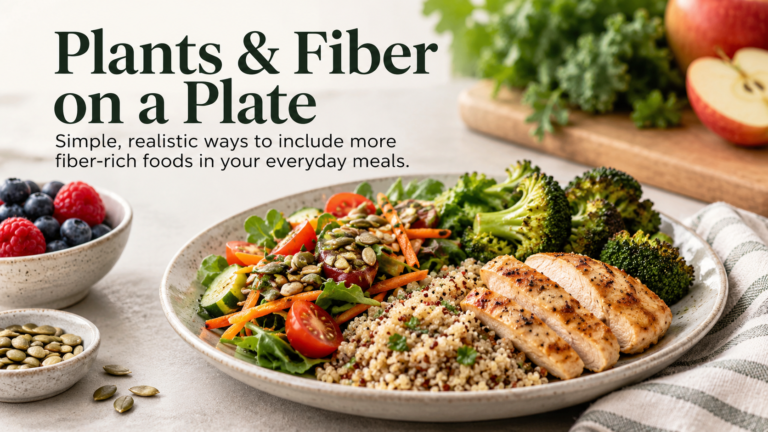
Other times, the protein is spread across several foods. Eggs, cheese, beans, grains, nuts, seeds, and other foods can contribute protein together.
And sometimes you’ll realize there really isn’t much protein there at all.
That isn’t a failed meal. It’s information.
What Protein Can Look Like at Breakfast
Breakfast is one of the easiest meals to accidentally build mostly around carbohydrates. Toast, oatmeal, cereal, fruit, muffins, and bagels can all be perfectly reasonable breakfast foods—but depending on what accompanies them, they may not provide much protein on their own.
You don’t have to get rid of them. You can simply build around them.
Oatmeal might become: oats cooked with milk or soy milk, topped with Greek yogurt, nuts, or seeds.
Toast might become: toast alongside eggs and cottage cheese, or topped with eggs and served with Greek yogurt and fruit.
Fruit might become: fruit with Greek yogurt or cottage cheese, plus nuts or seeds.
A grab-and-go breakfast might become: hard-boiled eggs, fruit, and yogurt rather than fruit alone.
Notice what we’re doing here: adding, not subtracting.
The oatmeal can stay. The toast can stay. The banana has committed no crimes. 😂
We’re simply giving protein a more noticeable place in the meal.
What Protein Can Look Like at Lunch
Lunch is often less about nutrition knowledge and more about whatever you can assemble between everything else you’re doing.
Fortunately, protein works pretty well with that.
A sandwich might include turkey, chicken, tuna, egg, cheese, hummus, or another substantial filling.
A salad can become a much more complete meal with chicken, salmon, tuna, eggs, cottage cheese, tofu, tempeh, lentils, beans, or edamame.
Leftover dinner can become lunch without undergoing some mysterious transformation into “lunch food.”
And a snack-style lunch can work too: cottage cheese or Greek yogurt, hard-boiled eggs, cheese, nuts, fruit, vegetables, whole-grain crackers, hummus, or leftovers can all be combined into something perfectly respectable.
Lunch does not have to look impressive.
It just has to feed you.
What Protein Can Look Like at Dinner
Dinner may be the meal where protein is easiest to recognize because many familiar meals already have an obvious centerpiece.
Chicken with roasted potatoes and vegetables.
Salmon with rice and broccoli.
Beef or turkey tacos with beans, vegetables, salsa, and tortillas.
A stir-fry with tofu or chicken, vegetables, and rice.
Lentil curry with rice and vegetables.
Pasta with meat sauce, chicken, shrimp, lentils, or beans.
Again, there isn’t one correct arrangement.
Sometimes one food provides most of the protein. Sometimes several foods contribute. A bean-and-grain bowl, for example, may get its protein from beans, grains, vegetables, seeds, and perhaps another topping all working together.
The useful question remains the same:
Where’s my protein?
If you can answer that fairly easily, you probably don’t need to interrogate your dinner any further.
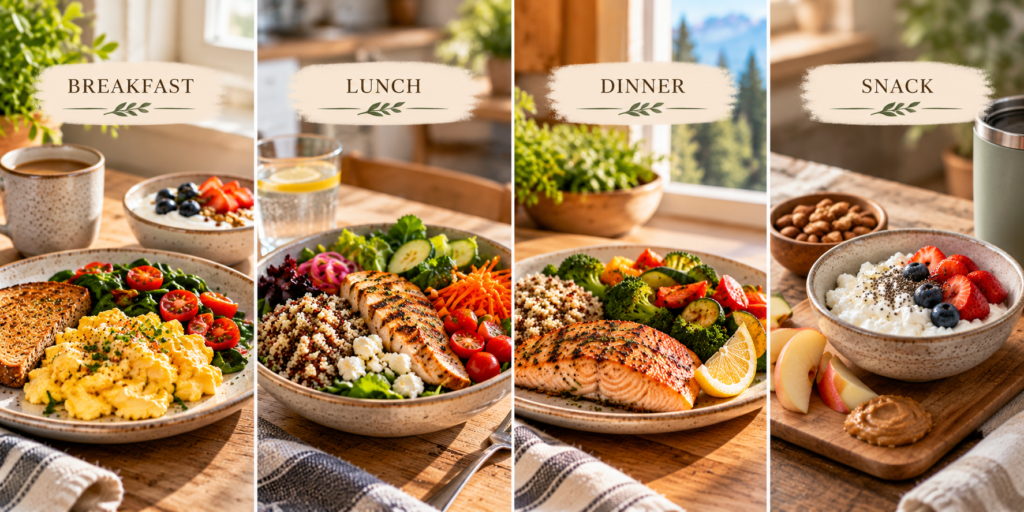
What About Snacks?
A snack doesn’t necessarily need to function like a miniature balanced meal. Sometimes you’re hungry for an apple, so you eat an apple. That is allowed. 😂
But when you want a snack to keep you satisfied longer—or when snacks are helping you get enough protein across the day—pairing foods can be useful.
Think:
Greek yogurt and berries.
Cottage cheese and fruit.
Apple and peanut butter.
Eggs and whole-grain crackers.
Edamame.
Cheese with fruit or crackers.
Hummus with vegetables and pita.
Nuts and fruit.
The point isn’t that every snack needs protein. It’s simply another opportunity when it makes sense for you.
Portions Don’t Have to Look the Same
This matters.
A 5’2″ woman who has been sitting at a desk all day and a 6’0″ woman who just finished a hard strength workout may not want—or need—the same amount of food at dinner.
Your appetite can also change from day to day. Activity changes. Meals earlier in the day change. Hunger changes. Life changes.
So rather than trying to create one universally correct “protein plate,” it makes more sense to understand the principle and adjust the amount to the person eating it.
For some people and some meals, a modest serving of a protein-rich food may be plenty. At other times, a larger serving or several protein sources may make sense.
The plate is a tool, not a rule.
You Can Also Build Protein Instead of Finding One Perfect Source
One of the most useful things to understand about protein is that the whole meal counts.
Two eggs provide protein. So does the cheese in your omelet. So does the milk in your coffee. So does the whole-grain toast beside it.
Lentils provide protein. So does quinoa. So does edamame. So do the seeds sprinkled over the bowl.
You don’t always need one enormous protein source sitting in the center of the plate.
Sometimes protein stacks.
That can be especially useful for people who eat little or no meat, people with smaller appetites, or anyone who simply likes meals made from several different foods.
And Sometimes the Answer Really Is “This Could Use More Protein”
That’s useful information too.
Maybe breakfast was toast and coffee.
Maybe lunch was a bowl of vegetable soup.
Maybe dinner is pasta with tomato sauce.
There is nothing inherently wrong with any of those meals.
But if you’re trying to support muscle, recovery, strength, or simply get enough protein overall, you might decide to add something.
Eggs beside the toast.
Beans, lentils, chicken, or Greek yogurt alongside the soup.
Meat, lentils, beans, seafood, or cheese with the pasta.
You don’t have to rebuild the meal.
Sometimes you just add the missing piece.
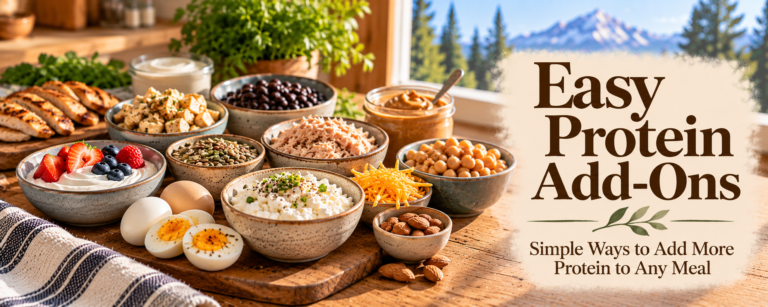
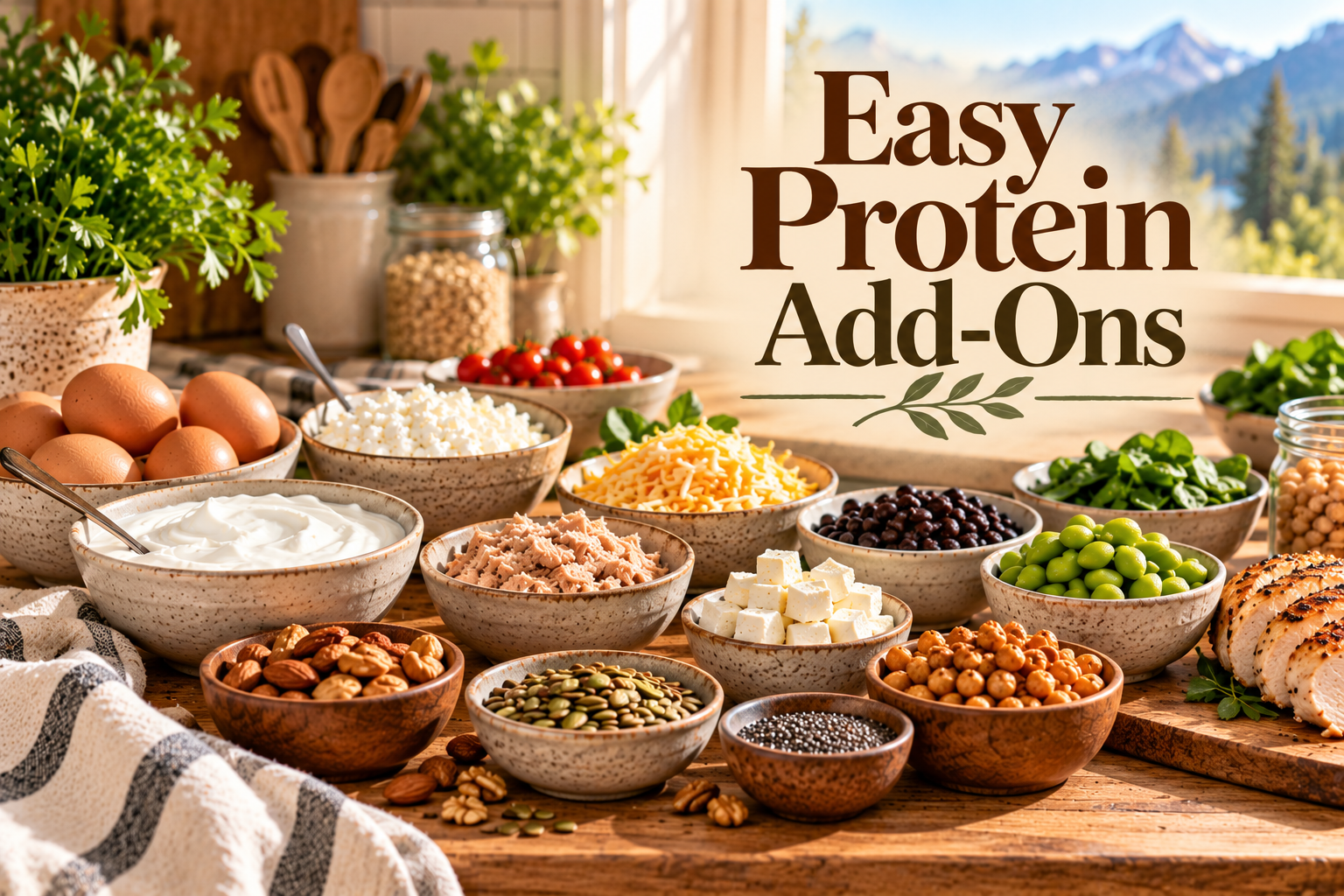
And that is exactly what our next Kitchen resource will tackle: Easy Protein Add-Ons.
The Part Worth Remembering
You don’t need every plate to contain the same amount of protein.
You don’t need to photograph your meals, weigh your chicken, or open a tracking app every time you sit down to eat.
You just need enough familiarity with your food to start noticing.
Where’s my protein?
Sometimes it will be one obvious food. Sometimes several foods will contribute. Sometimes you’ll notice there isn’t much there and decide to add some.
That’s body listening too.
You’re looking at the signal you’re about to send, understanding a little more about what your body can do with it, and making a choice based on what you need.
No perfect plate required.
Sources
Hudson JL, Baum JI, Diaz EC, et al. Protein Distribution and Muscle-Related Outcomes: Does the Evidence Support the Concept? Nutrients. 2020;12(5):1441. https://pubmed.ncbi.nlm.nih.gov/32429355/
Jespersen SE, Agergaard J. Evenness of dietary protein distribution is associated with higher muscle mass but not muscle strength or protein turnover in healthy adults: a systematic review. European Journal of Nutrition. 2021;60(6):3185–3202. https://pubmed.ncbi.nlm.nih.gov/33550490/
Olaniyan ET, O’Halloran F, McCarthy AL. Dietary protein considerations for muscle protein synthesis and muscle mass preservation in older adults. Nutrition Research Reviews. 2021;34(1):147–157. https://pubmed.ncbi.nlm.nih.gov/32883378/