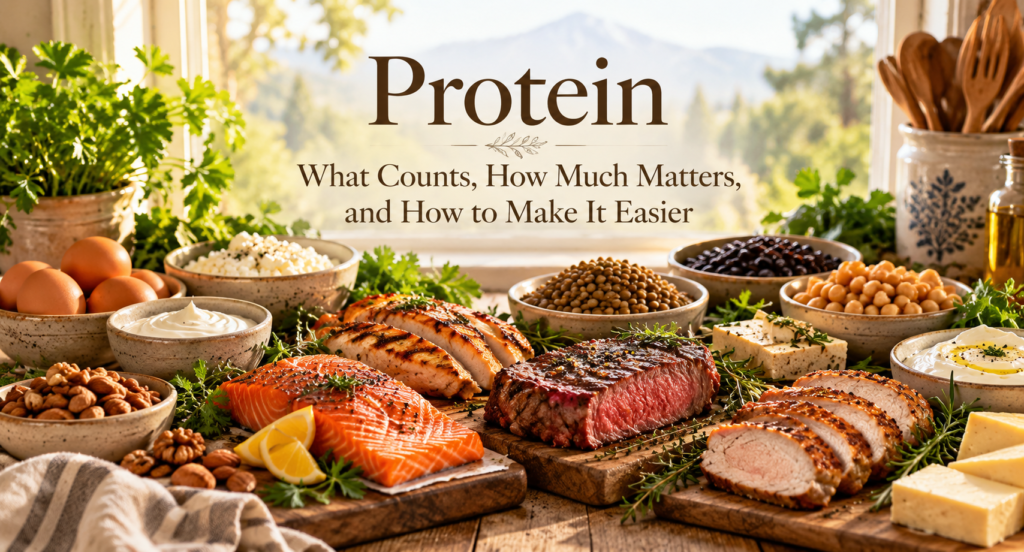
Protein Got Complicated Somewhere Along the Way
“Eat more protein” might be one of the most common pieces of nutrition advice women hear right now. It sounds simple enough until you actually try to use it. How much is more? What counts as a protein food? Does a handful of almonds count? What about beans? Do you need protein powder? Is the amount you ate at dinner enough to make up for a breakfast that barely contained any? And are you really supposed to spend the rest of your life weighing chicken and tracking grams?
Protein matters, particularly as women move through midlife. Muscle is constantly being broken down and rebuilt, and protein supplies the amino acids your body needs for that repair and rebuilding. As estrogen fluctuates and eventually declines through the menopause transition, maintaining muscle becomes more challenging, while aging itself can make muscle less responsive to the same amount of protein. That makes both resistance training and adequate protein increasingly valuable—not because your body has suddenly failed, but because the signals and support it responds to have changed. Researcher Dr. Stacy Sims has spent decades studying female physiology and emphasizes this distinction in her work with active women, particularly through perimenopause and menopause. Dr. Stacy Sims
But knowing that protein matters does not mean you need another complicated set of food rules. You need enough information to recognize a useful protein source, understand roughly how much your body may need, and make getting it considerably easier in the meals you already eat.
That is what this guide is for.
What Protein Actually Does in Your Body
Protein is often talked about as though its primary job is helping you build muscle. That is certainly one of its important roles, but protein is involved in far more than what happens during a strength workout.
Your body uses protein to build, maintain, and repair tissues throughout the body. Muscle, skin, hair, connective tissue, organs, enzymes, antibodies, and many hormones depend on amino acids—the smaller building blocks that make up protein. Your body is continually breaking proteins down and rebuilding them, which means protein is not something you need only on the days you exercise. It is part of the everyday maintenance work your body is doing all the time.
There are 20 amino acids your body uses to build proteins. Some can be made by the body itself. Nine are considered essential amino acids because your body cannot make enough of them on its own, so they must come from food. That is one reason both the amount and quality of the protein you eat matter.
Muscle deserves particular attention as we get older. Beginning in adulthood, maintaining muscle becomes increasingly important, and the hormonal changes surrounding perimenopause and menopause can add another challenge. Muscle is not simply about appearance or athletic performance. It contributes to strength, mobility, balance, bone health, metabolic health, and your ability to keep doing ordinary things independently as you age.
This is also why protein and strength training work so well together. Resistance training sends your body a signal that says, in effect, this tissue is needed—keep it, repair it, make it stronger. Protein supplies the amino acids your body can use to carry out that work.
Neither one replaces the other. Eating more protein without giving your muscles a reason to adapt is not the same as building strength, and strength training without providing adequate nutrition makes the rebuilding job harder than it needs to be.
Protein, then, is not a diet trick or simply another number to hit. It is raw material your body uses every day—and making enough of that material available becomes especially useful when preserving strength and muscle is part of the goal.
What Actually Counts as a Protein Source?
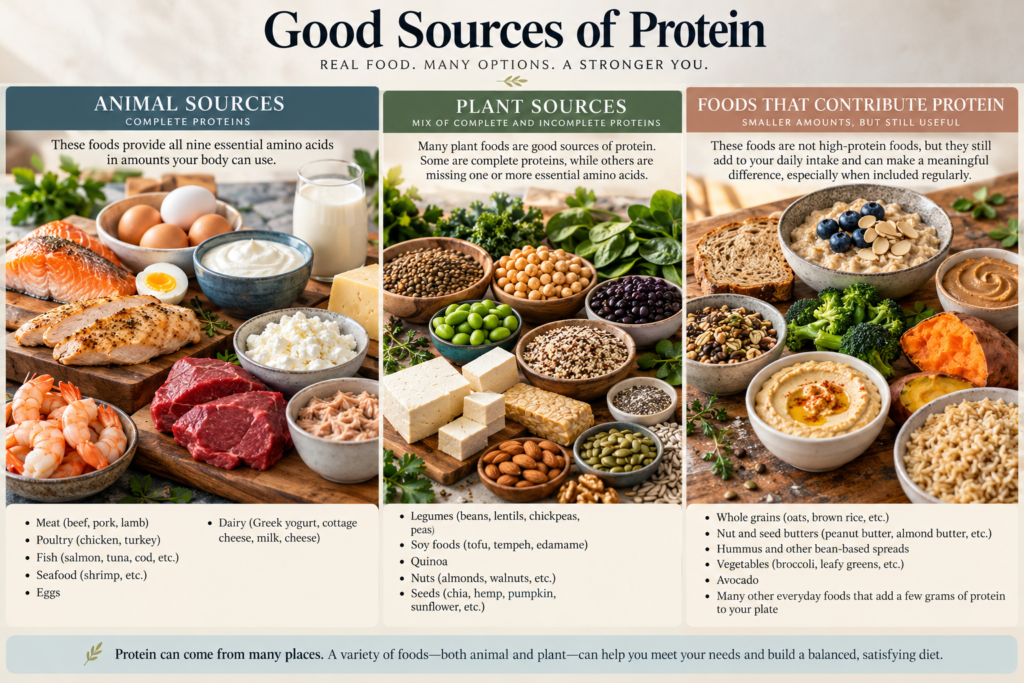
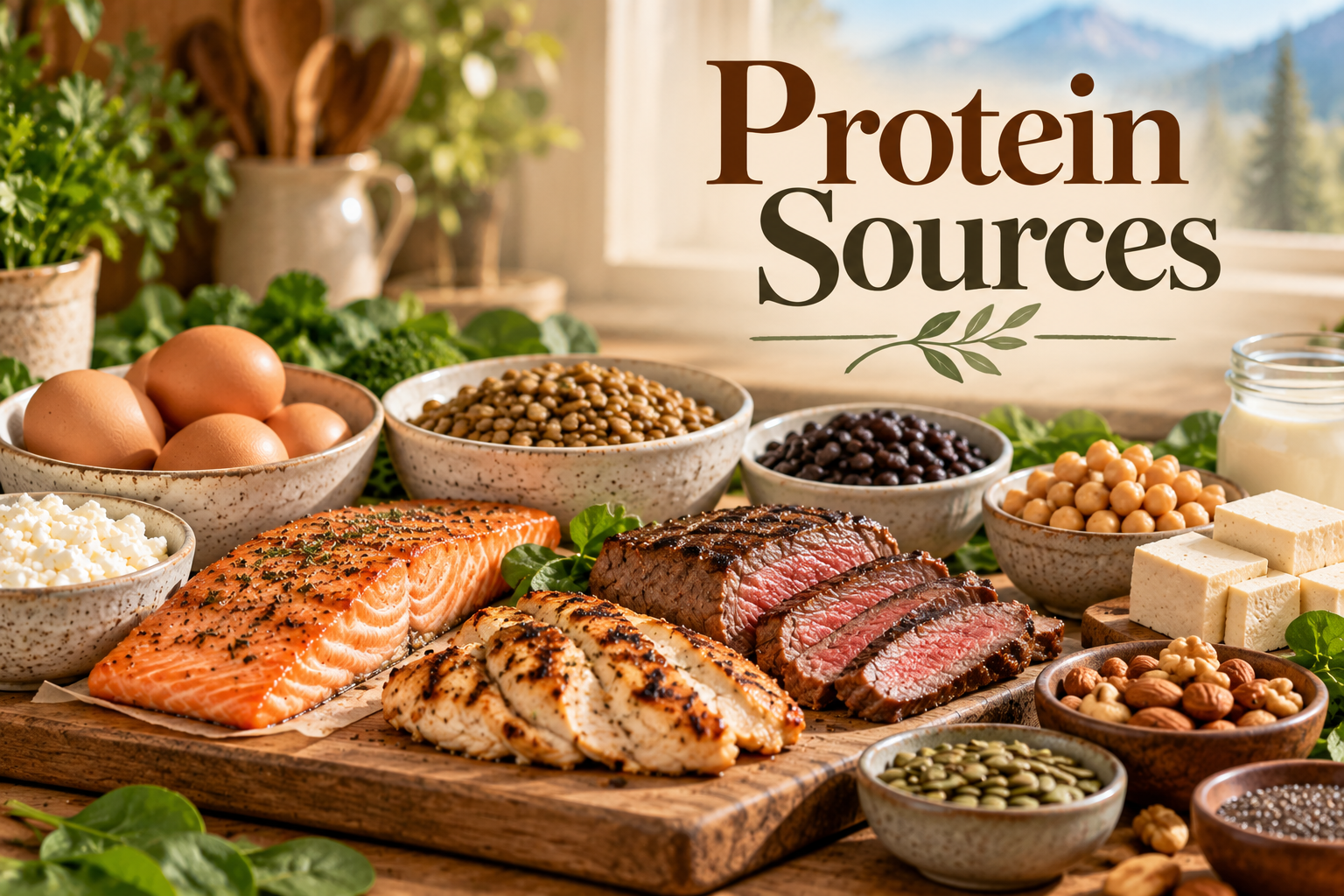
Protein shows up in more foods than you might realize. Meat, fish, eggs, dairy, beans, lentils, soy foods, nuts, seeds, grains, and even vegetables can all contribute some protein to your day. But there is an important distinction between a food that contains protein and a food that can realistically serve as the main protein source of a meal.
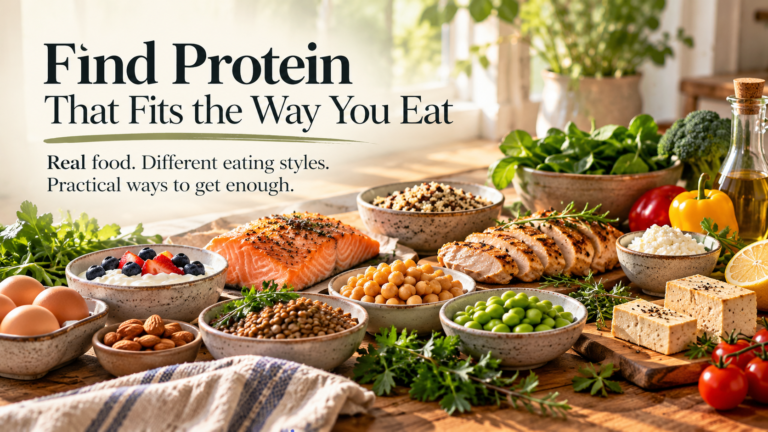
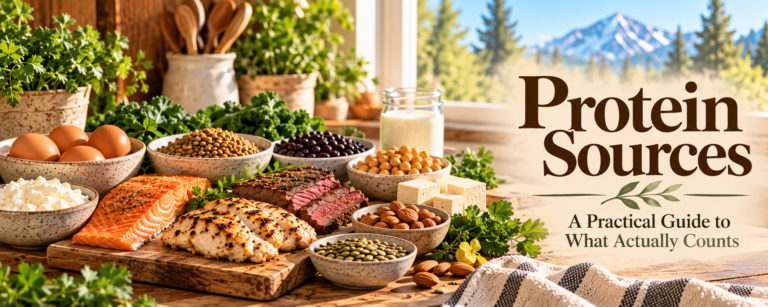
Chicken, turkey, beef, pork, fish, shellfish, eggs, Greek yogurt, cottage cheese, milk, tofu, tempeh, edamame, lentils, beans, peas, and seitan can all make meaningful contributions to a meal’s protein. The amount and amino acid profile vary from food to food, but these are the kinds of foods that can help answer the question, “Where is my protein?”
Other foods contribute protein without necessarily carrying the meal by themselves. Nuts, seeds, nut butters, oats, quinoa, whole grains, and many vegetables contain protein too. Those contributions count—they are not somehow invisible just because the food isn’t labeled a “protein food.” But the amount in a typical serving may be relatively small. Two tablespoons of peanut butter, for example, provide some protein, but they are not nutritionally equivalent to a substantial serving of fish, chicken, tofu, Greek yogurt, or lentils.
That distinction can make building meals much easier. You do not have to classify every food into a perfect nutritional category. Instead, look at the meal as a whole. If several foods contribute a little protein, those amounts add up. If there is already a substantial protein source, great. If there isn’t, that gives you useful information about what you might add.
There is also no single correct way to get your protein. An omnivore, pescatarian, vegetarian, and vegan can all build protein-rich meals; they will simply use different foods to do it. Variety is useful within any of those eating patterns because different protein foods bring different nutrients along with them.
Later, we’ll build a more comprehensive protein-source guide organized by eating style so you can quickly find options that work for the way you eat. For now, the important idea is much simpler: when you look at a meal, identify the foods contributing protein and ask whether together they provide a meaningful source—not merely whether protein appears somewhere on the ingredient list.
Complete Protein, Incomplete Protein—and Why This Doesn’t Need to Become Another Food Rule
You may have heard proteins described as either “complete” or “incomplete.” Those terms refer to their essential amino acid profiles. A complete protein provides all nine essential amino acids in sufficient proportions, while some protein foods provide relatively less of one or more essential amino acids.
Most animal proteins—including meat, poultry, fish, eggs, and dairy—are complete proteins. Soy foods such as tofu, tempeh, and edamame are complete plant proteins, and a few other plant foods also provide all nine essential amino acids in useful amounts. Beans, lentils, grains, nuts, seeds, and other plant foods contribute valuable protein too, although individual foods may be relatively lower in particular essential amino acids.
This is where nutrition advice used to get unnecessarily complicated. People eating plant-based diets were often told they needed to carefully combine complementary proteins at every meal—beans with rice being the classic example—so that every essential amino acid appeared in the right place at the right time.
Your body is considerably less fussy than that.
Different plant foods have different amino acid profiles, and eating a varied diet across the day can provide the essential amino acids your body needs without requiring you to engineer perfect combinations at every meal. Beans and grains happen to complement each other beautifully, but they do not have to arrive on the same fork for their protein to “count.”
Protein quality can still matter, particularly when most or all of your protein comes from plants. Some plant proteins are less digestible or provide lower amounts of certain essential amino acids, which can mean that someone eating an entirely plant-based diet benefits from being a little more intentional about variety, total protein intake, and including protein-rich foods regularly.
But intentional does not have to mean obsessive.
Eat a variety of protein sources. If you eat animal foods, vary those too. If you eat mostly or entirely plants, regularly include foods such as beans, lentils, tofu, tempeh, edamame, peas, whole grains, nuts, and seeds rather than expecting one favorite food to do all the work.
You do not need to memorize amino acid charts.
And you definitely do not need to play amino-acid Tetris every time you make lunch.
How Much Protein Do You Actually Need?
This is where protein advice can get confusing quickly, because there is no single number that is perfect for every person.
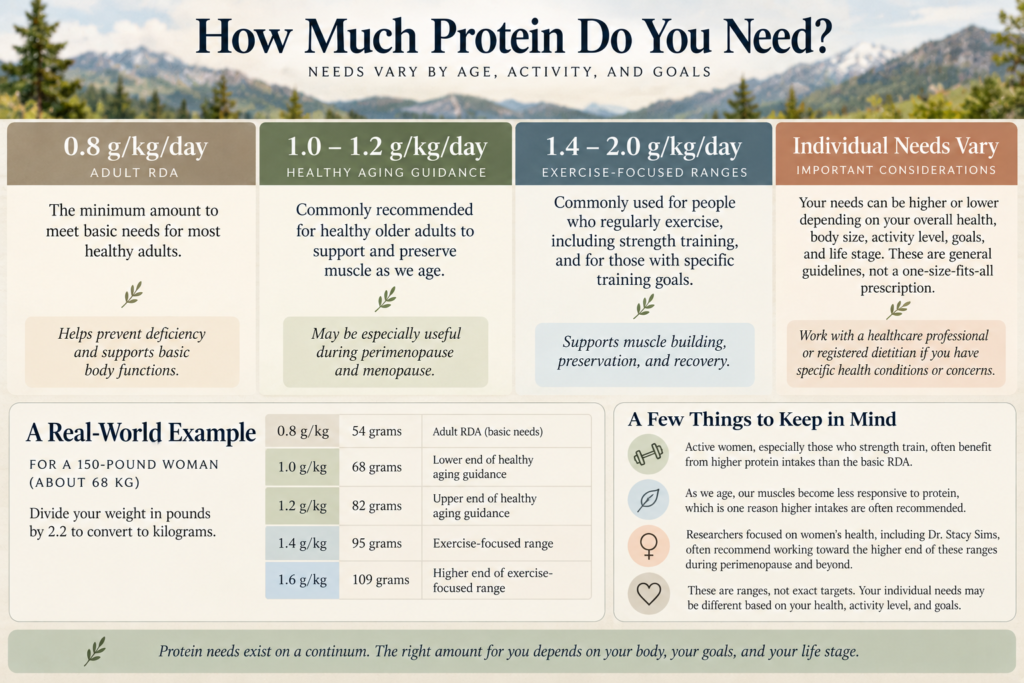
The current Recommended Dietary Allowance for protein for adults is 0.8 grams per kilogram of body weight per day. That number is useful, but it is important to understand what it represents. The RDA was established as the amount expected to meet the basic needs of nearly all healthy adults. It was not designed specifically to determine the amount that best supports muscle preservation, strength training, athletic recovery, or healthy aging.
For many women—particularly those who are active, strength train, or are focused on preserving muscle as they age—a higher intake may be useful. Recommendations vary depending on age, activity, health, and goals. Guidance for healthy older adults commonly begins around 1.0–1.2 grams per kilogram of body weight per day, while sports-nutrition recommendations for exercising adults commonly fall around 1.4–2.0 grams per kilogram per day. Researchers focused specifically on active women, including Dr. Stacy Sims, often recommend working toward the higher end of those ranges during perimenopause and beyond.For many women—particularly as they get older, move through perimenopause and menopause, or regularly strength train—a higher intake may be useful. Research on protein and healthy aging commonly supports intakes around 1.2 to 1.6 grams per kilogram of body weight per day for people trying to support or preserve muscle, with individual needs varying according to age, activity, energy intake, health, and training.
You do not need to know your weight in kilograms to understand what those numbers mean. Divide your weight in pounds by 2.2 to convert it to kilograms. A woman who weighs 150 pounds, for example, weighs about 68 kilograms. At the adult RDA of 0.8 grams per kilogram, that would be about 54 grams of protein per day. At 1.2 grams per kilogram, it would be about 82 grams. At 1.4 grams per kilogram, about 95 grams. And at 1.6 grams per kilogram, about 109 grams. These aren’t four different “correct” answers—they illustrate how substantially protein intake can change depending on whether we’re talking about basic adequacy, healthy aging, regular exercise, or more specific training goals.You do not need to know your weight in kilograms to understand what that means. Divide your weight in pounds by 2.2 to convert it to kilograms. A woman who weighs 150 pounds, for example, weighs about 68 kilograms. At 0.8 grams per kilogram, the RDA would be about 54 grams of protein per day. At 1.2 grams per kilogram, that would be about 82 grams. At 1.6 grams per kilogram, it would be about 109 grams.
That difference is one reason a woman can technically be meeting the RDA and still benefit from eating more protein when preserving or building muscle is the goal.
But these numbers are ranges, not commandments. Your body does not know whether you hit 96 grams instead of 100, and nothing magical happens at midnight if you missed your target. Protein needs exist on a continuum, and consistently getting a useful amount matters far more than perfectly hitting a number every day.
You also do not necessarily need to track protein forever. Tracking for a short period can sometimes be educational if you genuinely have no idea how much you are eating, but the goal can be to learn what adequate protein looks like in your own meals rather than creating another number you feel obligated to monitor.
That brings us back to a much easier place to begin: look at the meals you already eat and ask, “Where is my protein?”
If the answer is consistently obvious at breakfast, lunch, and dinner, you may already be much closer than you think.
Does It Matter When You Eat Your Protein?
Your total protein intake across the day matters, but when you eat it matters too—particularly when supporting muscle is part of the goal.
A common pattern is to eat relatively little protein early in the day and then consume most of it at dinner. Breakfast might be toast or cereal, lunch might be something light, and then dinner arrives with a substantial piece of chicken, fish, or meat. You may technically accumulate a reasonable amount of protein by the end of the day, but that does not necessarily make the most of the opportunities you had to support muscle along the way.
Eating protein stimulates muscle protein synthesis—the process your body uses to build and repair muscle proteins. Rather than concentrating nearly everything into one meal, distributing meaningful amounts of protein across several meals gives your body repeated opportunities to stimulate that process.
For many women, a practical place to start is somewhere around 25–35 grams of high-quality protein at a meal, although the amount that makes sense for you depends on your body size, age, activity, overall protein needs, and the protein source itself. Some researchers who specialize in female physiology, including Dr. Stacy Sims, emphasize the importance of adequate protein per meal for women in perimenopause and beyond rather than simply chasing one large daily total.
That does not mean every meal now requires a calculator. It means breakfast and lunch deserve some attention too.
If breakfast is normally oatmeal and fruit, perhaps Greek yogurt, milk, nuts, seeds, eggs, or another protein source could join it. If lunch is a salad, adding chicken, salmon, tuna, eggs, tofu, tempeh, beans, lentils, or cottage cheese can turn it into a more substantial meal. Dinner may already have an obvious protein source and need very little adjustment.
Protein around strength training can also be useful because exercise creates the stimulus for adaptation and protein provides amino acids needed for repair and rebuilding. You do not need to sprint toward a protein shake the second you put down a dumbbell, but regularly eating protein in the hours around training is a sensible way to support recovery.
The useful signal here is not “I must eat exactly this many grams every three hours.”
It is much simpler:
Instead of saving most of your protein for dinner, give your body meaningful protein opportunities throughout the day.
What Does Enough Protein Actually Look Like on a Plate?
Protein recommendations become much more useful when you can stop thinking in grams and start recognizing them as food.
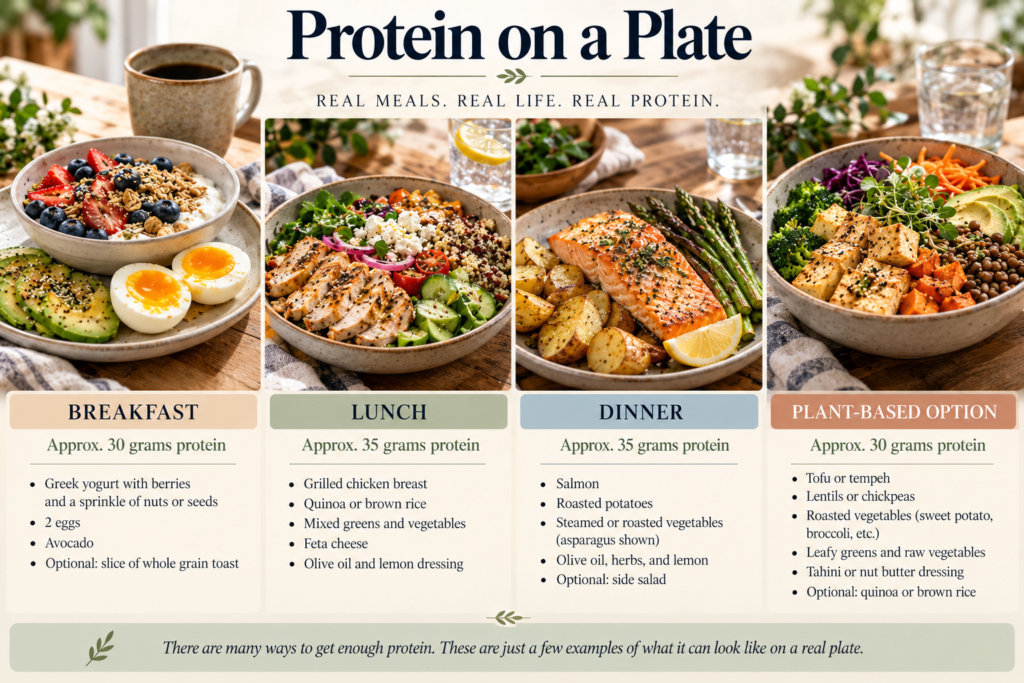
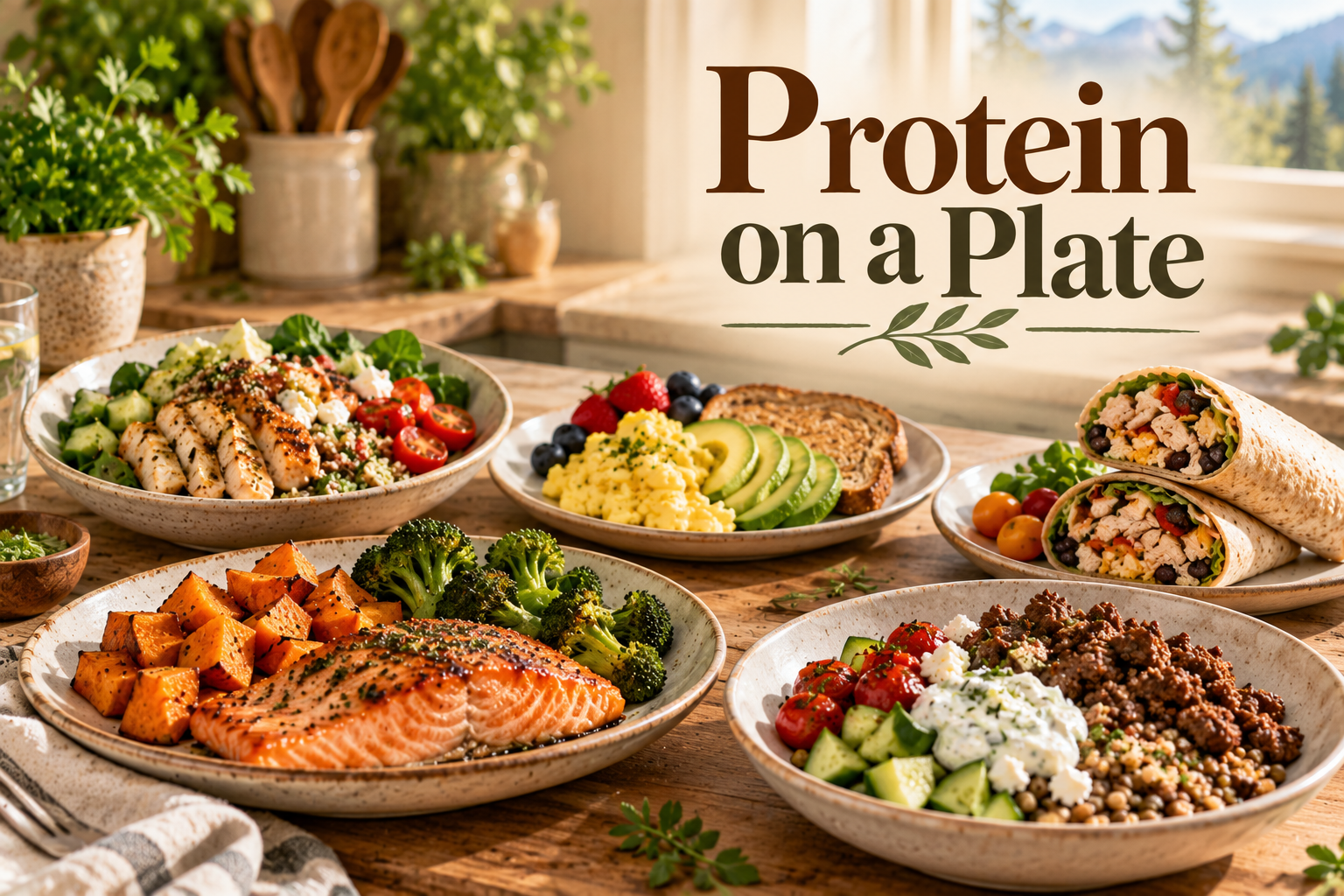
A breakfast with eggs, Greek yogurt, and fruit might provide a substantial amount of protein without looking anything like a traditional “high-protein” meal. A bowl built around chicken, rice, vegetables, and avocado has an obvious protein anchor. Salmon with potatoes and roasted vegetables does too. A tofu stir-fry, lentil bowl, or meal built around beans and grains can accomplish the same thing using plant foods.
The exact amount will vary with the food and serving size, which is why there is no universal visual rule such as “one palm equals exactly enough protein.” A palm-sized portion of chicken and the same volume of lentils do not contain identical amounts of protein. Two eggs provide useful protein, but they provide considerably less than a substantial serving of chicken or fish. A scoop of Greek yogurt can contribute quite a bit more than a spoonful of ordinary yogurt. Context matters.
Instead of trying to make every plate mathematically perfect, start by identifying its protein anchor. What food—or combination of foods—is doing most of the protein work here?
Sometimes the answer will be obvious: chicken, salmon, steak, pork, tofu, or a generous serving of lentils. Other meals may build protein from several places. Eggs with whole-grain toast and Greek yogurt, for example, receive protein from all three foods. A grain bowl might combine quinoa, beans, edamame, seeds, and another protein source, with each contributing to the total.
This is also why looking at the whole meal is more useful than labeling individual foods as “good” or “bad” sources of protein. You are building a meal, not taking a nutrition exam.
And you do not need every meal to look the same. Some will contain more protein than others. Some days will naturally land higher or lower. The goal is to create a pattern in which meaningful protein sources appear regularly enough that your body has the raw materials it needs.
When you’re standing in the kitchen wondering what to make, you can skip most of the math and begin with one question:
Where is my protein?
How to Make Protein Easier Without Rebuilding Your Entire Diet
Eating more protein does not require replacing everything you currently eat with chicken breast, protein shakes, and containers of meal-prepped food lined up across the refrigerator.
Usually, the easiest approach is to look at meals you already enjoy and ask what small change would give them a stronger protein anchor.
If you eat oatmeal for breakfast, you might make it with milk, stir in Greek yogurt, add nuts or seeds, or have eggs alongside it. If you love toast, keep the toast and add eggs, cottage cheese, smoked salmon, or another protein you enjoy. If lunch is usually soup, salad, or leftovers, adding chicken, tuna, salmon, tofu, beans, lentils, eggs, or cheese may be all it takes.
Dinner often needs the least help because many traditional dinner meals already include an obvious protein source. Instead, breakfast, lunch, and snacks are frequently where the easiest opportunities are hiding.
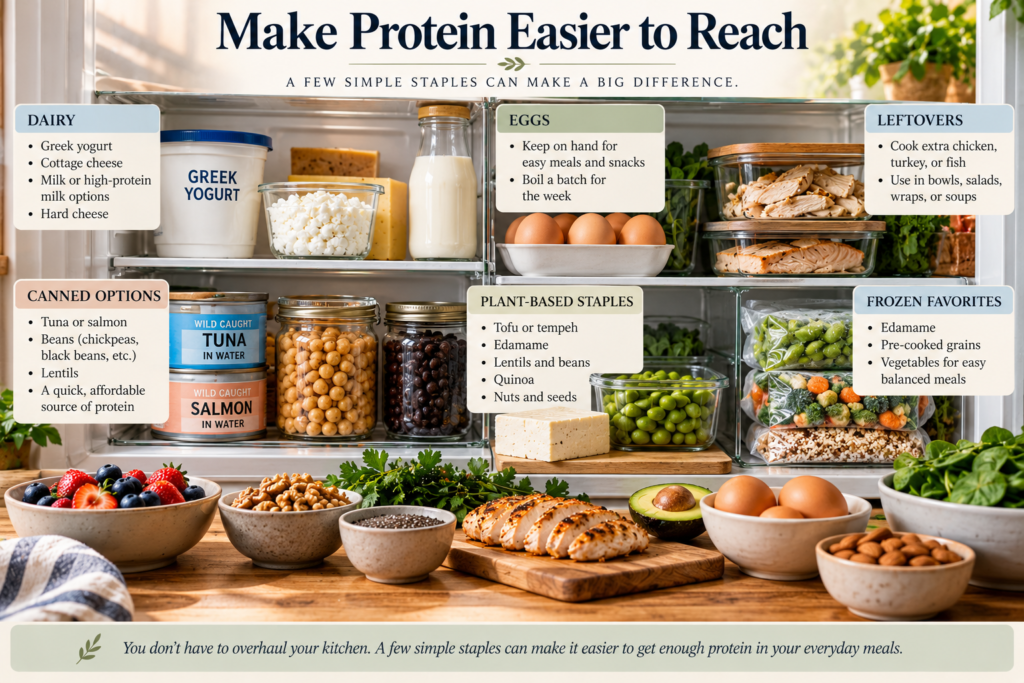
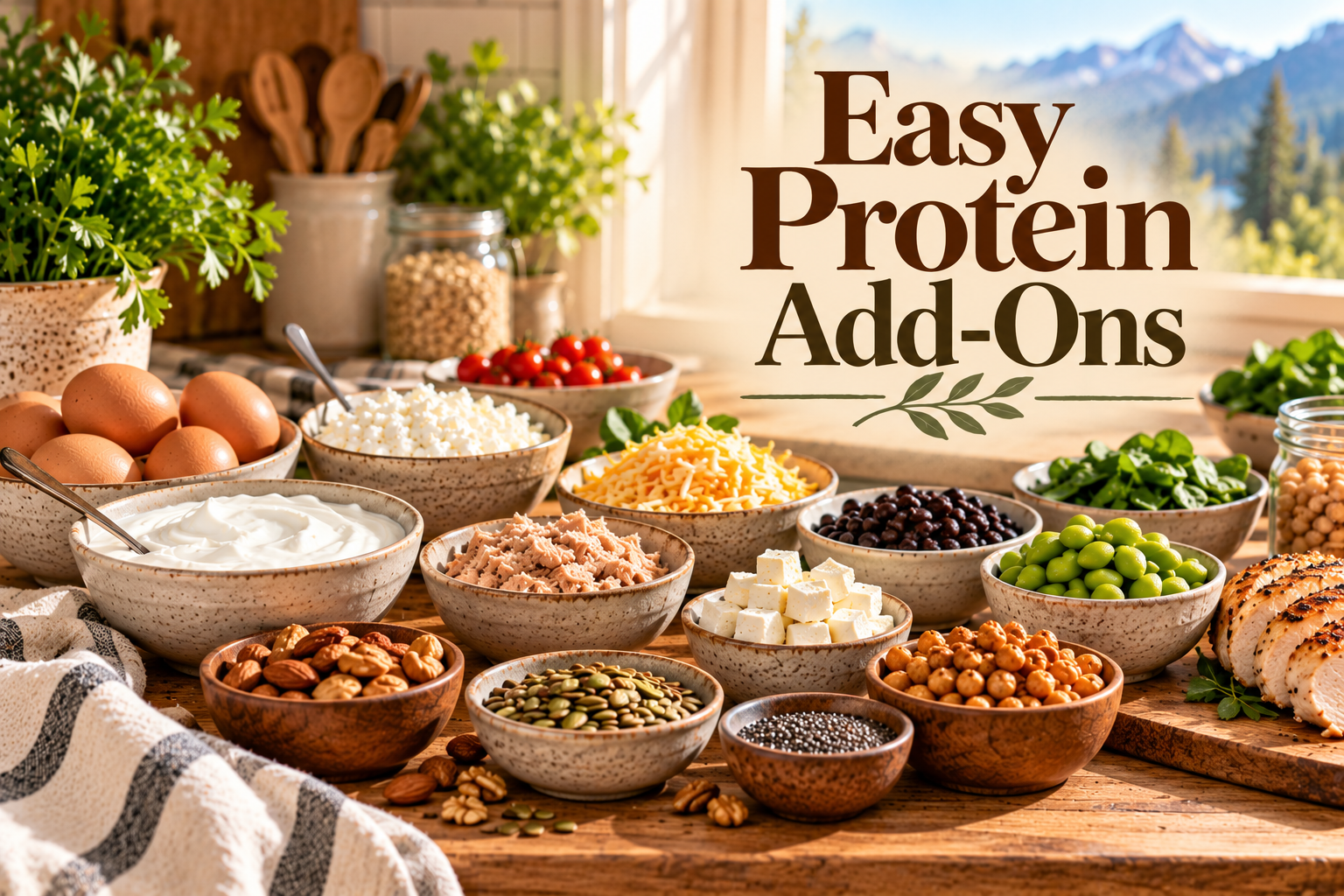
Keeping a few convenient protein foods around can make those decisions almost automatic. Eggs, Greek yogurt, cottage cheese, canned tuna or salmon, beans, lentils, tofu, edamame, cheese, and leftover cooked meat can turn whatever else you have into a meal surprisingly quickly. The freezer can help too: frozen fish, shrimp, cooked chicken, edamame, and other proteins do not become nutritionally inferior because you didn’t buy them fresh that afternoon.
And convenience foods are allowed.
A rotisserie chicken is still chicken. Canned beans are still beans. Frozen salmon is still salmon. Pre-cooked lentils still contain protein. Individual containers of Greek yogurt do not become less nutritious because you didn’t lovingly spoon the yogurt from a hand-thrown ceramic crock. 😂
Cooking a little extra when you are already cooking can help too. An additional piece of chicken at dinner can become tomorrow’s lunch. Extra taco meat can go into eggs, a bowl, salad, or quesadilla. A batch of lentils can move through several meals without requiring you to cook from scratch every time.
The goal is not to create a second job called Eating Enough Protein.
It is to make the useful choice easier to reach.
Look at what you already eat. Look at what you already buy. Then find the easiest places to strengthen the protein that’s already there.
What About Protein Powder, Shakes, and Bars?
Protein powder is not required to eat enough protein, and a protein shake is not inherently better than a meal made from ordinary food. But protein supplements can be extremely useful for one simple reason: they make protein convenient.
A scoop of protein powder can turn a smoothie that was mostly fruit into something more substantial. It can boost the protein in oatmeal or yogurt. A shake can provide an easy option after a workout, during a rushed morning, while traveling, or on a day when preparing another meal simply is not happening.
That convenience matters. Nutrition advice is only useful if it can survive real life.
Whole-food protein sources bring more than protein with them. Fish may provide omega-3 fats. Dairy foods can provide calcium. Beans and lentils bring fiber and other nutrients. Eggs provide an assortment of vitamins and minerals. Meat, poultry, soy foods, nuts, seeds, and other protein sources each bring their own nutritional package to the table. That is a good reason for ordinary foods to make up much of your diet—not a reason to treat protein powder as somehow inferior or “fake.”
If you use a protein powder, the type matters less than finding one that works for your needs, preferences, digestion, and eating pattern. Whey is a high-quality, leucine-rich complete protein and is well studied for supporting muscle protein synthesis. Casein is another complete dairy protein that digests more slowly. Soy is a complete plant protein, while other plant-based powders often use combinations such as pea and rice to provide a broader amino acid profile.
Protein bars fall into much the same category. Some are genuinely useful sources of protein. Others are essentially snack bars with a small amount of protein and very impressive marketing. Looking at the actual protein content—and the rest of the ingredient and nutrition information—will tell you considerably more than whatever is written in giant letters on the front of the wrapper.
None of these products earns extra credit simply because the word protein appears on the package.
Think of powders, shakes, and bars as tools rather than requirements. If they make getting enough protein easier, they can be useful. If you would rather eat your protein, that works too.
You do not need a supplement cabinet to build a protein-rich diet. But you also do not need to make nutrition unnecessarily difficult just to prove you can do everything with a fork.
Can You Eat Too Much Protein?
Because protein is important, it is easy for the conversation to drift toward the idea that more must always be better. It isn’t.
Once you are eating enough protein to support your body’s needs and your goals, continually adding more does not produce unlimited benefits. Protein still contributes energy, and every food you add to your diet takes up space that could otherwise be filled by something else. If pursuing an extremely high protein intake means vegetables, fruit, whole grains, legumes, healthy fats, or simply foods you enjoy keep getting pushed off the plate, the overall diet may become less balanced rather than more nutritious.
For most healthy people, protein intakes above the RDA and within commonly recommended ranges for active and older adults are generally considered safe. Higher-protein diets are also often blamed for damaging healthy kidneys, but evidence does not support the idea that reasonable higher protein intake causes kidney disease in people with normal kidney function.
That is different from saying protein intake never matters medically. People who already have chronic kidney disease or certain other health conditions may need individualized guidance about how much protein is appropriate. Pregnancy, significant medical conditions, and other circumstances can also change nutritional needs. Those are situations where advice from a physician or registered dietitian who knows your medical history matters more than a generalized number from an article.
For everyone else, there is little reason to turn protein into a competition.
You do not need the highest-protein yogurt, protein cereal, protein coffee, protein chips, protein cookies, and a protein shake alongside a dinner built around a giant steak simply because protein is currently having its nutritional moment.
Protein matters.
So do the rest of the foods on your plate.
The Part Worth Remembering
Protein can become complicated very quickly if you let it.
You can calculate grams per kilogram, compare amino acid profiles, think about leucine thresholds, analyze meal timing, evaluate protein quality, and track every gram that passes through your kitchen. Some of that information can be useful. None of it needs to become another full-time job.
The bigger picture is much simpler.
Your body uses protein every day to build, maintain, and repair tissue. As you move through midlife and beyond, maintaining muscle becomes increasingly important, and getting enough protein—alongside regularly using those muscles through resistance training—is one of the useful signals you can give your body.
You do not have to eat meat to do that. You do not need protein powder. You do not need the same breakfast every morning or perfectly portioned containers waiting in your refrigerator. And you certainly do not need to turn every meal into a math problem.
You need a pattern that works often enough.
Choose protein foods you actually enjoy. Keep convenient options around. Let several foods contribute when that makes sense. Spread meaningful sources across your day rather than expecting dinner to do all the work. Use supplements when they make life easier, not because you have been convinced you cannot possibly eat well without them.
And when all the information starts feeling like too much, come back to the simplest question in this entire guide:
Where is my protein?
Look at the meal in front of you. Find the answer.
If there isn’t much of one, you now know what you might add.
That is body listening too—noticing what your body needs and giving it useful information without demanding perfection in return.
Protein is one part of the plate. It does not need to become the whole plate.
And it definitely does not need to become another set of food rules.
Sources
International Society of Sports Nutrition — Position Stand: Protein and Exercise
Excellent support for resistance exercise + protein, daily protein requirements for exercising people, protein quality, supplementation, and timing. It supports roughly 1.4–2.0 g/kg/day for most exercising individuals. PubMed
Read the position stand
PROT-AGE Study Group — Evidence-Based Recommendations for Optimal Dietary Protein Intake in Older People
Useful authority for the aging discussion. Their recommendation for healthy older adults is approximately 1.0–1.2 g/kg/day, with higher needs possible depending on activity and health circumstances. DOI
Read the position paper
Protein Requirements and Recommendations for Older People: A Review
Supports our discussion of aging, muscle protein synthesis, and approximately 25–30 g of protein at a meal as a useful practical target in older adults. PubMed Central (PMC)
Read the review
Dr. Stacy Sims — How Much Protein Is Enough?
This is the Sims source I particularly want included. She discusses protein specifically through a female-physiology lens, including active women and women in perimenopause/menopause, and recommends higher intakes for active women than the baseline RDA. Dr. Stacy Sims
Read Stacy Sims’ article
Dr. Stacy Sims — How Plants and Protein Can Help You Through Menopause
Especially relevant to TSP because it addresses both protein and plant diversity in menopause. Sims recommends active women work within sports-nutrition ranges and discusses roughly 25–30 g per meal as a practical way to distribute intake. Dr. Stacy Sims
Read Stacy Sims’ menopause article
Higher-Protein Diets and Kidney Function — Systematic Review and Meta-Analysis
We actually have a very recent 2026 systematic review and meta-analysis of randomized trials now, which makes our kidney section stronger. It examined higher-protein diets in adults without chronic kidney disease. That distinction is important and matches the qualification we made in the article. PubMed Central (PMC)
Read the 2026 systematic review