Before You Hit the Couch
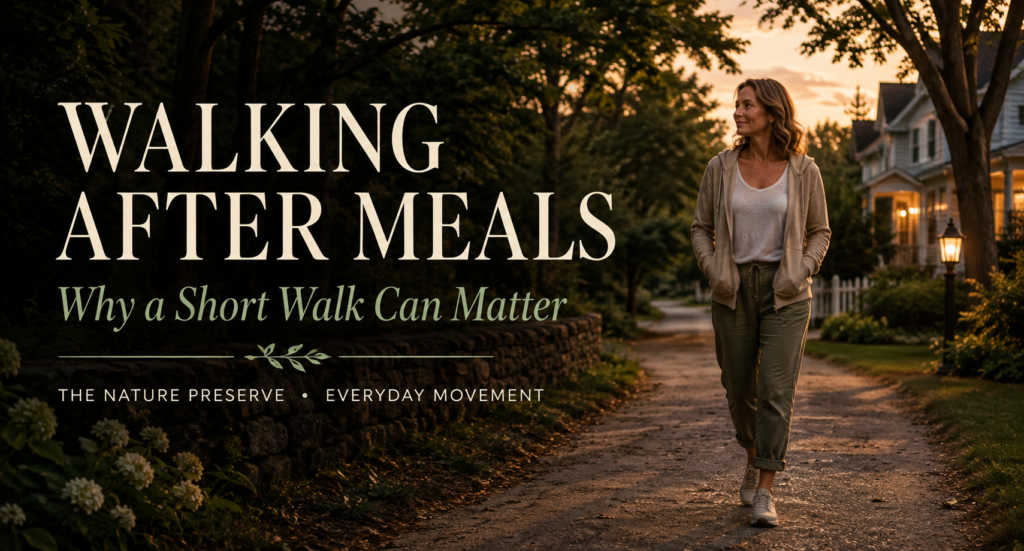
For many of us, dinner marks the end of the active part of the day. We eat, clear the table, finish whatever needs finishing in the kitchen, and head for the couch. And once we’re there, chances are we’re staying there for a while. There is absolutely nothing wrong with resting at the end of the day. But there is an interesting little window between finishing dinner and settling in for the evening that may be worth noticing.
What if, before you sit down, you walked? Not for an hour. Not necessarily as a workout. You don’t need to change clothes, track your pace, close a ring on your fitness tracker, or work up a sweat. You might walk around the block, take the dog outside, wander down the street and back, or spend ten minutes making a loop through your neighborhood. It sounds almost too simple to matter.
But research on movement after eating suggests otherwise. Walking after a meal can change the way your body handles the rise in blood sugar that naturally follows eating. And research comparing movement before and after meals suggests something particularly interesting: walking after you eat may make a difference.
Sometimes the useful change isn’t adding an entirely new workout to your life. Sometimes it’s changing what happens before you hit the couch.
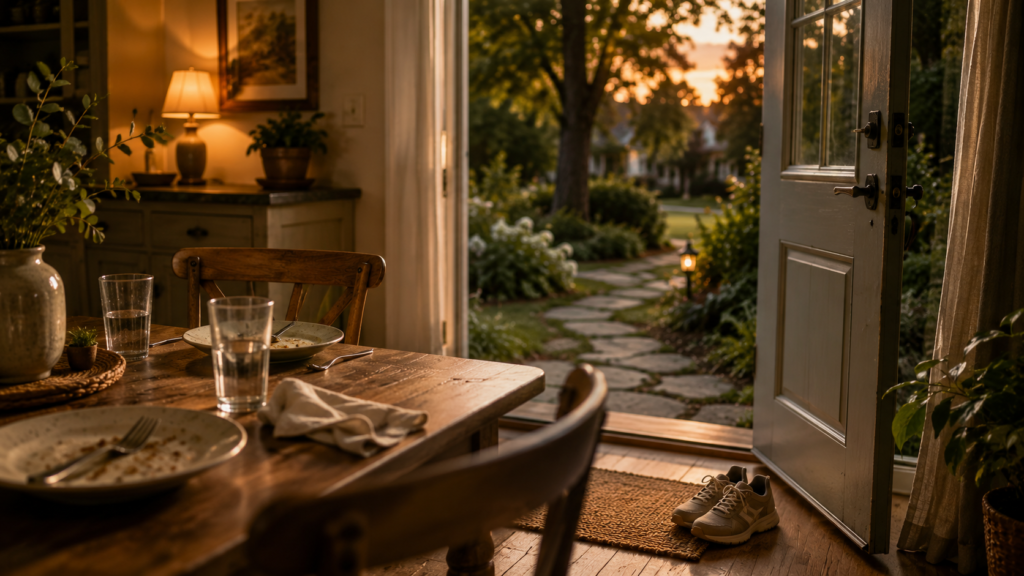
What Happens After You Eat?
After you eat, your body gets to work. Some of the food you’ve eaten is broken down into glucose, which enters your bloodstream and can be used for energy. Your body releases insulin to help move that glucose where it needs to go. And one of the places it can go is your muscles.
That’s where walking gets interesting. When you get up and move, your muscles need energy. They can use some of the glucose that’s available after your meal to help meet that need. That’s really the part you need to know.
Your body is already responding to the meal you ate. When you add a walk afterward, you’re sending another signal—and your body responds to that, too. This is one reason a short walk after eating can affect what happens to your blood sugar after a meal.
No biology degree required.
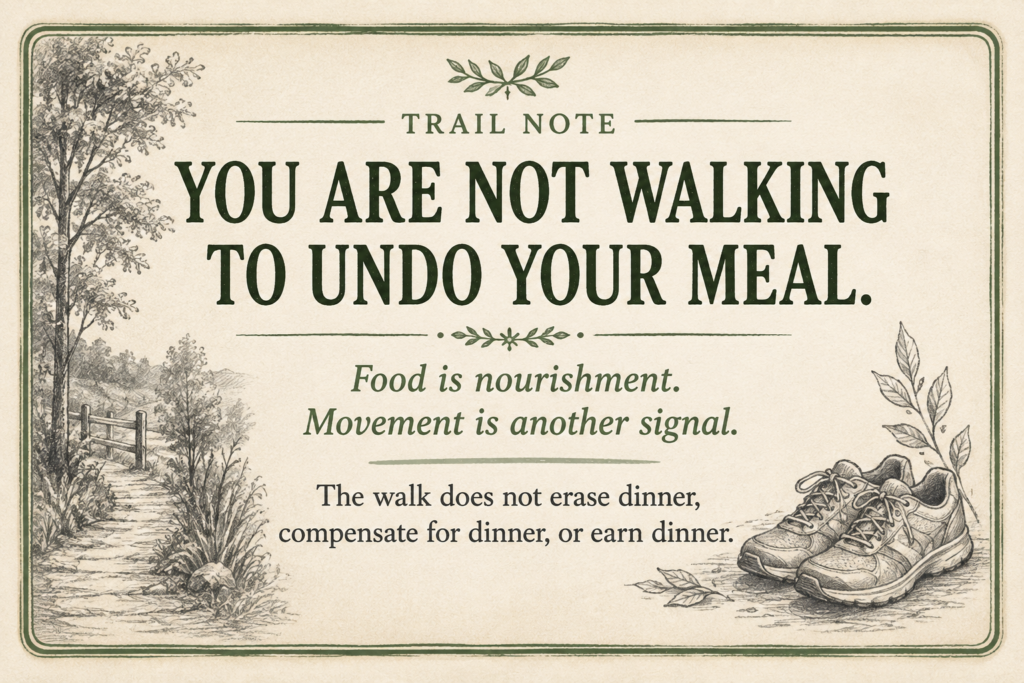
Why Walking Afterward Is Interesting
Walking is good for you whether it happens before breakfast, at lunchtime, after dinner, or because you realized at 9 p.m. that the dog has been staring at you for twenty minutes.
But researchers have found something interesting when they look specifically at blood sugar after meals. In a review that pulled together several studies, moving after eating did a better job of reducing the rise in blood sugar after the meal than exercising beforehand or not exercising. The researchers also found that waiting longer after eating seemed to reduce that effect.
That doesn’t mean you need to leap up from the table the second you put down your fork. It does mean there may be a practical reason not to automatically make dinner → couch the sequence every night.
And this is one of the things I love about everyday movement. Sometimes you can make a meaningful change without finding another hour in your schedule. You were going to finish dinner anyway. You were probably going to sit down afterward anyway. We’re simply asking: What if there were a few minutes of movement in between?
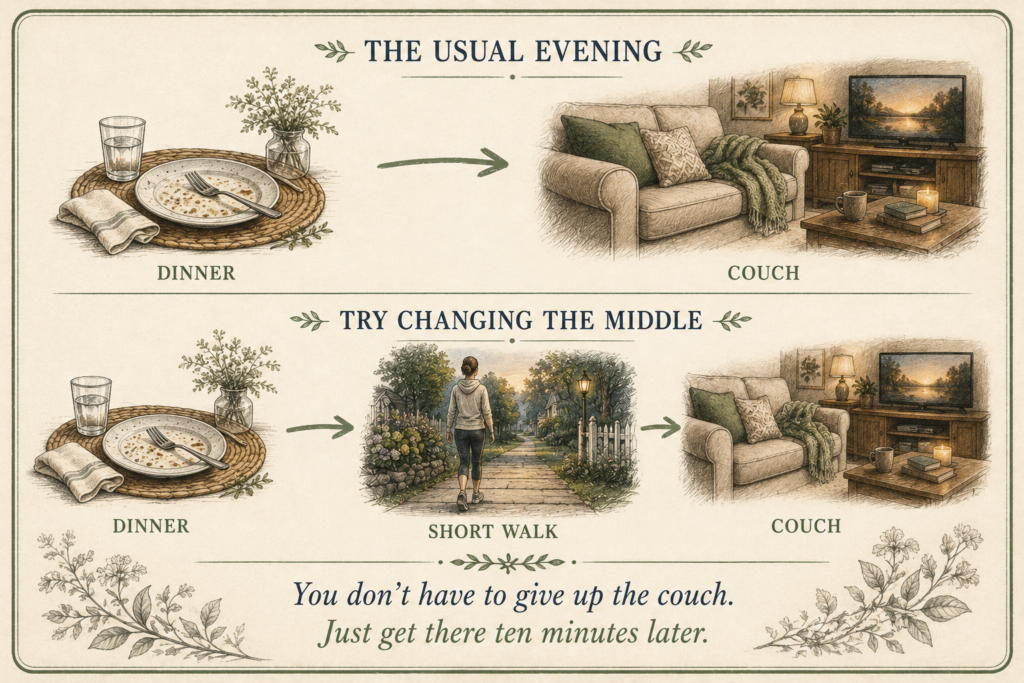
Does It Have to Be 10 Minutes?
Ten minutes gets talked about a lot when people discuss walking after meals, and there is some research behind that number. One study followed 41 adults with type 2 diabetes. At one point, they were asked to walk for 30 minutes each day. At another, they divided that same amount of walking into three 10-minute walks—one after each main meal.
Same total walking time. Different timing. The shorter walks after meals did a better job of controlling the rise in blood sugar after eating than doing one 30-minute walk at another time of day. The difference was especially noticeable after dinner.
That’s fascinating. It does not mean ten minutes is a magic number. Minute nine isn’t sitting there accomplishing nothing while minute ten waits to activate the health fairy. 😂
Different studies have looked at different amounts and types of movement, so we don’t have one perfect number that applies to every person, every meal, and every situation. A larger review of the research found that walking and other exercise performed soon after eating can help reduce the rise in blood sugar after a meal, but it did not establish “exactly ten minutes” as some universal requirement.
So instead of treating ten minutes like a prescription, think of it as something much more useful: It’s doable. Ten minutes is short enough to fit into an ordinary evening. It’s long enough to get outside and go somewhere. And for many people, it feels a whole lot less intimidating than adding another “workout” to the day.
Have five minutes? Walk five. Have fifteen and the weather is beautiful? Stay out longer. The walk doesn’t stop mattering because the stopwatch didn’t land on exactly 10:00.
How Hard Do You Have to Walk?
You don’t need to turn the sidewalk into a racetrack. The research on movement after meals has included different kinds and intensities of activity. There isn’t one walking speed everyone needs to hit, and the goal here isn’t to turn every meal into another training session.
A comfortable walk is a perfectly reasonable place to begin. You may naturally walk a little faster on some days. On others, you may wander while your dog conducts a forensic investigation of a shrub for six uninterrupted minutes. It still counts as movement.
If you want a more challenging walking workout, we have an entire trail for that. Hills, intervals, pace changes, longer routes, changing terrain, and added resistance can all make walking more challenging. This doesn’t have to be that walk.
This one can simply be the walk between dinner and the rest of your evening.
Try This After Dinner
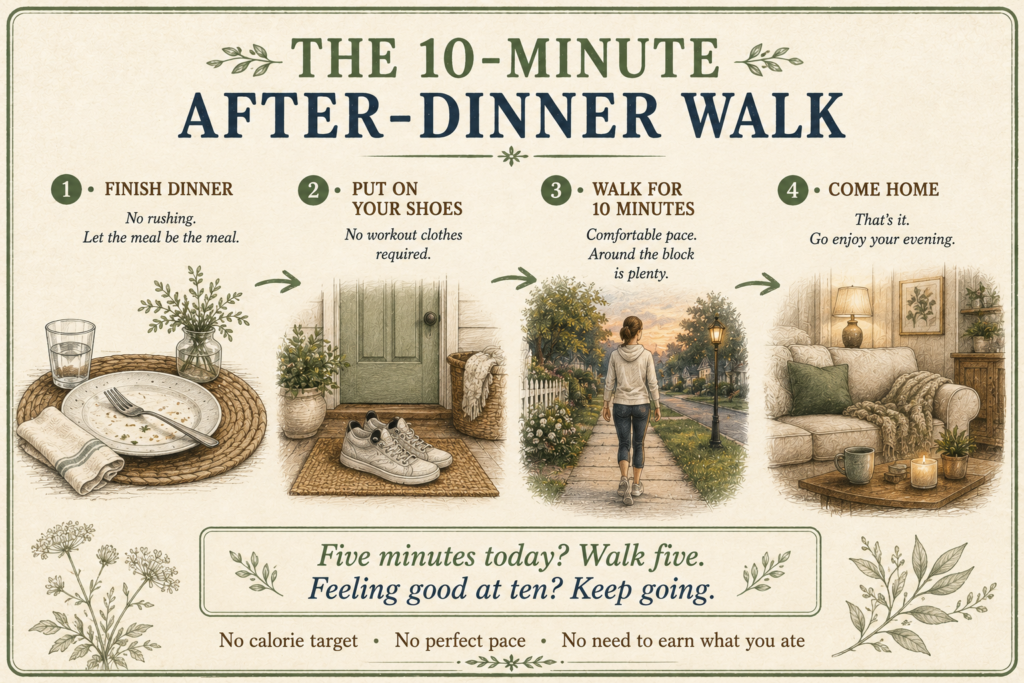
Finish your meal. Put on your shoes. Walk for 5–15 minutes at a comfortable pace. Come home.
No calorie target. No perfect pace. No need to earn what you ate.

Which Meal Should You Walk After?
You don’t have to save this idea for dinner. Maybe walking after breakfast is easy because the dog needs to go outside anyway. Maybe lunch gives you the best opportunity because you can leave your desk and walk around the building. Maybe dinner works because your partner or kids can come with you. Or maybe one particular meal is almost always followed by a long stretch of sitting. That’s a pretty natural place to experiment.
In that study comparing one 30-minute walk with three shorter walks, the biggest difference showed up after the evening meal. The researchers noted that dinner tended to contain more carbohydrate and was followed by more sitting.
Interesting? Absolutely. A rule that says everybody must walk after dinner? No.
Start where it fits your life. Because we’re not trying to find the most scientifically perfect walking schedule and then force your Tuesday to cooperate with it. We’re looking for something you can actually do.
If lunch works, walk after lunch. If dinner works, walk after dinner. If today you have seven minutes before you need to drive someone to practice, seven minutes is what you’ve got.
Consistency is built in real life, not under perfect laboratory conditions.
Before You Hit the Couch
This may be the easiest place to start. Not because sitting on the couch is bad. Not because you need to stay in motion from sunrise until bedtime. And certainly not because rest needs to be earned. It’s simply because transitions can become habits without us really noticing them.
Dinner ends. Couch. Lunch ends. Desk. Breakfast ends. Car. None of those things is inherently wrong. But once you start paying attention to everyday movement, those transitions become interesting. They’re opportunities.
Before you sit down for the evening, walk to the end of the street and back. Take the dog around the block. Walk outside with your partner and talk about the day. Call a friend and walk while you’re talking.
Take a lap around the office building after lunch. Walk to the mailbox by taking the unnecessarily long route. Go outside because the sky looks beautiful. You don’t need to make the walk productive.
The movement is enough.
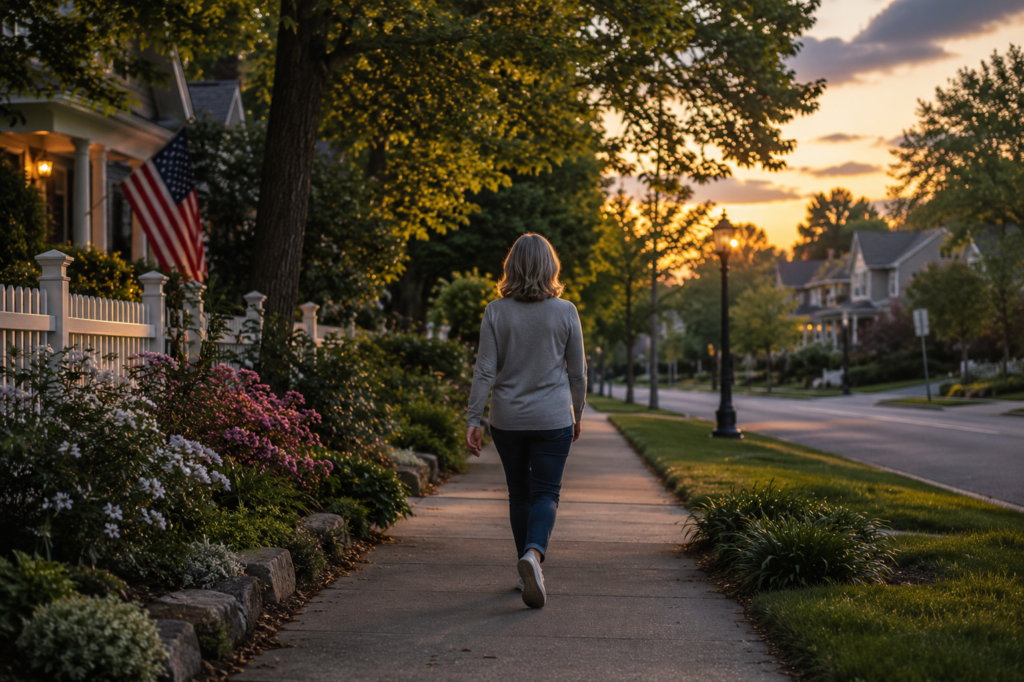
The Signal You’re Sending
This is exactly what we mean when we talk about signals. You eat dinner. Your body responds to the food you’ve eaten. Then you get up and take a walk. That’s another signal. Your muscles start working, your body responds to the movement, and now you’ve changed what happens after the meal.
You didn’t cancel out dinner. You didn’t fix anything. You simply changed one part of the pattern. And that’s what makes this worth experimenting with.
You can take a short walk after a meal, notice how it fits into your life, and decide whether it’s something you want to keep doing. This doesn’t mean every change you notice in your energy, hunger, blood sugar, body composition, mood, or health can be traced back to whether you walked after dinner. Bodies—and lives—are far more complicated than that.
This is simply one signal you can choose to change. Then you observe.
That’s the experiment.
Try This Tonight: The 10-Minute After-Dinner Walk
You don’t need a program for this one. Finish dinner. Give yourself a few minutes if you need them. Put on your shoes. Step outside—or walk somewhere indoors if that’s what works for you. Walk at a comfortable pace for ten minutes. Then come home.
That’s it.
Don’t grade the walk. Don’t worry about how far you went. Don’t turn it into a calorie calculation. Don’t decide it only counts if your fitness tracker approves. And don’t use it to compensate for something you ate.
You ate dinner. Then you moved your body. Both can simply be parts of taking care of yourself.
If ten minutes feels like too much today, walk five. If ten minutes passes and you’re enjoying yourself, keep going.
Tomorrow, you get to choose again.
A Note Before You Go
For many people, a short, comfortable walk is a simple form of movement. But your own health and circumstances still matter.
If you have diabetes and take insulin or certain medications that lower blood sugar, exercise can sometimes cause your blood sugar to drop too low. How food, medication, and activity work together can vary from person to person, so talk with your healthcare professional about what is appropriate for you.
And if you have an injury, balance concern, health condition, or symptoms that make walking uncomfortable or unsafe, get guidance appropriate for your situation.
The goal isn’t to force a walk because an article told you to. It’s to find movement that works for your body and your life.
A Walk Doesn’t Have to Be a Workout to Matter
There will be days when you want the hills. Days when you want the intervals. Days when you lace up your shoes specifically because you want to train. And there can also be nights when dinner is over, the kitchen is mostly clean, and the couch is calling your name.
Maybe you answer it ten minutes later.
Walk to the corner. Notice the evening air. See which neighbor is outside. Let the dog inspect the same mailbox he inspected yesterday as though new evidence may have emerged overnight. 😂 Watch the light change. Walk around the block and come home.
You didn’t burn off dinner. You didn’t earn dessert. You didn’t complete another task required to be “good” at taking care of yourself. You simply changed one small part of the evening.
You ate. You moved. Your body received those signals and responded. And tomorrow, you can decide whether you want to send them again.
Change the Signals. Change the Response.
Sources & Further Reading
Engeroff T, Groneberg DA, Wilke J. After Dinner Rest a While, After Supper Walk a Mile? A Systematic Review with Meta-analysis on the Acute Postprandial Glycemic Response to Exercise Before and After Meal Ingestion in Healthy Subjects and Patients with Impaired Glucose Tolerance. Sports Medicine. 2023.
Read the research:
PubMed
Full text on PubMed Central
Reynolds AN, Mann JI, Williams S, Venn BJ. Advice to walk after meals is more effective for lowering postprandial glycaemia in type 2 diabetes mellitus than advice that does not specify timing: a randomised crossover study. Diabetologia. 2016.
Read the research:
PubMed
American Diabetes Association. Standards of Care in Diabetes—2026: Facilitating Positive Health Behaviors and Well-being to Improve Health Outcomes. Diabetes Care. 2026.
Read the guidance:
American Diabetes Association Standards of Care