
There is a particular kind of betrayal that happens when the woman walking next to you is moving at what appears to be exactly the same speed you are—and somehow she is casually telling you a story while you’re wondering when breathing became a full-time job.
Or maybe you’re the one doing the talking.
Maybe you’ve spent months watching the same number appear on your walking app and wondering whether you’re supposed to be faster by now. Maybe someone told you that a walk only “counts” if you maintain a certain pace. Maybe you’ve seen charts assigning meaning to miles per hour and quietly wondered where your body is supposed to fit into all of it.
Walking seems like it should be simple.
Then somebody hands us a stopwatch.
Suddenly we’re asking:
How fast should I be walking?
What counts as brisk?
Is my pace too slow?
Should I be pushing harder?
Why did this same walk feel easy last week and absolutely terrible today?
Those are reasonable questions.
But I think we’ve been starting with the wrong one.
Instead of asking How fast should I walk?, try asking:
What am I asking this walk to do?
Because there isn’t one correct walking pace.
The pace that helps you recover from yesterday’s strength workout may be different from the pace you choose when you’re deliberately challenging your cardiovascular system. The pace you naturally settle into on a flat sidewalk may change when you step onto roots, rocks, mud, hills, or sand. And the pace that feels comfortable to you may represent a very different physical demand for the woman walking beside you.
Speed tells us something.
It just doesn’t tell us everything.
Your breathing tells us something too. So does perceived effort. Terrain matters. Fitness matters. Recovery matters. Even the purpose of the walk matters.
And once we stop treating pace like a grade we’re supposed to earn, it becomes something much more interesting.
Information.
Not Am I fast enough?
But:
What is this pace asking of my body—and how is my body responding?
That’s a question worth taking with us onto the trail.
Your Body Already Knows How to Walk
Here’s something I didn’t expect to find quite so fascinating: when you walk without deliberately controlling your speed, your body doesn’t appear to choose a pace at random.
Humans tend to settle into what researchers call a preferred or self-selected walking speed—basically, the pace you naturally choose when nobody is telling you to speed up, slow down, or chase a number on a screen. And for decades, researchers have noticed something interesting about that pace: under steady walking conditions, it tends to fall near a speed that is relatively economical for getting your body from one place to another.
That does not mean there’s a tiny accountant somewhere in your brain calculating calories per mile.
But your nervous system is receiving an enormous amount of information while you move. Your muscles and joints are working. Your breathing changes. Your feet are meeting the ground. Your eyes are taking in what’s ahead of you. Your brain is continually coordinating balance, stride length, timing, effort, and speed—and somehow, out of all of that information, you settle into a pace that feels like your pace.
Researchers are still working out exactly how we make that choice. Energy efficiency appears to be part of the story, but it isn’t the whole story. Sensory information, perceived effort, mechanics, the environment, and even how quickly we’re trying to get somewhere can influence the speed we choose. More recent work suggests that real-world walking may involve a tradeoff between conserving energy and conserving time.
Apparently even the human nervous system understands that sometimes we have somewhere to be.
And the system can adapt remarkably quickly. Change the slope beneath someone’s feet and preferred walking speed changes. Put someone on rough natural terrain and the relationship between speed and energy cost changes too. Our walking behavior responds to the conditions we’re moving through rather than blindly maintaining one supposedly ideal speed.
Think about how naturally you already do this.
You don’t usually walk down a steep rocky trail at exactly the same pace you use on a smooth sidewalk. You shorten a step when the ground gets awkward. You slow down when you’re tired. You speed up when the rain starts and the car is still half a mile away. You probably do most of it without consciously issuing instructions to your legs.
Your body is constantly solving the problem of how to move through the world you’re actually in.
I love that, because it gives us a very different place to begin.
Your natural pace isn’t automatically the pace you should use for every walk. Sometimes we’re going to intentionally ask the body for more. Sometimes we’ll deliberately slow things down. Training, after all, means changing the demand when we want a different response.
But before we start manipulating pace, it’s worth recognizing that your body wasn’t waiting for your fitness tracker to teach it how to walk.
It’s been gathering information and adjusting the whole time.
What Does “Brisk” Actually Mean?
“Walk at a brisk pace.”
You’ve probably heard that advice approximately four thousand times. It’s in exercise recommendations, health articles, walking plans, and conversations about getting more cardiovascular activity.
There is just one small problem.
What exactly is brisk?
You can find numbers attached to it. Public-health guidelines often use particular walking speeds as examples of moderate-intensity activity, and numbers like that are useful when researchers need a consistent way to classify physical activity across large groups of people.
But there is an important distinction hiding underneath those numbers: absolute intensity and relative intensity are not the same thing.
Absolute intensity describes the activity itself—essentially, how much energy that activity requires without taking the individual’s fitness into account. Relative intensity asks a different question:
How demanding is this activity for the person actually doing it?
That means two women can walk side by side at exactly the same speed and have two different exercise experiences.
For one woman, three miles per hour might feel comfortable enough that she could carry on a conversation all afternoon. For another, that same pace may noticeably raise her breathing and heart rate. Give them a hill and things may change again. Give one of them a heavy backpack and we’ve changed the demand without changing the woman at all.
Same speed. Different bodies. Different demand.
This is why I don’t particularly love handing someone a miles-per-hour number and calling it the brisk walking pace. The number can tell us something about the activity. It cannot tell us everything about what the body receiving that activity is experiencing.
Fortunately, your body provides some pretty useful clues of its own.
The Surprisingly Useful Talk Test
If you’d like to know how hard you’re working, one of the tools available to you requires no watch, app, heart-rate monitor, subscription, charging cable, or understanding of what the hell your wearable means by “training readiness.”
Try talking.
The basic talk test is wonderfully simple. During moderate-intensity aerobic activity, you should generally be able to talk but not sing comfortably. As intensity moves into vigorous territory, carrying on a conversation becomes much harder; you may only get out a few words before needing to pause for a breath.
And this isn’t just a cute fitness trick somebody made up because it was easy to remember. Researchers have studied the talk test against physiological markers used in exercise science. As exercise intensity rises, ventilation increases to meet the body’s changing metabolic demands. Around important physiological thresholds, breathing begins increasing enough that comfortable speech becomes progressively more difficult. Research has found that the ability—or inability—to speak comfortably tracks reasonably well with these changes, making the talk test a practical way to estimate exercise intensity without laboratory equipment.
We do not need to turn your Saturday morning walk into a cardiopulmonary exercise test to make that useful. In everyday terms, think of it roughly like this:
Easy: You can talk comfortably. Your breathing is under control, and conversation isn’t competing for oxygen.
Moderate: You’re breathing noticeably harder, but you can still speak in sentences. You could talk. Singing the entire chorus of your favorite song would be considerably less appealing.
Hard: Conversation starts breaking into shorter phrases because breathing has become a much higher priority.
These aren’t laboratory-grade boundaries, and the talk test has limitations. It’s a practical estimate, not a magical biological ruler. But that’s precisely why I like it: it brings attention back to the person doing the walking instead of asking a universal number to tell every body what it’s experiencing.
So the next time someone tells you to “walk briskly,” you don’t necessarily need to stare at your watch until it produces the correct number. Notice what the pace is asking of you.
Your breathing knows you’re working even if your watch doesn’t give you a gold star for it.
The Same Pace Can Be a Different Workout
Here’s where comparing walking speeds gets particularly unhelpful.
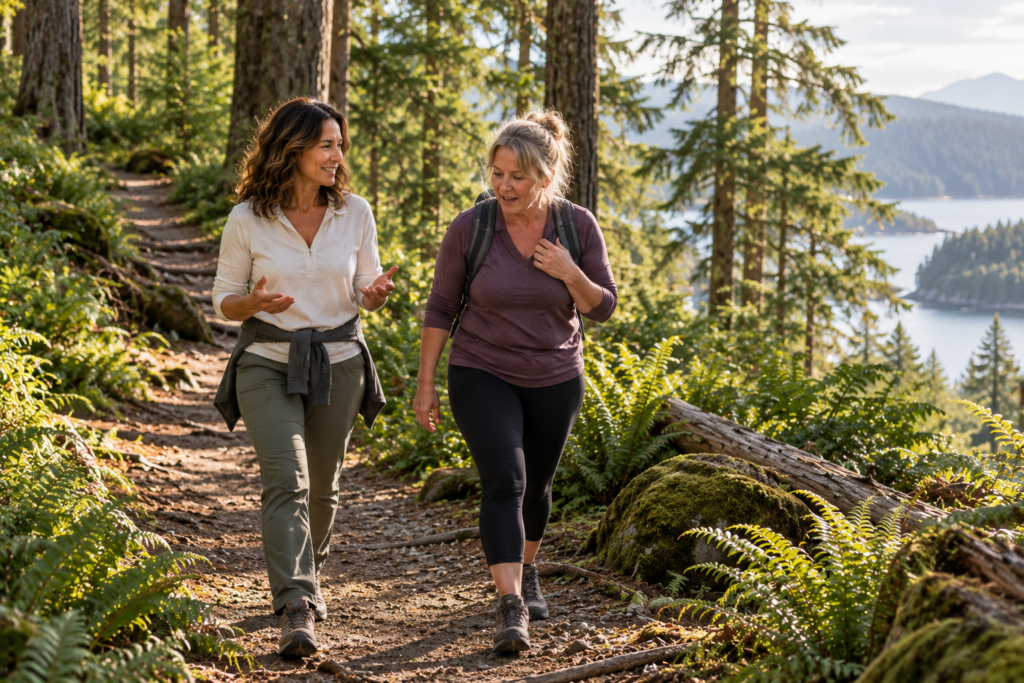
Two women can walk the same path at the same three-mile-per-hour pace and experience very different demands. Fitness matters. So do gait, strength, mechanics and aerobic capacity. There is also evidence that age can affect the energetic cost of walking itself.
In one small study of 38 women ages 25 to 79, the women in the older group chose a walking pace that was, on average, 23 percent slower than the younger women—but the metabolic cost of their walking was actually 15 percent higher. Even when researchers compared the groups at the same speed, walking still cost more energy for the older women.
That’s one small study, so it certainly doesn’t tell us that walking becomes exactly 15 percent harder after a particular birthday. What it does illustrate is something much more useful:
Speed alone cannot tell you how much work a body is doing.
That’s worth remembering when another woman passes you on the trail—or when you’re comparing today’s pace with the one you maintained ten years ago. A slower pace can still represent substantial physiological demand. A faster pace may feel relatively easy to someone whose fitness has adapted to it. So please stop racing the woman next to you-actually, race her if you’re both having fun and she knows there’s a race happening. Just don’t use her pace as evidence about the quality of your own walk.
Your walking pace is not a personality test.
Faster doesn’t mean more disciplined. Slower doesn’t mean lazy. The useful question is what that pace is asking of your body.
What Are You Asking This Walk to Do?
And that brings us to the question I think matters much more than How fast should I walk?
What are you asking this walk to do?
Because we don’t need every walk to send the same signal. Maybe yesterday was a hard strength-training day and today you want twenty easy minutes outside because moving feels good and your legs would appreciate not being given another assignment. Great. Easy is the assignment.
Maybe you’ve been sitting at your desk for three hours and you’re walking around the neighborhood before your next meeting. You aren’t trying to improve your VO₂ max before returning an email. You’re breaking up a long period of sitting and putting some movement back into your day. That counts too.
Maybe today’s walk is your aerobic training. Now you may deliberately increase the demand—pick up the pace, find a hill, extend the distance, or use intervals that move you in and out of harder efforts. Your breathing changes. Your perceived effort rises. The body receives a different signal.
None of those walks is the “real” one. They simply have different jobs.
This is where perceived effort becomes useful alongside the talk test. Exercise scientists commonly use rating-of-perceived-exertion scales—usually called RPE—to describe how hard an effort feels to the person doing it. You don’t need to memorize an official chart to understand the idea. You’re already doing some version of this whenever you think, This is easy, Okay, I’m working now, or Whose idea was this hill?
Perceived effort isn’t meaningless because it’s subjective. The subject is the person exercising. That’s rather important.
Formal RPE scales have been studied extensively, and perceived effort is commonly used as a practical way of assessing relative exercise intensity. It gives us information that a raw speed cannot: how demanding the work feels relative to the person performing it.
That doesn’t mean we throw away every objective measure. Pace, distance, heart rate and time can all be useful. If you’re training toward a specific goal, some of those numbers can become especially useful. But they’re tools. They aren’t the purpose of the walk.
So before deciding whether today’s pace is “good enough,” decide what you’re trying to accomplish. If the goal is recovery, slowing down isn’t failing the workout. If the goal is a harder aerobic effort and you’re comfortably strolling while discussing an entire season of your favorite show without pausing for breath, you may need to ask a little more of yourself.
The signal should match the response you’re trying to create. Sometimes the right signal is harder. Sometimes it’s easier. And sometimes it’s simply go outside and move your body for a while.
All three can belong in the same life.
When Your Usual Pace Doesn’t Feel Usual
Once you stop treating pace like a score, something else becomes possible: you can actually pay attention to it.
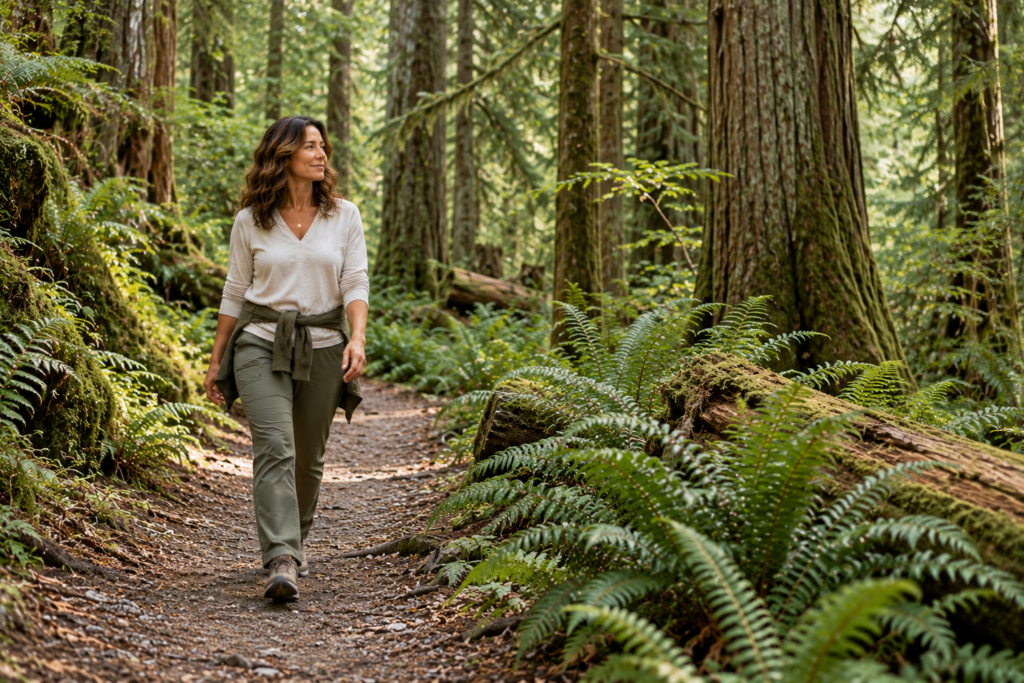
Maybe you have a loop through your neighborhood that you’ve walked a hundred times. You know the hill that makes you breathe a little harder, the corner where you usually settle into your stride, and roughly how long the whole thing takes without checking your watch every thirty seconds. Most days, it feels familiar.
Then one Tuesday, it doesn’t.
The hill feels steeper. Your legs feel heavier. You’re breathing harder at a pace that normally feels comfortable, and the woman who routinely power-walks past you with terrifying enthusiasm seems to be moving at approximately highway speed.
It would be easy to look at your slower pace and decide you’ve somehow lost fitness overnight. Or you could get curious.
Maybe you slept badly. Sleep loss has been studied extensively in exercise research, and systematic reviews have found that it can impair physical performance and, in many circumstances, increase how hard exercise feels. The exact effects vary depending on the type of sleep loss, the activity being performed, and the population being studied, but the broader point is useful: the same body can experience the same physical task differently under different recovery conditions.
Maybe it’s hot. Exercising in heat adds a thermoregulatory demand that simply isn’t there under cooler conditions. Your body has to move you and work harder to dissipate the heat you’re producing. Heart rate, sweating, thermal strain and perceived effort can all change as a result.
Maybe yesterday was leg day and your quadriceps have filed a formal complaint. Maybe you’ve been sick. Maybe the trail is muddy. Maybe you’re carrying a backpack today. Maybe you’ve accumulated several demanding days in a row and haven’t fully recovered from them yet.
And sometimes you won’t know. That’s important too.
Not every slower walk needs an explanation. Human bodies are not machines that produce an identical output every time we enter identical instructions. There is normal variation in how we feel and perform from one day to another, and pace is only one piece of information.
One weird walk is not a diagnosis.
But noticing that today’s familiar walk feels unusually difficult can still be useful feedback. Instead of Why am I so slow today?, try asking:
What’s different today?
That tiny change in the question takes us out of judgment and puts us right back into observation.
Your Baseline Is More Interesting Than Her Benchmark
Walking speed actually has a serious life outside the fitness world. Researchers and clinicians measure gait speed because it can provide useful information about physical function, mobility and health, particularly as people get older. Large studies have found relationships between walking speed and factors including age, mobility and physical function.
That does not mean I want you timing yourself to the mailbox every morning in case your gait speed has dropped by three-tenths of a second. Please don’t. 😂
Population-level research and individual day-to-day life are two different things. Researchers can look across thousands of people and find meaningful patterns without giving us a magic cutoff that determines whether your Tuesday morning walk was acceptable.
For everyday purposes, I think there’s something much more interesting available to us: you know what normal feels like for you.
Over time, you begin to recognize your comfortable pace. You know what moderate effort feels like. You know how your breathing usually responds to that hill. You know whether twenty minutes leaves you energized or completely spent. That gives you a reference point no chart on the internet can provide.
And if something changes significantly and stays changed, that deserves more attention than an isolated slow day. A persistent unexplained decline in what you can comfortably do—or symptoms such as chest pain, fainting, unusual dizziness or severe or unusual shortness of breath—belongs in a different category from I slept terribly and today’s hill was rude. That’s when we’re no longer talking about optimizing a walking workout; we’re talking about symptoms worth taking seriously.
But most of the time, we’re doing something far less dramatic. We’re learning our own patterns.
Your baseline doesn’t have to become another metric to obsess over. You don’t need a spreadsheet. You don’t need to establish a personal walking-performance department. You just need to notice.
Because once you know what your easy feels like, what your moderate feels like, and what your challenging feels like, you can make much better decisions about what to ask of your body next.
And that is where pace becomes something much more useful than a number.
It becomes feedback.
Find Your Pace
The next time you go for a walk, try something: for the first few minutes, don’t chase a number. Don’t deliberately speed up because your watch says you’re moving too slowly, and don’t try to recreate yesterday’s pace. Just walk until you settle into the speed your body naturally wants to choose.
Then notice what happens.
How does your breathing feel? Could you comfortably carry on a conversation? Does the pace feel easy, moderate, or genuinely challenging? What happens when the ground changes or the trail begins to climb? If you deliberately pick up the pace for a few minutes, what changes? When you slow back down, how quickly does the effort begin to settle?
You don’t need to record any of it unless you want to. We’re not collecting data for publication. We’re learning what your pace feels like from the inside.
Try it again on another day and you may notice something different. The pace that felt effortless yesterday might feel surprisingly demanding after a terrible night’s sleep. A speed that once made you breathe hard may eventually become comfortable as your fitness improves. A hill may become less intimidating. Or you may discover that the walk you enjoy most isn’t the fastest one at all.
Those aren’t verdicts. They’re feedback.
Over time, that feedback gives you something much more useful than somebody else’s recommended miles per hour: a growing understanding of how your body responds to different levels of demand.
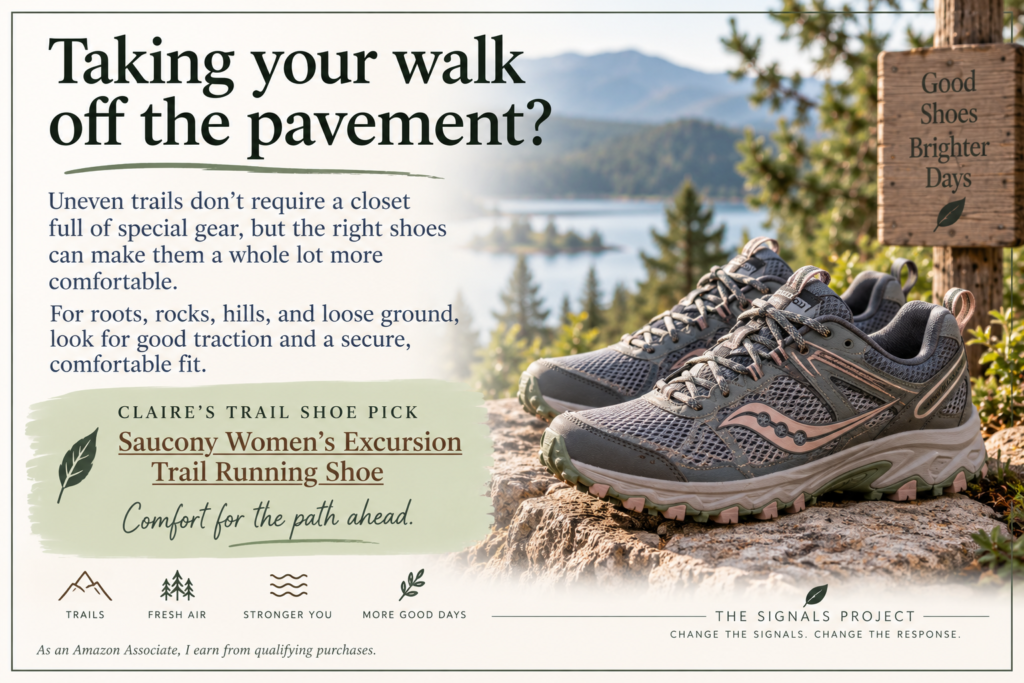
Affiliate link — I may earn a commission from qualifying purchases at no additional cost to you.
There Is No Pace to Prove
Somewhere along the way, walking acquired a performance review.
We started measuring miles, minutes, steps, heart rate, zones and pace. Those numbers can be genuinely useful. They can help us train intentionally, recognize progress and understand how our bodies respond to different demands.
But they can also make it remarkably easy to forget what the numbers were supposed to help us understand in the first place.
The body.
There is no universal walking pace that proves you’re fit enough, trying hard enough or doing this correctly. There is only the pace you’re walking, the conditions you’re walking through, the purpose of the walk and the response your body is giving you today.
Sometimes you’ll choose to push. You’ll walk faster, climb the hill, lengthen your stride or deliberately spend some time breathing hard. That challenge is a useful signal when challenge is what you’re trying to send.
Other days, you’ll wander.
You’ll notice the moss growing up the side of a tree. You’ll stop because the light coming through the branches is ridiculous. You’ll walk slowly enough to hear the creek before you can see it, or because your legs are tired, or because the person beside you is telling a story you don’t want to rush.
That walk doesn’t become less valuable because your watch found it unimpressive.
And perhaps that’s the part of finding your pace that matters most. You’re not searching for one perfect speed you’ll maintain forever. You’re learning how to choose a pace that fits the body, the day, the terrain and the reason you stepped outside in the first place.
Some days your pace will tell you you’re ready for more. Some days it will tell you to ease off. And sometimes it won’t need to tell you anything particularly profound at all.
You’ll simply be walking.
No pace to prove. No woman to outrun. Just a body moving through the world—and enough curiosity to notice what it tells you along the way.
Sources
Carlisle, A., & Kuo, A. D. (2023). Optimization of energy and time predicts dynamic speeds for human walking. eLife, 12, e81939.
Gast, K., Kram, R., & Riemer, R. (2019). Preferred walking speed on rough terrain: Is it all about energetics? Journal of Experimental Biology, 222(9), jeb185447.
Jones, L. M., Waters, D. L., & Legge, M. (2009). Walking speed at self-selected exercise pace is lower but energy cost higher in older versus younger women. Journal of Physical Activity and Health, 6(3), 327–332.
Reed, J. L., & Pipe, A. L. (2014). The talk test: A useful tool for prescribing and monitoring exercise intensity. Current Opinion in Cardiology, 29(5), 475–480.
Brawner, C. A., Keteyian, S. J., & Ehrman, J. K. (2022). An examination and critique of subjective methods to determine exercise intensity: The talk test, feeling scale, and rating of perceived exertion. Cardiology Clinics, 40(2), 207–217.
Craven, J., McCartney, D., Desbrow, B., et al. (2022). Effects of acute sleep loss on physical performance: A systematic and meta-analytical review. Sports Medicine, 52, 2669–2690.
Périard, J. D., Eijsvogels, T. M. H., & Daanen, H. A. M. (2021). Exercise under heat stress: Thermoregulation, hydration, performance implications, and mitigation strategies. Physiological Reviews, 101(4), 1873–1979.
Studenski, S., Perera, S., Patel, K., et al. (2011). Gait speed and survival in older adults. JAMA, 305(1), 50–58.