There is absolutely nothing wrong with a treadmill. There is nothing lesser about walking laps through the mall, lifting weights in your living room, pacing the hallway while you take a phone call, or getting your movement wherever you can fit it into your day. If that’s where movement fits, that’s where it fits. It counts.
But take that same walk outside and something interesting happens. The ground may change beneath your feet. The light changes. The temperature changes. Your eyes have somewhere farther away to look. There may be wind against your skin, birds somewhere overhead, traffic in the distance, or leaves moving above you.
And if you walk into the woods? Even the air gets interesting.
We’ll get to that, because this was one of those research rabbit holes I did not expect to love nearly as much as I did.
Movement Is Still Movement
Before we wander too far into the woods, let’s establish something important: you do not need a forest for movement to count. A twenty-minute treadmill walk is movement. A twenty-minute walk around your neighborhood is movement. So is walking through the grocery store, doing yard work, taking the stairs, carrying laundry, or pacing the sidelines while your kid is at practice.
Taking movement outside does not magically turn it into a better kind of movement. But movement never happens in isolation. The body receives information from the larger set of conditions in which that movement occurs. Change the environment, and you may change some of those conditions too.
That makes outside interesting—not because it is automatically better, but because more than one thing may change when you walk out the door.
Researchers Have a Name for This
You’ll sometimes see the term green exercise in research. It generally refers to physical activity performed in natural environments or green spaces, and researchers have compared it with exercise performed indoors or in built environments.
The findings aren’t as simple as outside good, inside bad. In fact, a systematic review and meta-analysis examining 38 studies and 1,168 participants found that when outdoor and indoor exercise were compared, many of the physiological differences weren’t particularly convincing.
But one finding kept getting my attention: people enjoyed moving outside more.
That may sound almost laughably simple compared with all the impressive physiological things we could measure. I don’t think it is. Because if you’re trying to make movement part of your actual life, eventually one question matters an awful lot: Do I hate doing this?
If the answer is yes every single time, consistency is going to be a much harder sell. We talk a lot about consistency around The Signals Project because patterns are built through repetition. A theoretically perfect workout that you dread every minute of may be harder to repeat than a simple walk you genuinely look forward to.
So if taking movement outside makes it more enjoyable for you, that isn’t some frivolous bonus. Enjoyment may be part of your strategy for learning to like movement enough to keep doing it.

Your Mind Experiences the Environment Too
This is where the research gets especially interesting. A 2026 systematic review and meta-analysis examining 51 studies found that green exercise was associated with better well-being and positive affect and lower negative affect compared with indoor exercise, exercise in built environments, and non-exercise conditions.
There is also research suggesting exposure to natural environments can influence certain aspects of attention. A systematic review of 42 studies found small-to-moderate improvements in working memory and cognitive flexibility after nature exposure, with less consistent evidence for attentional control.
None of this means we’re prescribing a walk in the woods as treatment for depression or anxiety. We’re not. What it gives us is something much more practical: the place where you move may change the experience of moving.
Think about the difference between staring at the elapsed-time display on a treadmill and following a trail. On the treadmill, you may know that you have been walking for precisely eleven minutes and forty-three seconds because the glowing number in front of your face has made absolutely certain you know it.
Outside, your attention has somewhere else to go: a turn in the path, a dog coming toward you, the smell of somebody’s fireplace, a bird you can’t identify, a ridiculous mushroom, or a tree that has apparently decided to grow sideways.
You are still walking. But walking may no longer be the only thing you’re experiencing. And sometimes that difference is enough to make twenty minutes feel less like something you’re completing and more like somewhere you’ve been.
The Ground Changes Too
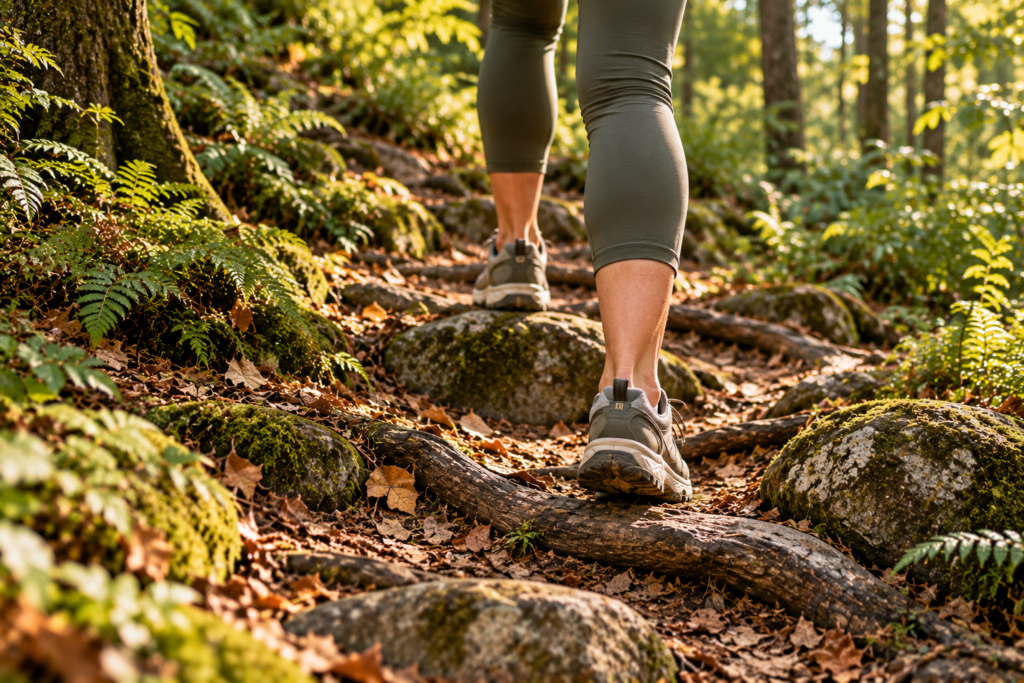
Take your walk onto a trail and something even more literal happens: the movement itself may change.
Researchers studying people walking at the same speed across different outdoor surfaces found that energy expenditure increased as participants moved from sidewalk to dirt, gravel, grass, and woodchips. In that small study, walking on woodchips required about 27 percent more energy than walking on sidewalk at the same speed.
Laboratory research on uneven terrain has found similar effects. When healthy adults walked over an uneven surface, muscle activity increased in several muscles of the legs and thighs, and net metabolic energy expenditure increased by about 28 percent compared with smooth terrain.
Same walking speed. Different ground. Different demand.
That’s fascinating—not because we now need to hunt down woodchips every time we go for a walk, but because it shows how quietly the environment can change what the body is being asked to do.
That doesn’t mean you need to go find the most treacherous trail in town and call it optimization. Please don’t. A trail, grassy field, sandy beach, hill, or uneven path can change the physical demands of walking simply because your body has to negotiate what’s underneath you.
And if smooth, level ground is safer or more appropriate for you, there is no prize for making your walk harder. The sidewalk still counts.
Light Comes Along for the Walk
There’s another part of going outside that is easy to overlook because we usually aren’t thinking of it as part of movement at all: light.
When you move outside during the day, you’re also spending time in the natural outdoor light environment. Light exposure is one of the environmental inputs involved in regulating the body’s circadian system—the biological timing system involved in the sleep-wake cycle and many other daily rhythms.
That doesn’t mean an outdoor walk is a sleep treatment. It simply means that one ordinary activity can expose the body to more than one environmental condition at once.
You went outside to walk. The daylight came with it.
And then there are the trees.
Because this is where things get wonderfully weird.
There Really Is Something in the Air
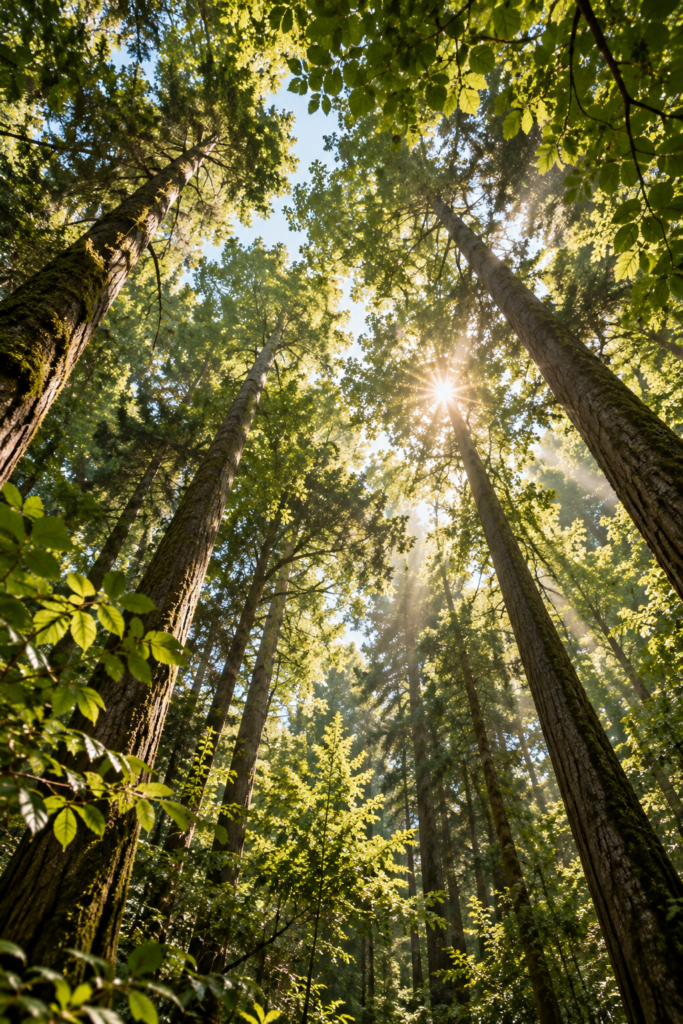
And then there are the trees. This is the part where I fell completely down the research rabbit hole. Because when people say there’s something about being in the woods, it turns out there is—in the most literal sense—actually something in the air.
If you’ve ever spent a few days camping or deep in the woods and thought, Why do I feel so different here? science cannot yet give you one neat answer. But it has found something fascinating. Trees and other plants release naturally occurring compounds into the atmosphere called biogenic volatile organic compounds, or BVOCs. Among the compounds researchers study in forest environments are alpha-pinene, beta-pinene, and limonene. You may also encounter the word phytoncides, a term commonly used in this area of forest-health research.
In other words, the trees are literally putting compounds into the air around you. And when you’re walking through a forest, you’re breathing that air. How freaking fascinating is that?
Researchers have been investigating whether inhalation of these compounds contributes to some of the psychological and physiological effects observed during forest exposure. Laboratory and human research has explored possible relationships involving mood, relaxation, cognition, inflammation, immune activity, and other outcomes.
Now, before we turn a pine tree into the next wellness miracle, there are some important limits to what we know. Researchers have not established that breathing these compounds is the reason people feel better in forests. And that may be partly because a forest is extraordinarily difficult to reduce to one ingredient. You’re not standing in a laboratory inhaling an isolated compound. You’re in a forest.
Maybe It’s the Whole Forest
Forest environments change many things at once. There is the light filtering through the canopy, the temperature and humidity, the sounds, the visual complexity, the ground beneath your feet, the absence—or reduction—of traffic and screens, the movement itself, and yes, the compounds released by plants.
Researchers studying forest exposure are trying to untangle all of those variables. Some reviews have reported associations between forest-based interventions and improvements in measures related to stress, mood, anxiety, depression, and quality of life. But the studies vary widely in design and quality, which makes it difficult to identify one mechanism responsible for those effects.
And maybe we don’t have to turn the forest into a pill before we’re allowed to appreciate it. We have a strange habit in modern wellness culture: we find something interesting in the natural world and immediately want to identify the active ingredient, isolate it, concentrate it, package it, and sell it back to ourselves.
Meanwhile, the forest is still standing there.
There is fascinating research happening on forest environments and the compounds trees release. Scientists should keep doing it. We can go take a walk while they figure it out.
The forest doesn’t need to be medicine to be valuable. It can simply be a place where movement feels good.
You Don’t Need a Forest
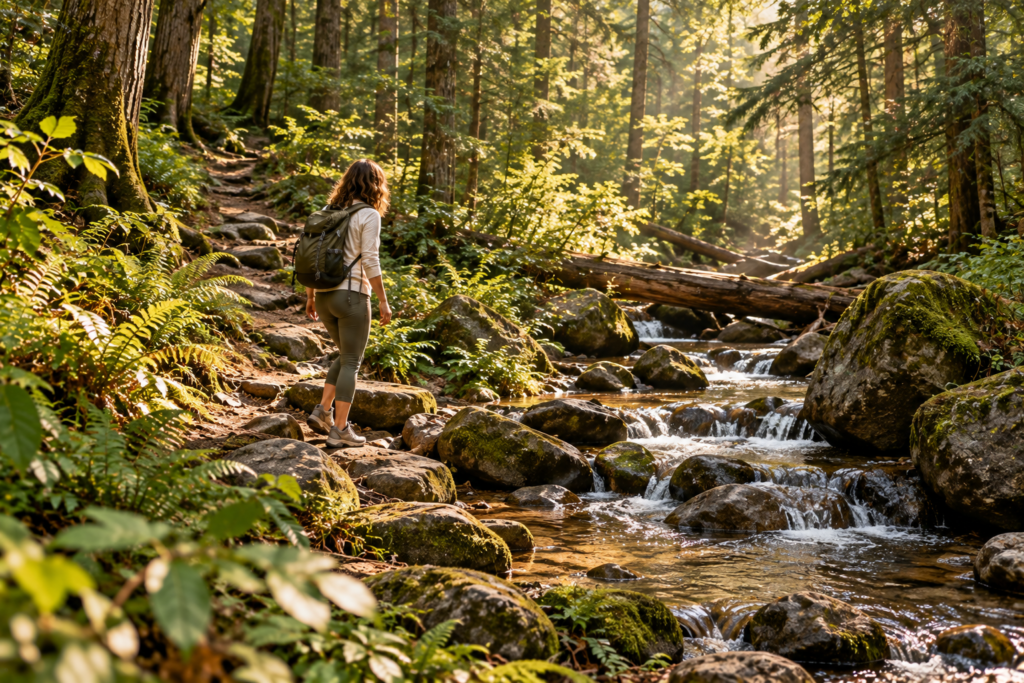
As fascinating as the forest research is, you do not need to disappear into the wilderness every afternoon. Parks, gardens, tree-lined neighborhoods, beaches, trails, greenways, and even a patch of grass can change the sensory environment around your movement.
The useful question isn’t: Where is the scientifically perfect place to exercise? It’s much simpler: Is there somewhere I enjoy moving more?
Maybe that’s a wooded trail. Maybe it’s the park near your house, the beach, your backyard, or the loop around your neighborhood where everybody seems to know the same golden retriever.
And maybe some days the answer is still your living room.
The goal isn’t to manufacture an ideal outdoor experience. It’s to notice whether changing the environment changes your experience of movement.

Not Every Outdoor Environment Is the Same
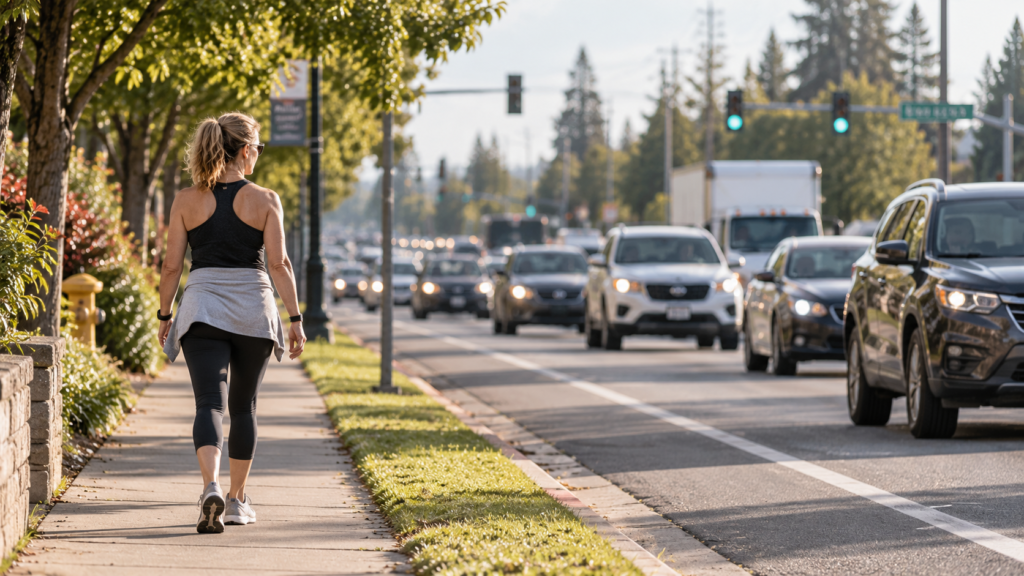
But before this turns into Claire Says Everyone Must Exercise Outside Now, let’s establish something: outside is not automatically better. A quiet wooded trail and the shoulder of a six-lane road at rush hour are both technically outside. They are most certainly not the same environment.
Exercise increases breathing rate and the amount of air moving through your lungs. Near heavy traffic, that can also mean greater exposure to traffic-related air pollution. Reviews examining physical activity and air pollution generally find that the benefits of exercise remain substantial, but they also support a very practical idea: when you have a choice, where and when you exercise can matter.
If your only available walk happens during rush hour beside heavy traffic, an indoor workout may make more sense that day. The same is true when wildfire smoke is hanging over your neighborhood, the heat is unsafe, sidewalks are icy, or—as I am being personally reminded today—the pollen has apparently declared war on your entire respiratory system.
This isn’t about making outdoor movement complicated. It’s about recognizing that environment is part of the signal too. We can be selective about the conditions in which we move.
Sometimes the better choice is the trail.
Sometimes it’s the treadmill.
Both count.
What If You Don’t Actually Hate Movement?
Maybe you’ve spent years saying, I hate walking. But what you’ve actually learned is, I hate walking on a treadmill while staring at a wall. Those aren’t necessarily the same thing.
Maybe walking through the woods feels completely different. Maybe you like having somewhere to go. Maybe you like hills, roots, rocks, changing scenery, or the tiny decisions your body has to make as the terrain changes beneath you. Maybe you like walking the dog, exploring a new trail, wandering through a park, or having enough going on around you that you forget you’re technically exercising.
Or perhaps you genuinely love your treadmill. You put on your show, nobody bothers you, the weather can’t ruin anything, and those thirty minutes belong to you. Then for heaven’s sake, keep the treadmill.
We’re not looking for the universally superior environment. We’re looking for the environment that helps you build a life with more movement in it.
Because if you enjoy the experience, you may be more willing to repeat it. And repetition is where a single walk begins becoming a pattern.
Try This: Change the Environment
Don’t add another workout this week. Take one thing you already planned to do and change where you do it. If you were going to walk for twenty minutes, take the walk outside. If you usually walk the same neighborhood route, try the park. If you have access to a wooded trail, take one of your walks there. And if outside isn’t a good option today, don’t force it. Save the experiment for another day.
Then pay attention to the experience—not to judge it, not because every sensation needs to go into a tracker, and not because we’re conducting a clinical trial on ourselves. We’re just curious.
Did you enjoy it? Did you think about the time as much? Did your attention wander differently? Did the terrain change your pace? Did you naturally walk longer—or shorter? Did you feel more interested in what was around you?
And perhaps the most important question: Would you choose to do it again?
Those observations are feedback. They give you information about the conditions in which movement may be easier—or harder—for you to repeat. And then you get to choose what signal you want to send next.
Sometimes, Just Go Outside
We don’t yet know exactly why a walk through the woods can feel so different from the same amount of time spent moving indoors. And perhaps expecting one explanation is asking the wrong question.
A natural environment isn’t one thing. It’s light and sound and air and terrain and temperature and distance and plants and movement and attention—and whatever happens when all of those things meet one human being on one particular day.
Science can keep pulling those pieces apart and studying them. It should. That’s how we learn. But while researchers investigate the mechanisms, the rest of us are allowed to experience the whole thing.
You don’t need to buy special equipment, start another program, or turn your walk into a performance. And you certainly don’t need to convince yourself that outside is always better. But if movement is something you already want to make part of your life, the world outside your door gives you another variable to explore.
Maybe you’ll like movement more when there’s somewhere to go. Maybe you’ll discover that you love trails. Maybe you’ll become the woman who takes her coffee around the block. Maybe you’ll garden. Maybe you’ll walk the dog farther. Maybe you’ll spend Saturday morning in the woods and come home unable to explain exactly why you feel so damn good.

Affiliate link — I may earn a commission from qualifying purchases at no additional cost to you.
You don’t have to explain it. You can notice it. You can remember it. And you can go back. If it makes you want to move again tomorrow, that’s worth knowing.
Sometimes you don’t need a different workout. Sometimes you can keep the movement simple and change the conditions around it.
Change the Signals. Change the Response.
Sources
Stevenson, M. P., Schilhab, T., & Bentsen, P. (2018). Attention Restoration Theory II: A systematic review to clarify attention processes affected by exposure to natural environments. Journal of Toxicology and Environmental Health, Part B, 21(4), 227–268.
Kowalsky, D. B., et al. (2021). Human walking in the real world: Interactions between terrain type, gait parameters, and energy expenditure. PLOS ONE.
Voloshina, A. S., Kuo, A. D., Daley, M. A., & Ferris, D. P. (2013). Biomechanics and energetics of walking on uneven terrain. Journal of Experimental Biology, 216, 3963–3970.
Lahart, I., et al. (2024). Acute effects of outdoor versus indoor exercise: A systematic review and meta-analysis.
Effects of green exercise on mental health: A systematic review and meta-analysis. (2026). Frontiers in Psychology.
Antonelli, M., Donelli, D., Barbieri, G., Valussi, M., Maggini, V., & Firenzuoli, F. (2020). Forest volatile organic compounds and their effects on human health: A state-of-the-art review. International Journal of Environmental Research and Public Health, 17(18), 6506.
Jiang, S., et al. (2026). Effects of physical activity in polluted air on physiological health in healthy populations: A systematic review and meta-analysis of controlled trials. Ecotoxicology and Environmental Safety, 315, 120098.
Dijk, D.-J., & Lockley, S. W. (2001). Sleep-Wake as a Biological Rhythm. Annual Review of Psychology, 52, 277–303.