
Response

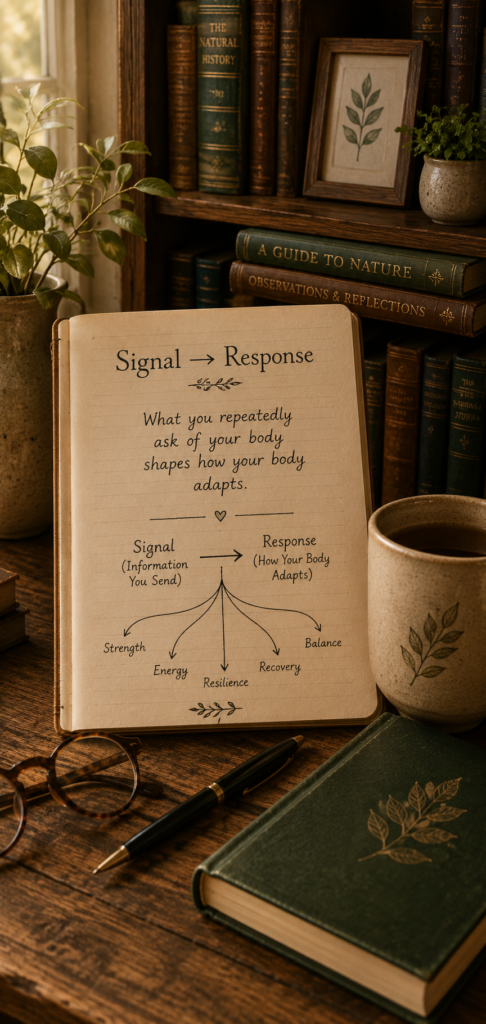
Listening is only the beginning. Once we begin noticing the signals our everyday choices create—and the ways our bodies respond to them—we have something we did not have before: information. Maybe several late nights are followed by fatigue. Maybe regular strength training is followed, over time, by greater strength. Maybe eating enough earlier in the day is followed by steadier energy. The first part of the conversation is what we send. The response is what the body does with it.
A response may be something we welcome: greater strength, steadier energy, feeling more rested, improved stamina, or feeling comfortably full after a meal. It may also be something we wish were different: persistent hunger, cravings, fatigue, restless sleep, declining strength, low energy, or changes in body composition. And sometimes the response is subtle enough that we only recognize it after seeing the same pattern repeatedly. None of these responses is a judgment. They are outcomes arising within a complicated body responding to many pieces of information at once.
This is why one response rarely tells us the whole story. One restless night does not prove that yesterday’s choices caused it. One nourishing meal does not determine how you will feel tomorrow. Bodies are influenced by countless factors, and not all of them are within our control. But patterns can give us useful information. When certain signals are repeated and certain responses tend to follow, we have something worth becoming curious about.
That curiosity gives us a place to participate in the conversation. We can ask: What signals have been present? What response am I seeing? Is there something within my influence that I would like to change? If there is, the choice we make next becomes another signal. Maybe we go to bed earlier. Maybe we eat enough at breakfast. Maybe we begin strength training, take a recovery day, spend some time outside, or make room to slow down. Then we observe again.
Signal. Response. Notice. Choose. Signal again. This is not about controlling the body or guaranteeing a particular outcome. It is about learning how your choices and your body’s responses relate over time. You do not need to understand every response perfectly. You only need enough curiosity to keep learning the language.
What Is a Response?
A response is what happens after a signal is received. When we eat, move, rest, train, recover, or experience stress, we create information that the body must work with. The body responds through countless processes designed to meet the demands of the environment we are creating. Some responses happen quickly. Others develop gradually as the same signals are repeated over time.
Strength training, for example, creates a demand on muscle tissue. With adequate recovery and nourishment, the body can respond to that repeated demand by adapting. Sleep creates conditions that support restoration and recovery. Food provides energy and raw materials the body can use. Stress creates its own demands, and the body responds by shifting resources to meet them.
None of these responses exists in isolation. The body is constantly receiving many signals at once and responding to the larger pattern they create. A response is not a reward for sending the “right” signals, and it is not a punishment for sending the “wrong” ones. It is the body responding to the information, resources, and demands it has received.
That distinction gives us a different way to think about change. Instead of asking, Why won’t my body cooperate? we can begin asking, What signals has my body been receiving, and what might this response help me understand? We will not always know the answer, and not every response can be traced neatly to one behavior or choice. But we can become curious about patterns.
When there is something within our influence, we can choose to change a signal, give the body time to respond, and observe what happens next. Signal. Response. Observation. Then, if we choose, a new signal—and the conversation continues.
Notice First. Then Choose.
Once you begin recognizing your body’s responses, it can be tempting to immediately decide what you should change. Tired? Go to bed earlier. Hungry? Eat more. Low energy? Move more—or maybe move less. But a response does not always tell us exactly which signal created it, and bodies are rarely that simple.
Fatigue might follow a short night, several demanding days, too little food, a change in routine, or many things working together. Hunger may change with meal timing, nourishment, activity, sleep, stress, or countless other factors. Soreness may follow a new strength workout. Restless sleep may appear during an unusually stressful week. The response gives you information, but it does not necessarily give you an instruction.
That is where curiosity becomes useful. Instead of immediately asking, What am I supposed to do? begin with, What might have contributed to this? Look backward before deciding what to send forward. What signals were present? What have you been eating? How have you been sleeping? Have you been moving? Training? Recovering? Has life been unusually demanding? Is this response new, or is it part of a pattern?
Sometimes you may see something you want to experiment with. You might eat enough earlier in the day, protect more time for sleep, add a walk, begin strength training, or create more room for recovery. Each of those choices becomes a new signal. Then you give your body time to respond and notice what happens.
You will not always find a neat explanation, and changing a signal will not guarantee a particular response. That is okay. The goal is not to solve your body like a puzzle. It is to become more thoughtful about the conversation.
Notice the response. Look back at the signals. Choose what you want to send next.

Responses Take Time
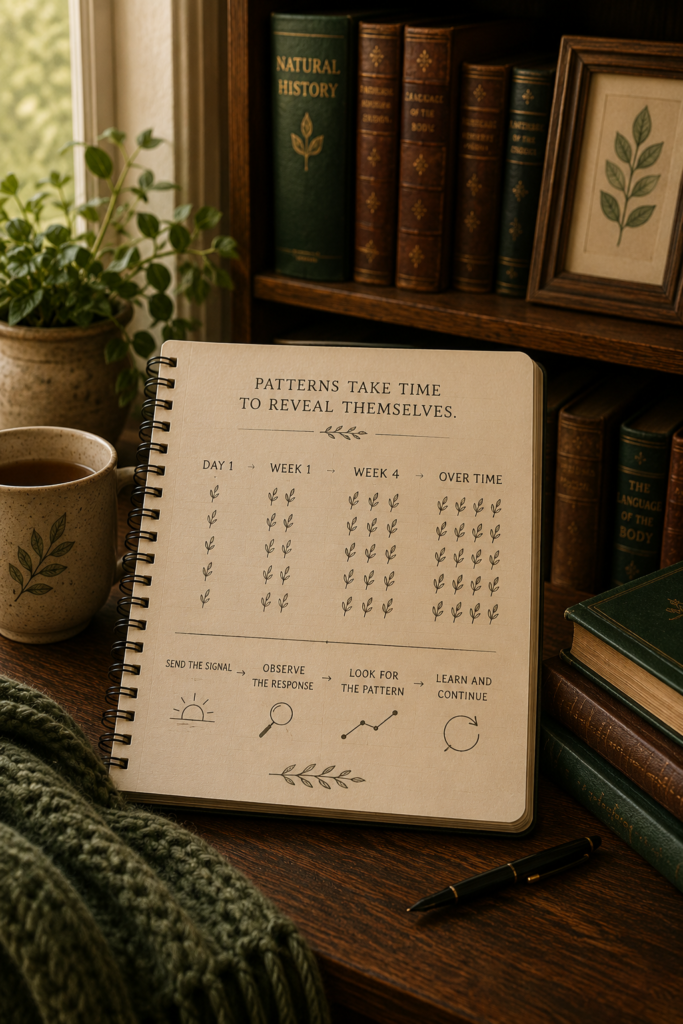
Some responses are easy to notice. Others unfold so gradually that we may not recognize them until we look back. A meal can affect fullness within hours. A late night may be followed by fatigue the next day. But other responses—changes in strength, stamina, sleep patterns, energy, or body composition—may emerge only after signals have been repeated for days, weeks, or longer.
That matters because it is easy to expect one choice to produce one immediate outcome. We strength train once and look for evidence that it worked. We eat differently for a day and wonder why we do not feel different yet. We go to bed early one night and expect to wake completely restored. But the body is responding to far more than a single moment. It is continually working with the larger pattern of information it receives.
This is also why consistency can be so powerful. Repeated signals give the body repeated information. Strength training creates recurring demand. Regular nourishment provides recurring resources. A consistent sleep routine repeatedly creates conditions that support sleep and recovery. Everyday movement becomes part of the environment the body experiences again and again.
And still, the response will not always be immediate, predictable, or exactly what we hoped to see. Bodies are complex. Life changes. Many factors influence an outcome, including things we cannot control. Consistency is not a guarantee. It simply gives a signal the opportunity to become a pattern.
Sometimes the most useful thing we can do is give the body time. Send the signal. Observe the response. Look for the pattern rather than demanding proof from a single day.
Your body is responding to a conversation that unfolds over time.
Responses You Might Notice
Your body is responding all day long. Some responses are obvious. Others become so familiar that you may simply think, This is just how my body is now. Noticing them gives you something worth becoming curious about.
Hunger & Fullness
Feeling hungry soon after eating. Staying full for several hours. Changes in appetite or cravings.
Energy
Steady energy—or an afternoon crash. Waking energized or struggling to get going. Changes in how capable you feel during ordinary parts of your day.
Strength & Movement
Growing stronger. Everyday tasks feeling easier or harder. Changes in soreness, recovery, stamina, balance, or mobility.
Sleep
Falling asleep easily or struggling to settle down. Waking during the night. Waking rested—or waking tired despite enough time in bed.
Stress & Recovery
A racing heart. Tight muscles. Shallow breathing. Restlessness or irritability. Or the opposite: breathing slowing, tension easing, and your body beginning to settle.
Body Composition & Metabolism
Changes in weight, measurements, muscle mass, fat storage, or how your clothing fits.
None of these responses tells you exactly what caused it. A response is not proof of a particular signal. It is a reason to become curious. What signals preceded it? What has been repeated? What changed?
Notice the response. Then look for the signals that may have preceded it.

The Conversation Continues
Your body is responding all the time. Not judging you. Not grading your choices. Not deciding whether you have been “good” or “bad.” It is simply responding to the information and demands it receives.
Once you understand that, a response can become something other than a source of frustration. It can become something worth noticing.
Maybe your energy changes. Your hunger changes. Your sleep changes. You become stronger. Recovery becomes easier—or harder. Your body composition shifts. You feel calmer, more capable, or more rested. None of those responses tells the whole story by itself. But each can give you a reason to look back at the signals that came before it.
And that is where this becomes useful.
You can notice a response without judging it. You can look backward without blaming yourself. You can change a signal and give your body time to respond. Then you can observe what happens next.
There will not always be a neat answer. Bodies are complex, and life is messy. But you do not need perfect certainty to begin learning your own patterns.
Send a signal. Notice the response. Stay curious about the connection.