Walking Isn’t a Race
Somewhere along the way, even walking became something we were supposed to measure. Steps, miles, minutes, speed. How far did you go? How fast did you get there? Did you get your heart rate high enough for it to count?
But not every walk needs to be a workout, and not every workout needs to leave you breathless.
Sometimes the best place to begin is simply finding a pace that feels comfortable enough to enjoy and easy enough to return to tomorrow.
That doesn’t necessarily mean walking slowly. It means walking at a speed that works for you, on this particular day, with the body and energy you brought along.
What Does a Comfortable Pace Actually Feel Like?
One of the simplest ways to recognize a comfortable walking pace is to pay attention to your breathing.
If you can carry on a conversation without needing to stop every few words to catch your breath, you’re probably walking at an effort you can comfortably sustain.
This is sometimes called the talk test, and it’s a useful way to gauge effort without checking a watch or tracking your heart rate.
Your breathing might be a little quicker than when you’re sitting on the couch. Your legs might feel like they’re doing something. That’s perfectly fine.
But you shouldn’t feel as though you’re racing to keep up with an imaginary finish line.
And here’s something worth remembering: comfortable doesn’t mean effortless. A walk can feel pleasant and still be doing your body some good.
Your Pace Won’t Be the Same Every Day
Maybe yesterday you walked around the lake without giving your pace a second thought. Today, the little hill on the way home feels surprisingly steep.
Nothing has gone wrong.
Your walking effort can change depending on how well you slept, the weather, the terrain, your energy, and a dozen other ordinary things.
A pace that feels easy on flat pavement might feel quite different on an incline. A speed that feels wonderful on a cool morning might feel exhausting in the afternoon heat.
That’s why it can be more helpful to pay attention to how walking feels than to insist on maintaining the same speed every time.
You don’t have to earn a slower day. You can simply have one.
Try This on Your Next Walk
The next time you head outside, give yourself a few minutes to settle into your natural stride.
Don’t worry about speed. Just walk.
After a little while, notice your breathing. Could you comfortably tell someone about your morning? Are your shoulders relaxed? Does your pace feel sustainable, or are you already thinking about how much farther you have to go?
If you’re working harder than you’d like, ease up a little. If you’re feeling energetic and want to walk faster, that’s fine too.
Then spend a few minutes enjoying that rhythm.
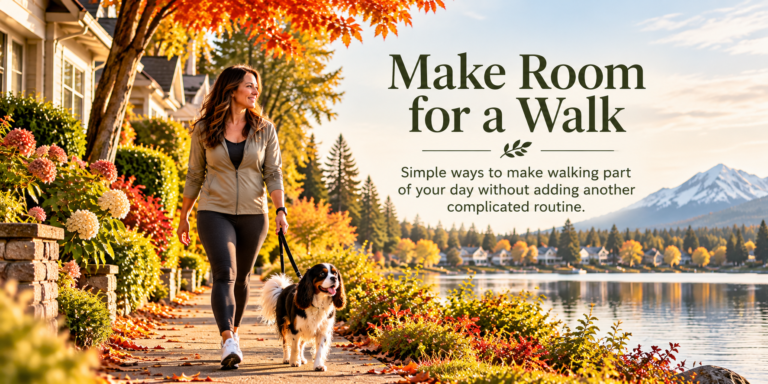
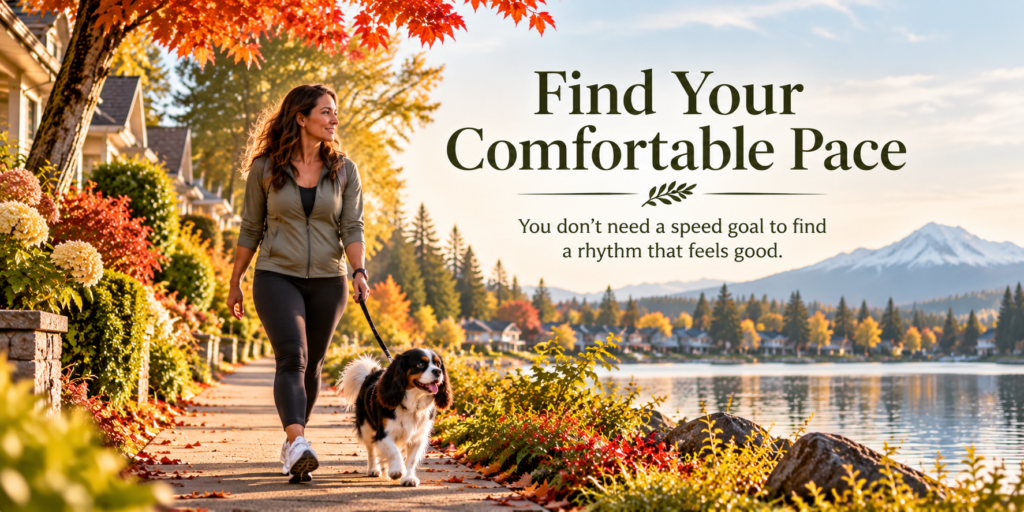
You can always slow down to look at someone’s garden, let the dog investigate an interesting patch of grass, or stop beside the water for a moment.
Those things aren’t interruptions to your walk. They’re part of it.
A Pace Worth Returning To
There’s something reassuring about discovering that you don’t need to keep up with anyone else’s idea of a good walk.
Some days you’ll move quickly. Other days you’ll wander. And occasionally, a five-minute loop around the block will be exactly what fits.
The goal isn’t to find one perfect walking speed and hold on to it forever.
It’s to get comfortable recognizing the pace that works for you, so heading outside feels like an invitation rather than another obligation.
Start where you are. Find your rhythm. And enjoy the walk.
Part of the Easy & Steady collection in The Signals Project Nature Preserve. Explore more everyday walking ideas and find a way to make walking fit your life.