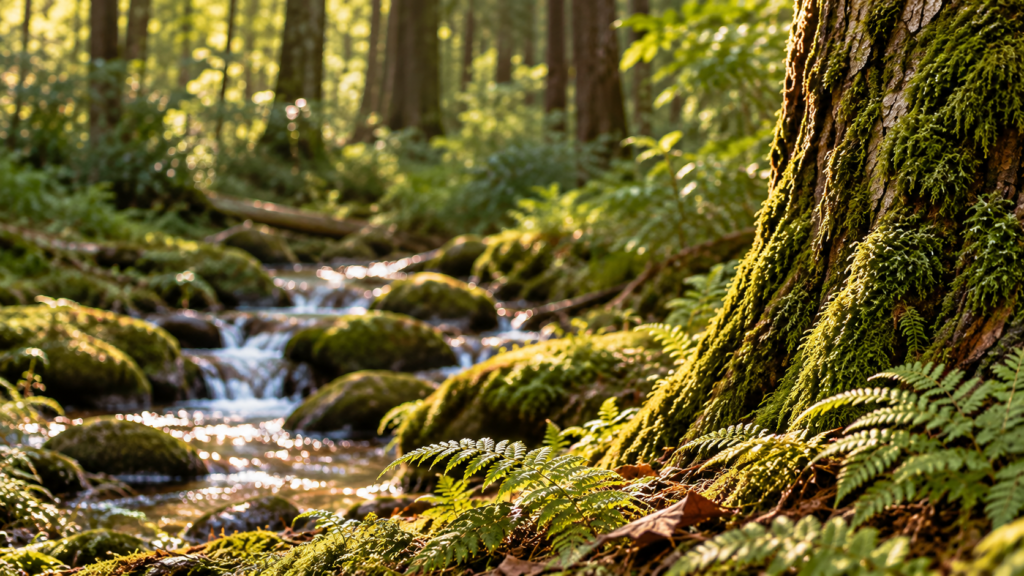
At some point, most of us heard some version of the same wilderness advice: if you ever get lost in the woods, look for moss. Moss grows on the north side of trees, so it can tell you which direction you’re facing.
It’s the sort of fact that sticks around because it sounds wonderfully useful. No compass? No problem. Apparently the forest has been labeling north for us all along.
Except, of course, you’ve probably also walked past trees covered in moss on two sides, three sides, or nearly all the way around. Look closely enough in a damp forest and you may find moss growing on rocks, fallen logs, stumps, soil, walls, and just about anywhere else that seems willing to stay wet long enough.
So which observation should we believe?
As is so often the case in nature, the interesting answer is somewhere between “yes” and “not exactly.”
The Old Saying Didn’t Come From Nowhere
There really can be more moss on the north-facing side of trees in parts of the Northern Hemisphere. The important word there is can.
Mosses are bryophytes, a group of small non-vascular plants. Unlike vascular plants, they don’t have the same internal plumbing system for moving water over long distances. Their relationship with the moisture immediately around them is therefore particularly important, and many mosses flourish in damp environments.
Now think about a tree standing somewhere in the mid-latitudes of the Northern Hemisphere. Over the course of the day and year, its south-facing side generally receives more direct sunlight than its north-facing side. The more shaded side can remain cooler and lose moisture more slowly.
For some mosses, that’s a very nice place to live.
Researchers have found that aspect—the direction a surface or slope faces—can influence bryophyte growth and communities. Experiments in boreal forests, for example, have found different responses between north- and south-facing forest edges because their microclimates differ. But research on actual tree trunks also demonstrates why we shouldn’t turn that tendency into a universal rule: different mosses and liverworts can show different patterns, and some have even been found more abundantly on south- or west-facing surfaces in particular forests.
So our old bit of woodland wisdom contains an observation worth keeping.
It just needs a rather large asterisk.
Moss Isn’t Looking for North
Here’s the better way to think about it: moss isn’t looking for a compass direction. It’s responding to conditions.
Imagine two sides of the same tree. The north side gets relatively little direct sunlight, but it’s exposed to wind and sits beside an open clearing. The west side is shaded by a huge neighboring tree, sits near a creek, and stays damp long after a rainstorm.
Which one sounds more hospitable?
Suddenly, “north” isn’t nearly as important as the little environment surrounding that patch of bark.
Ecologists call a small set of local atmospheric conditions a microclimate. One part of a forest can be cooler, wetter, darker or less windy than another part only a short distance away. A tree trunk has its own tiny variations too. Nearby vegetation can cast shade. Terrain can block sunlight. Bark can hold moisture differently. Forest density, exposure, rainfall and nearby water can all influence what happens in one particular spot.
That’s why moss can grow on the north side of a tree, the south side, both sides or all the way around it. In a sufficiently shaded, moist forest, the entire trunk may provide suitable habitat.
And if you cross into the Southern Hemisphere, even the familiar directional tendency changes. There, south-facing surfaces generally receive less direct sunlight, so the classic Northern Hemisphere rule doesn’t simply travel with you.
So, Can You Navigate by Moss?
Not reliably.
If you’re standing in an appropriate Northern Hemisphere environment and notice that many exposed trees consistently have substantially heavier moss growth on the same side, that pattern may tell you something about sun exposure and direction.
But one mossy tree is not a compass.
There are simply too many other variables affecting where moss can thrive. Even sources that describe the north-facing tendency caution against treating moss as a dependable navigation tool.
And that might be the most interesting part of this old claim.
Someone, somewhere, was paying attention.
They noticed that moss often seemed thicker on a particular side of the trees. They connected that observation with direction. The pattern was real enough to become knowledge passed from one person to another.
The mistake came later, when a pattern became a rule.
Look at the Tree Again
The next time you find a moss-covered tree, don’t worry about immediately deciding whether the old saying is right or wrong.
Get curious.
Walk around the tree.
Notice where the moss is thickest. Look upward and see where the sunlight reaches. Look at the trees around it. Notice whether the ground is damp, whether there’s water nearby, whether one side opens toward the sky while another disappears beneath the canopy.
You might find more moss on the north side.
You might not.
Either way, you’ve discovered something much more useful than a piece of trivia. You’ve started looking at the forest not as a collection of isolated things, but as a place where light, water, terrain, weather and living organisms are constantly interacting.
And once you start noticing those relationships, even an ordinary mossy tree becomes a little more interesting.
THE CLAIM: Moss grows on the north side of trees.
THE CHECK: There’s a real pattern behind the saying, particularly in some Northern Hemisphere environments—but moss can grow on any side of a tree where the conditions are right.
THE TAKEAWAY: Don’t use moss as your compass. Use it as an invitation to look closer.
Sources
Woodland Trust — “What Side of the Tree Does Moss Grow On?”
A clear overview of why moss is often associated with the north side of trees in the Northern Hemisphere, the importance of moisture and shade, and why moss should not be relied upon as a compass.
Read the Woodland Trust article
Hylander, K. — “Aspect Modifies the Magnitude of Edge Effects on Bryophyte Growth in Boreal Forests.” Journal of Applied Ecology (2005).
A field experiment showing that north- and south-facing forest edges create different microclimatic effects on moss growth, supporting the role of exposure and local conditions rather than a simple compass rule.
Read the research paper
Thomas et al. — Study of epiphytic bryophyte distribution on tree trunks in an old-growth forest.
Especially useful for the myth check: moss and liverwort species showed different relationships with trunk direction, and total moss cover in the study was actually greater on southern than northern aspects. In other words, species and local habitat matter.
Read the study PDF
Åström et al. — “Slope Aspect Modifies Community Responses to Clear-Cutting in Boreal Forests.” Ecology (2007).
Research showing that north- and south-facing slopes can support different bryophyte communities and respond differently to environmental change—another demonstration that aspect affects habitat without creating a universal “moss equals north” rule.
View the study on PubMed