
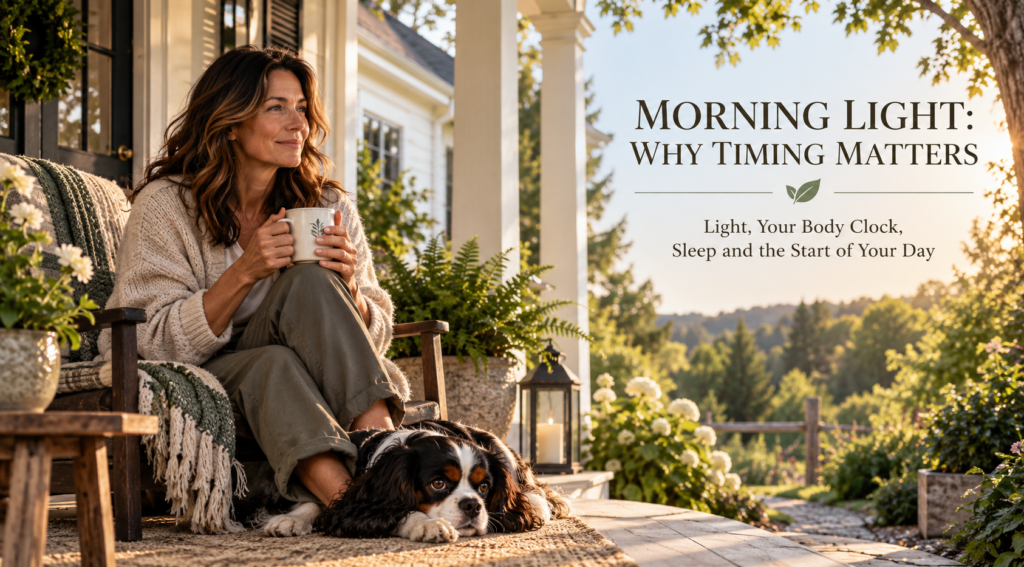
There is something different about morning light.
Not necessarily something dramatic. You may not feel your body respond the moment you step outside. There is no switch you can sense flipping somewhere behind your eyes. But light is one of the most important pieces of information your body receives about where it is in the day.
Long before alarm clocks, calendars, electric lights and glowing screens, the rising and setting of the sun provided a remarkably reliable pattern. Morning became brighter. Evening became darker. And the human body developed internal timing systems that use those changing patterns of light and darkness as information.
We still have those systems.
Our environment, however, has changed considerably.
We can wake in a dark bedroom, walk into a dim hallway, spend the morning beneath indoor lighting and stare into illuminated screens before ever encountering much natural daylight. At night, we can do essentially the opposite—surrounding ourselves with light long after the sun has disappeared.
That does not mean modern life has somehow ruined us. It means the timing of light reaching our eyes can be different from the environmental pattern our biology evolved alongside.
And that makes morning light worth understanding.
Your Body Keeps Time
Your body does not wait for you to look at a clock to know approximately what time it is.
Throughout the body, biological processes follow daily rhythms. Sleep and wakefulness, body temperature, hormone release, digestion, alertness and many other functions change across roughly 24-hour cycles.
These are known as circadian rhythms.
At the center of this timing system is a small region of the brain called the suprachiasmatic nucleus, or SCN. It acts as a central coordinator, helping synchronize rhythms throughout the body.
But an internal clock needs information from the outside world if it is going to remain aligned with the actual day.
One of its most powerful sources of that information is light.
Specialized light-sensitive cells in the retina detect environmental light and communicate with areas of the brain involved in circadian timing. That means light reaching your eyes does more than help you see the trail, find your coffee or avoid stepping on whatever the dog left in the hallway.
It also carries timing information.
Morning light essentially helps tell your circadian system:
The day has begun.
Morning Light Is a Signal
This is where morning light fits beautifully into the larger idea behind The Signals Project.
Light is an environmental input.
Your body receives it.
And your body responds.
That response is not based on whether the light is “healthy” or whether you remembered to perform a perfect morning routine. Your circadian system is simply gathering information about the environment and adjusting accordingly.
Light encountered earlier in the day can help anchor the body’s internal timing to daytime. Light encountered late at night can provide very different timing information.
This is why conversations about light are incomplete when they focus only on brightness.
Timing matters too.
The same biological system is receiving different information depending on when that light arrives.
Why Outside Is Different From Inside
You do not have to stare at the sun—and absolutely should not—to give your circadian system information about daylight.
Simply being outside exposes your eyes to ambient light from the sky and surrounding environment.
And outdoor daylight is generally much brighter than ordinary indoor lighting, even when the weather does not look particularly impressive.
A cloudy morning still has a sky.
A gray morning is still daytime.
You do not need a spectacular sunrise pouring over a mountain ridge for daylight to count.
That distinction matters because “get morning sunlight” can accidentally sound like advice available only to someone with beautiful weather, a porch facing east and a leisurely morning schedule.
What we’re really talking about is morning daylight exposure.
Sometimes that might be a sunrise walk.
Sometimes it is drinking coffee on the porch.
Sometimes it is walking the dog around the block.
And sometimes it is standing outside for a few minutes before getting into the car.
The biology does not require an Instagram-worthy morning.
Morning Begins a Clock That Matters at Night
One of the most interesting things about morning light is that its relevance does not end in the morning.
Your circadian system helps organize the timing of processes that unfold across the entire day and into the night.
Melatonin is part of that story.
Melatonin is often casually described as the “sleep hormone,” but that shorthand can make its role sound simpler than it is. Melatonin is strongly involved in signaling biological night. Under typical conditions, levels remain low during daylight and rise in the evening as the body moves toward its nighttime phase.
Light exposure influences that timing.
This is one reason researchers studying circadian biology care not only about how much light people receive, but when they receive it.
Morning and daytime light help establish daytime signals. Darkness—and reduced light exposure in the evening—helps establish nighttime signals.
Sleep, in other words, is not something the body begins preparing for only when your head hits the pillow.
The signals have been arriving all day.
And Then There Is Evening Light
Morning light is only one half of the environmental pattern.
The other half is darkness.
For most of human history, evenings became dramatically darker than daytime. Modern environments allow us to extend bright light far into biological night.
Electric lighting is enormously useful. Nobody needs to start reading by candlelight at 5:00 p.m. in December in the name of circadian purity.
But evening and nighttime light can influence circadian timing and suppress melatonin, particularly when light is sufficiently bright or biologically effective.
Screens are part of that environment, but they are not the entire story.
The brightness of the light, its spectrum, how long you’re exposed to it, how close it is to your eyes and the timing of exposure all matter. That is why reducing this conversation to “blue light is bad” misses quite a bit.
Your body is responding to a light environment, not judging individual devices.
Does Morning Light Improve Sleep?
This is where we need to resist turning an interesting area of physiology into another internet promise.
There are good biological reasons to expect appropriately timed light exposure to influence circadian timing, and light is used clinically in the treatment of certain circadian rhythm and sleep-wake disorders.
Research also connects patterns of daytime and evening light exposure with sleep timing, alertness and other outcomes.
But that does not mean five minutes outside tomorrow morning will cure insomnia.
Sleep is influenced by many things: circadian timing, sleep pressure, stress, medical conditions, medications, environment, behavior, age and individual differences among them.
Morning light is not a magic sleep treatment.
It is one piece of information in a much larger system.
And that may actually make it more interesting—not less.
Because instead of asking whether morning light is a “hack,” we can ask a better question:
What information is my environment giving my body about when day and night occur?
How Much Morning Light Do You Need?
This is where simple internet advice tends to become suspiciously precise.
You may have seen recommendations telling everyone to get exactly 5, 10, 20 or 30 minutes of morning sunlight.
Biology is not quite that tidy.
The amount of light reaching your eyes varies enormously depending on cloud cover, season, latitude, time of day, surroundings and whether you are outside or behind glass. Individual sensitivity and previous light exposure can matter as well.
So there is no universally correct number of minutes that applies to every person in every place on every morning.
The more useful principle is simpler:
Give your body a clear daytime signal reasonably early in your day when you can.
That may mean spending a little time outside after waking rather than remaining in a dim indoor environment for the entire morning.
You don’t need a stopwatch.
What About Looking Through a Window?
Daylight through a window is still light.
But being outside usually provides a much stronger environmental light exposure than sitting inside, because windows, building orientation, distance from the glass and indoor surroundings can substantially reduce the amount of light reaching your eyes.
That does not make window light worthless.
If getting outside is difficult because of mobility, weather, caregiving, work, safety or any other reason, sitting near a bright window may be a perfectly reasonable way to increase daytime light exposure compared with remaining in a darker interior space.
We do not need to turn a useful biological principle into another all-or-nothing rule.
What If Getting Outside in the Morning Isn’t Practical?
Sometimes morning daylight simply isn’t readily available.
You may wake before sunrise. Winter mornings may be dark. Mobility, health, caregiving, work schedules, weather, safety or where you live can make stepping outside first thing unrealistic. And at some latitudes during parts of the year, there may simply not be much daylight available when your morning begins.
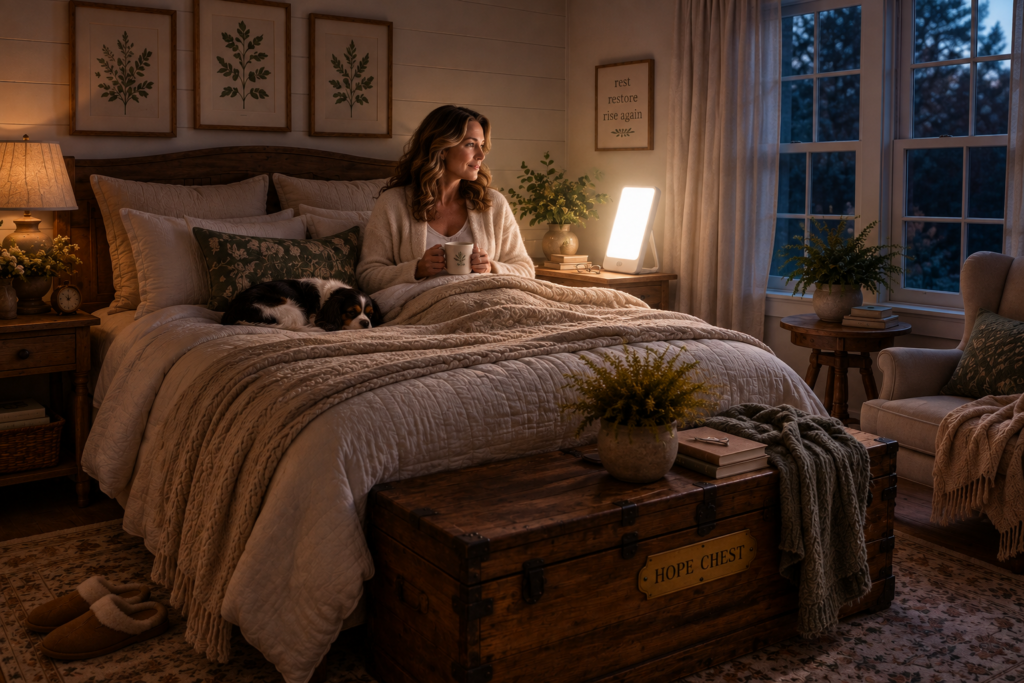
This is where bright light therapy lamps, sometimes called light boxes, can be useful.
These devices are designed to provide bright visible light indoors. Bright light therapy has been studied for circadian rhythm and sleep-wake disorders and is also an established treatment for seasonal affective disorder. Timing matters, though: bright light can shift circadian timing differently depending on when it is used, so more light at any random hour is not necessarily better.
A related option is a dawn-simulation alarm clock. Rather than suddenly filling the room with light when the alarm sounds, these devices gradually increase brightness before or around waking, mimicking part of the transition from night to morning. Many also pair the increasing light with gentler alarm sounds, such as birds or other nature sounds, rather than beginning the day with a blaring alarm.
Neither device perfectly recreates being outdoors, and neither is something everyone needs. But they can be practical tools when morning daylight is difficult to access.
Bright light therapy is also biologically active—that is, after all, the reason it can influence circadian timing. If you’re considering a bright light box specifically for therapeutic use, particularly if you have an eye condition, take medications that increase light sensitivity, or have bipolar disorder, it’s worth discussing its use with an appropriate healthcare professional.
The point isn’t that everyone needs to buy something to get morning light “right.”
It’s that lack of easy access to morning daylight doesn’t have to end the conversation.
Morning Light Doesn’t Have to Become Another Thing You’re Failing At
This matters.
The wellness world has an impressive ability to discover something useful and immediately turn it into a compulsory ritual.
Wake before sunrise.
Go outside within a certain number of minutes.
Stay there for precisely the correct amount of time.
Do it without glasses.
Don’t look through windows.
Face a particular direction.
Combine it with exercise, hydration, journaling and whatever else happens to be trending that week.
Suddenly, daylight has become homework.
It doesn’t need to be.
The useful idea underneath all of that is wonderfully ordinary:
Your body uses light to understand time.
So perhaps you open the curtains when you wake up.
Maybe you take your coffee outside.
Maybe the first few minutes of the dog’s walk become part of your morning rather than another task on your list.
Maybe you use a bright light on mornings when outside simply isn’t an option.
Maybe you step outside before the day gets away from you and notice that the world has already changed from night to morning.
None of those things needs to be optimized to be worthwhile.
The Bigger Picture
Morning light is interesting partly because it reminds us how much information the body receives from things we rarely think of as information.
Light.
Darkness.
Food.
Movement.
Temperature.
Stress.
Rest.
Timing.
Repetition.
The body is continuously responding to the conditions around it.
And sometimes understanding those conditions gives us a more useful place to begin than trying to force a particular outcome.
You do not need to chase the sunrise.
You do not need a perfect morning routine.
And you certainly do not need to turn one more ordinary part of being human into a test you can pass or fail.
But tomorrow morning, you might open the door.
Step outside.
Look around.
The day has begun.
Your body notices.
Sources
National Heart, Lung, and Blood Institute — Circadian Health and Light
Excellent foundation for the article. It covers light/dark exposure as the major environmental signal synchronizing the master circadian clock in the suprachiasmatic nuclei and the broader relationship between light, circadian rhythms and physiology.
Read the NHLBI workshop report
Blume, Garbazza & Spitschan — Non-visual effects of light
This is particularly useful for our explanation that light reaching the retina does more than enable vision: it affects biological timing and alertness. It also supports why intensity, spectrum and timing all matter rather than simply declaring “blue light bad.”
Read the review
Journal of Pineal Research — Morning Light and Human Melatonin Rhythms
A newer 2026 review specifically examining how morning light can shift circadian timing and melatonin rhythms. Importantly for the tone of Learn, the authors also identify areas that remain incompletely characterized rather than making morning light sound magical.
Read the review
National Institute of Mental Health — Seasonal Affective Disorder
This is our strongest practical source for the light-box section. NIMH describes light therapy as a mainstay of winter-pattern SAD treatment and discusses morning use of a 10,000-lux UV-filtering light box, while also noting precautions for people with certain eye diseases or medications that increase light sensitivity.
NIMH: Seasonal Affective Disorder
American Academy of Sleep Medicine — Circadian Rhythm Sleep-Wake Disorders
Useful support for the article’s distinction between generic “get some sun” advice and timed light/dark exposure as an actual circadian intervention. AASM’s current guideline work explicitly includes timed light/dark exposure among interventions for circadian rhythm sleep-wake disorders.
AASM circadian-rhythm guideline information
Avery et al. — Dawn Simulation and Bright Light in Seasonal Affective Disorder
This is the one I’d use specifically for our dawn-alarm discussion. It’s a randomized controlled trial comparing dawn simulation, bright-light therapy and a dim-light control. Dawn simulation isn’t just a cute alarm-clock concept; it has actually been studied as a light intervention.
Read the PubMed record