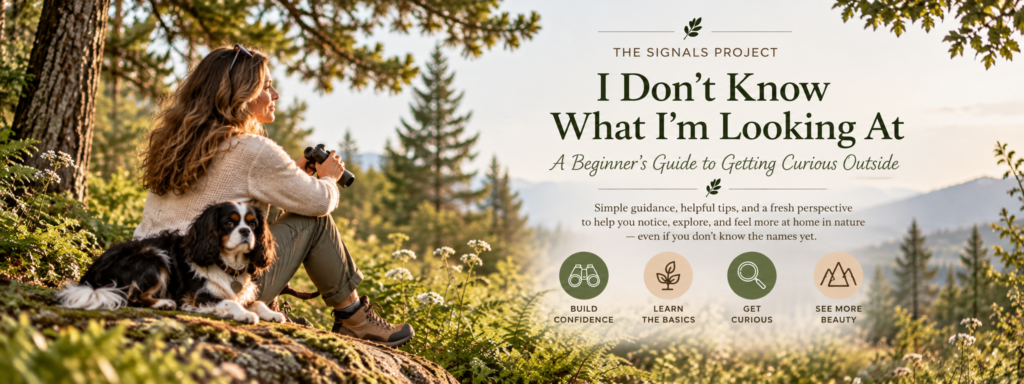
There is a particular kind of uncertainty that can show up when you begin spending more time outside. You’re standing somewhere beautiful, surrounded by trees and plants and birds and all sorts of things that seem interesting, and you realize you have absolutely no idea what most of them are.
Maybe you recognize an oak tree. Probably a dandelion. You know a squirrel when one runs across the path. Beyond that, things can get a little fuzzy. Is that a cedar? A fir? Some kind of pine? What made those tracks in the mud? What is that enormous bird circling overhead? And how does everyone else seem to know?
It can make nature feel like a place where everyone else received an instruction manual you somehow missed. They know the birds. They recognize the trees. They can point at something growing beside the trail and casually give you its name while you’re standing there thinking, I was just going to say pretty purple flower.
Here is the part worth knowing: most people don’t know either.
And the people who do know learned.
You Aren’t Supposed to Know This Already
Tree identification is a learned skill. So is identifying wildflowers, birds, mushrooms, animal tracks, rocks, insects and nearly everything else you might encounter outside. Some people learned because they grew up around someone who taught them. Others studied it professionally. Some bought a field guide, joined a birding group, downloaded an identification app or spent years stopping every few feet on walks because they wanted to know what they were seeing.
None of that knowledge arrived automatically because they were “outdoorsy.”
The internet can make this particularly easy to forget. Follow enough hikers, gardeners, birders, photographers and naturalists and it begins to seem perfectly ordinary for someone to recognize a bird from three notes of its song or identify a tree from a photograph of its bark. What you’re seeing, though, is often the result of years of accumulated knowledge presented in a few effortless-looking seconds.
You are not behind because you don’t know those things. You are simply standing at the beginning of something someone else has been learning for a while.
And you don’t actually have to learn any of it unless you want to.
Start With What You Can See
Before you worry about what something is called, notice what is actually in front of you.
Maybe the tree has deeply ridged bark. Maybe one side is covered in moss and the other isn’t. Perhaps its branches begin much higher than those of the trees around it. Maybe the leaves are enormous, or tiny, or shaped differently from anything else nearby. You might notice that one plant grows only beside the water while another seems happiest in an open patch of sun.
You can do the same thing with animals. You don’t have to identify the little brown bird to notice that it keeps returning to the same branch. You can watch a squirrel carry something far too large for it across the yard. You can wonder what left a line of footprints beside a puddle without knowing whether they belong to a raccoon, an opossum or your neighbor’s extremely adventurous cat.
Listen, too. Notice which sounds are close and which seem farther away. Look at the ground occasionally, and then remember to look up. Pay attention to movement. Notice color, texture, shape and pattern. See what grows together and what seems to prefer a space of its own.
None of this requires knowing the correct name for anything.
In fact, learning to notice first and identify second can make the eventual answer far more interesting. Instead of discovering only that you were looking at a particular kind of tree, you discover that you had already noticed something about how that tree lives.
Let Curiosity Pick the Subject
You also do not need to pay attention to everything.
A walk through the woods contains an almost ridiculous amount of information. Trying to identify every plant, bird, tree and track would turn a pleasant afternoon into an exam no one asked you to take. Let most of it remain unnamed background and wait for something to make you stop.
Maybe today it’s a mushroom growing from the side of a fallen log. Tomorrow it might be a bird with an unexpectedly bright flash of color beneath its wings. Another day you may notice tiny tracks crossing fresh snow and realize you’ve walked past tracks like them dozens of times without ever really seeing them.
Take a picture if you want. Look closer without disturbing it. Wonder about it.
Then keep walking.
Curiosity doesn’t have to become a project every time it appears. I wonder what that is can be a complete thought.
You Can Find Out Later
Of course, sometimes wondering makes you want an answer.
There are wonderful tools for that. Identification apps can help narrow down a plant, bird or insect. A simple field guide can be surprisingly fun to flip through. Parks often have signs describing common species, and visitor centers may have displays or people who know the area extraordinarily well. You can take a photograph and look it up when you get home.
You also don’t have to pretend you knew something before you learned it. Every person who can confidently identify the bird outside your window once encountered that bird without knowing its name.
Learning one thing often makes the next walk more interesting. Once you recognize something, you start seeing it elsewhere. Then perhaps you notice something similar but not quite the same. One question becomes another, and knowledge accumulates almost accidentally.
That is very different from deciding you need to study nature before you’re qualified to enjoy it.
Knowing the Name Isn’t the Same as Knowing the Place
There is another kind of knowing that has very little to do with identification.
You can know the enormous tree beside the bend in your neighborhood path without knowing its species. You can notice when its first leaves appear in spring and where its shade falls in summer. You can recognize the place where the frogs become impossibly loud after rain or the stretch of sidewalk where tiny flowers appear every year.
Return often enough and you begin noticing changes. A place that once looked simply green develops layers. Certain birds appear in particular spots. One corner catches the evening light differently. Flowers come and go. Leaves change. Water rises and falls. Things that were once part of the background become familiar.
You may eventually learn their names.
Or you may not.
Either way, you have begun to know the place.
Curiosity Is Enough
You do not need hiking experience to belong outside. You do not need expensive gear, an impressive vocabulary or the ability to identify what made every mysterious noise in the bushes. You certainly do not need to become a naturalist.
You can begin with something much smaller.
Look at one thing long enough to notice something about it.
Listen for a sound you normally would have missed.
Wonder why something grows there, where a bird is going, what made that strange little hole in the ground or why one leaf looks completely different from the others.
Find out if you want to.
Leave it a mystery if you don’t.
There is no test at the end of the trail.
You are allowed to simply be interested.
And once you stop worrying about whether you know enough to be there, you may discover just how much there is to see.