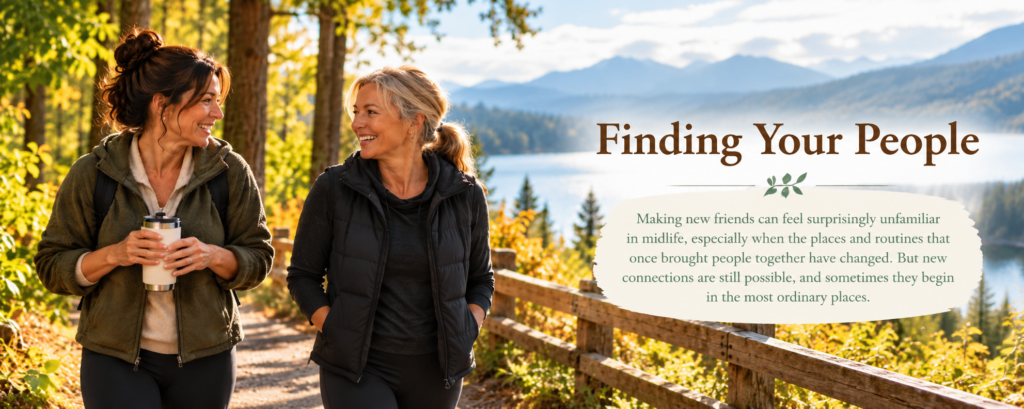
Remember when making friends seemed to happen almost by accident?
You sat next to someone in class, worked the same shift, lived down the hall, or spent every Saturday standing beside the same parents at your kids’ games. You saw each other often enough that eventually someone suggested getting coffee, and before long you were friends.
Of course, it wasn’t always that easy. But there were plenty of places where we naturally crossed paths with the same people.
By the time we reach our forties and fifties, some of those places have disappeared from our lives.
The kids get older. Jobs change. People move. We stop going to the activities that once filled our calendars. Sometimes we look around and realize that while we still know plenty of people, we don’t necessarily spend much time with them anymore.
And if we’d like to make a new friend, we might find ourselves wondering where on earth we’re supposed to start.
It’s a funny thing, being old enough to have decades of life experience and still feeling a little awkward about asking someone if they’d like to get coffee.
When the Familiar Places Change
I think one of the biggest differences between making friends at twenty and making friends at fifty is how often we see the same people.
When you’re younger, school, work, roommates, and social activities can put you in regular contact with people without much effort on your part. You have time to get to know each other gradually. You find out who makes you laugh, who shares your interests, and who you enjoy being around.
Later in life, that kind of repeated contact isn’t always built into our days.
You might work from home. Your children might have outgrown the activities where you used to see other parents. You might have moved somewhere new, changed careers, or simply found that the people you once spent time with are now busy with different things.
And sometimes our interests change.
The activities we enjoyed ten years ago might not be the ones we’re drawn to now. We may be discovering things we never had time for before, or realizing that we’d like more people in our lives who enjoy the things we enjoy today.
None of that means there’s something wrong with our existing friendships.
It just means our lives keep changing, and sometimes our social circles change with them.
Start Somewhere You Actually Want to Be
If you’re hoping to meet new people, I think it helps to begin with something you’d enjoy doing even if you didn’t make a single friend.
Maybe that’s a walking group, a gardening club, a class at the community center, or volunteering somewhere that matters to you. Maybe it’s a book club, a local hiking group, or a regular exercise class.
The particular activity matters less than whether you genuinely want to be there.
Because here’s the thing: if you join something solely to meet people and don’t enjoy the activity, you’re probably not going to keep showing up.
And showing up is often how friendships begin.
You see someone a few times. You recognize each other. You start talking before class or while you’re putting your things away. Eventually the conversations get a little longer.
You might discover that you have something in common beyond the reason you both came.
Or you might not. That’s okay, too.
Not every friendly conversation needs to become a friendship. Sometimes it’s simply nice to know a few more familiar faces around town.
Give It a Little Time
One thing I think we forget about friendship is how gradually it often develops.
We remember the people we’ve known for years and how comfortable we feel around them now. We forget that there was probably a time when we barely knew what to say to each other.
New friendships don’t usually arrive with that same sense of familiarity.
You might meet someone you like and still feel a little unsure. You might have a lovely conversation one week and barely speak the next. You might wonder whether the other person is interested in getting to know you or is simply being polite.
It’s not always easy to tell.
But if you enjoy someone’s company, there’s nothing wrong with giving the connection a little room to grow.
Say hello the next time you see them. Ask how something they mentioned last week turned out. Suggest grabbing coffee after class if the conversation seems to be heading that way.
And try not to put too much pressure on what happens next.
Some people become close friends. Some become the people you’re always happy to run into. Both can add something good to your life.
Making Room for Who You Are Now
There’s another part of making friends in midlife that I think is worth talking about.
Sometimes we’re changing right alongside our circumstances.
Perimenopause and menopause can affect sleep, mood, energy, and how comfortable we feel in our bodies. For some women, those changes arrive during an already busy stretch of life, when work, family responsibilities, and aging parents are demanding plenty of attention.
And sometimes we’re changing in ways that have nothing to do with hormones.
We may be rethinking how we spend our time. Finding new interests. Letting go of expectations we’ve carried for years. Realizing that the things we once enjoyed don’t necessarily fit us anymore.
That can affect what we want from our friendships, too.
Maybe we used to love big social gatherings but now prefer spending time with one or two people. Maybe we’re ready to try something new after years of putting everyone else’s schedules first. Maybe we’re looking for friends who understand this stage of life, or maybe we’d love to spend time with people who bring entirely different experiences and perspectives.
There’s no rule that says our friendships have to look the way they did twenty years ago.
And we don’t have to pretend to be the person we used to be just to make new ones.
Finding People Who Understand
There’s something comforting about talking to someone who understands what you’re going through without needing a lengthy explanation.
Maybe it’s another woman who’s navigating hot flashes and sleepless nights. Maybe it’s someone who’s also watching her children become more independent, caring for aging parents, or trying to figure out what she wants the next chapter of her life to look like.
Sometimes it’s a relief to say, “Is this happening to you, too?” and hear someone answer, “Oh, absolutely.”
That kind of understanding can make an unfamiliar experience feel a little less isolating.
But shared circumstances aren’t the only foundation for friendship.
Some of the most interesting people we meet may be in completely different stages of life. They may have different families, backgrounds, interests, or experiences. We might have very little in common on paper and still thoroughly enjoy each other’s company.
I think there’s room for both.
People who understand where we are, and people who introduce us to something we haven’t experienced yet.
You Don’t Need a Whole New Circle
I don’t think the goal of making friends in midlife should be to build the biggest possible social circle.
Some people genuinely enjoy having lots of friends and a busy calendar. Others would rather have a few close relationships and plenty of time to themselves.
Neither is better.
And if you’re perfectly happy with the friendships you already have, there’s no reason to go looking for more just because someone says you should.
But if you’ve been wishing you had someone to take a walk with, meet for lunch, or call when something funny happens, it’s worth remembering that new friendships aren’t reserved for younger people.
You can meet someone wonderful at forty-five, fifty-five, seventy, or well beyond.
You can find a new walking companion, a friend who shares your love of gardening, or someone who makes you laugh so hard you forget what you were talking about.
And sometimes the friendship you didn’t know you were missing begins with a conversation you almost didn’t have.
Keep Showing Up
I wish there were a simple way to know which new connections will turn into lasting friendships.
There isn’t.
Sometimes you meet someone and click immediately. Sometimes you get to know each other slowly over months. And sometimes a promising friendship doesn’t develop, for reasons that have very little to do with either person.
That’s just part of it.
But I do think there’s something to be said for staying open to the possibility.
Go to the class. Join the walk. Say hello to the woman you keep seeing at the same coffee shop. Make conversation with someone who seems interesting.
You don’t have to become the most outgoing person in the room. You don’t have to force yourself into activities you dislike or fill every spare moment with social plans.
Just give yourself a few opportunities to meet people.
And if you find someone whose company you enjoy, don’t be afraid to see whether they’d like to spend a little more time together.
After all, she might be wondering exactly the same thing.