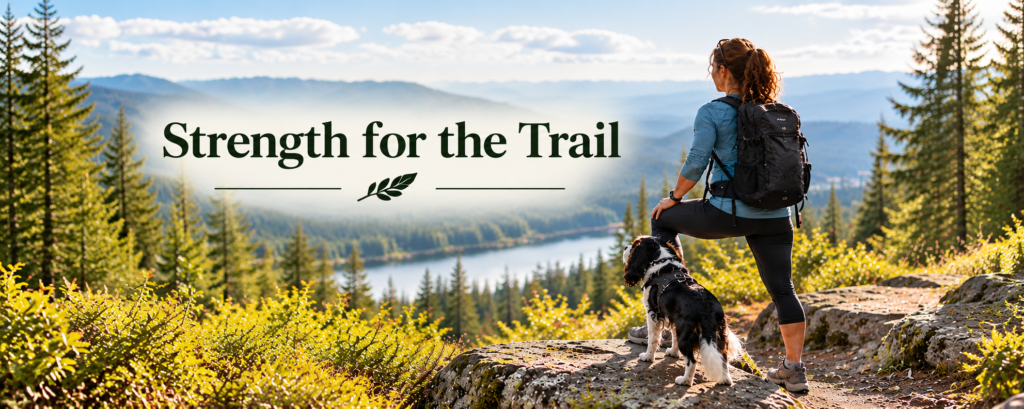
There’s a particular kind of satisfaction that comes from reaching a beautiful viewpoint after a challenging walk. Maybe you’ve climbed a long hill, navigated a rocky stretch of trail, or followed a winding path through the trees until the landscape finally opens up in front of you.
It’s tempting to think of that moment as the finish line.
But unless someone is coming to pick you up at the top, you’ve still got to get back down.
That’s one reason strength matters so much when we spend time outdoors. It’s not simply about making the climb. It’s about having the stability, endurance, and confidence to enjoy the entire adventure, including the return trip.
What the Trail Asks of You
Unlike a smooth sidewalk, a trail rarely offers exactly the same movement twice. You might step over a root, climb onto a rock, navigate loose gravel, or lower yourself carefully down a steep section.
Your legs provide much of the power, but your hips, core, and smaller stabilizing muscles also help you maintain control as the ground changes beneath you.
Even carrying a backpack adds another consideration. Water, snacks, extra layers, and other essentials may not seem particularly heavy when you first set out, but their weight can become more noticeable as the miles add up.
These are everyday examples of functional strength: the ability to use your muscles for the things you actually want to do.
Build Strength Before You Need It
You don’t have to wait until you’re on a difficult trail to prepare for one.
Simple movements such as sit-to-stands, step-ups, calf raises, and controlled balance exercises can help develop some of the strength and stability that outdoor walking requires.
Walking hills and stairs can build familiarity with climbing, while regular walks on manageable, varied terrain give you opportunities to practice adapting to different surfaces.
You don’t need to do everything at once. A little strength work alongside your usual walking routine can be a useful place to begin.
And if you’re just getting started, choose exercises and routes that match your current abilities. There’s no advantage to making the preparation harder than it needs to be.
Save Something for the Way Back
One of the most useful trail habits is remembering that reaching your destination is only part of the outing.
A climb that feels manageable while you’re fresh may feel very different after an hour or two on your feet. Descending also requires your muscles to control each step, especially when the trail is steep or uneven.
Before heading out, consider the total distance, elevation changes, expected conditions, and how long you anticipate being outside. Bring appropriate supplies, allow time for breaks, and be willing to turn around before reaching your planned destination if conditions or energy levels call for it.
There’s no shame in choosing a shorter route. The best adventure is one you can complete safely and still enjoy.
Strong Enough for More of the World
Strength doesn’t have to be about lifting the heaviest weight or tackling the most demanding trail.
Sometimes it means being able to step confidently over a fallen branch, carry your own supplies, climb a hillside without feeling completely exhausted, or explore a little farther than you could last season.
And sometimes it means having enough energy left to notice the birds, admire the trees, or sit beside a lake for a while before heading home.
That’s the kind of strength worth building.
Not just strength to reach the top, but strength to enjoy everything along the way.