
One of the most common questions people have when they begin strength training is how often they actually need to do it. Is twice a week enough? Should you aim for three days? Do you need to work different muscles on different days? And if you miss a workout, have you somehow undone the progress you were making?
The fitness world has a remarkable ability to make a relatively straightforward question feel complicated. Between elaborate weekly workout splits, conflicting advice about recovery, and routines designed for people who seem to have unlimited time to exercise, it’s easy to assume that getting stronger requires a much bigger commitment than your life can realistically accommodate.
Fortunately, it doesn’t.
Strength training works by giving your muscles a challenge, allowing them time to recover, and repeating that process consistently enough for your body to adapt. How you organize those workouts matters, but the ideal schedule isn’t necessarily the one with the most training days. It’s the one that provides enough of a challenge to make progress while leaving room for recovery and everything else in your life.
For women in their 40s, 50s, and beyond, strength training can be especially valuable for maintaining muscle, supporting bone health, and preserving the physical abilities that make everyday life easier. But those benefits don’t require you to spend every afternoon in a gym.
A thoughtful starting schedule can be surprisingly simple.
The Short Answer: Start With Two or Three Days a Week
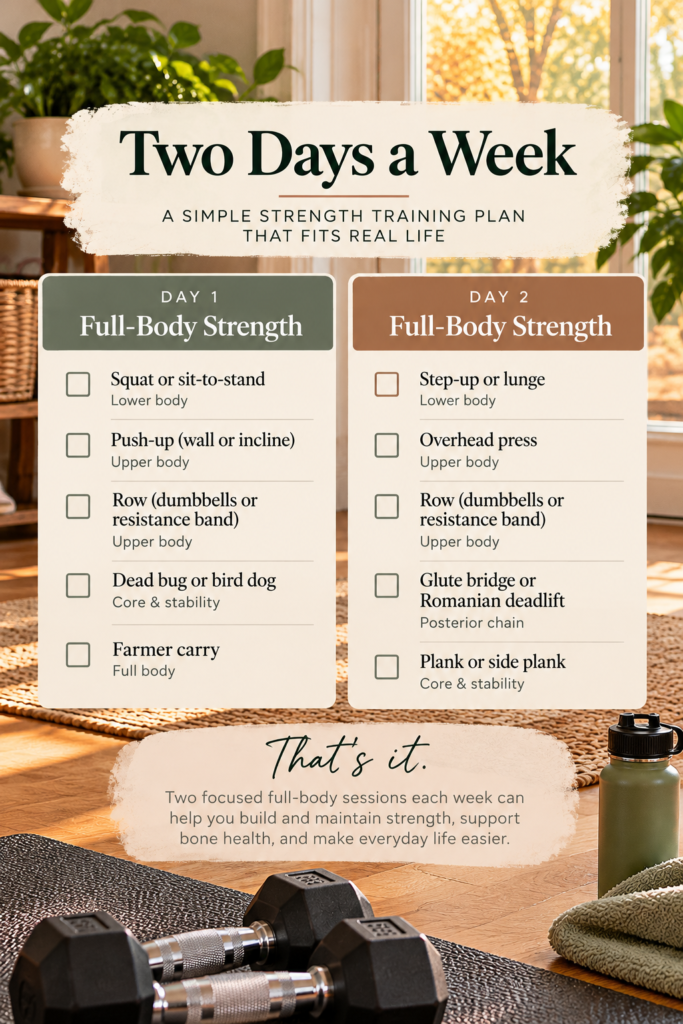
For most healthy adults who are new to strength training, two or three sessions per week is a practical place to begin. In fact, the U.S. Physical Activity Guidelines recommend muscle-strengthening activities involving all major muscle groups on at least two days each week.
That means two well-planned strength workouts aren’t a consolation prize for people who can’t manage five. They’re a legitimate starting point for building strength and improving physical function.
If you’re training twice a week, you might choose Monday and Thursday. If three days fit comfortably into your schedule, Monday, Wednesday, and Friday could work well. The specific days aren’t particularly important. What matters more is giving yourself opportunities to train regularly while allowing adequate recovery between sessions that challenge the same muscles.
For beginners, full-body workouts are often the simplest approach. Rather than assigning a different body part to every day of the week, you can include movements for your legs, hips, back, chest, shoulders, and core within the same session. This allows you to practice important movement patterns regularly without needing an elaborate schedule.
And if you’re starting from very little activity, there’s nothing wrong with beginning even smaller. One manageable session is a better first step than a five-day plan you dread before the week has even started. You can build toward two consistent days as your confidence, strength, and routine develop.
The goal isn’t to see how many workouts you can squeeze into a calendar.
It’s to create a pattern of challenge and recovery that your body can respond to—and that you can realistically maintain.
Why Recovery Days Are Part of Getting Stronger
It’s tempting to think of strength training as something that only happens while you’re exercising. You lift a weight, your muscles work, and the effort you put into that workout is what makes you stronger.
But the workout is only part of the process.
When you challenge your muscles with resistance, you create a stimulus that tells your body it needs to become better equipped to handle that demand. In the hours and days that follow, your body begins the work of repairing, rebuilding, and adapting. Given enough time, appropriate nutrition, and repeated training, those adaptations can lead to greater strength and improved muscular endurance.
Recovery isn’t time away from making progress. It’s part of how progress happens.
This is one reason beginners often benefit from leaving a day between full-body strength sessions. If you train on Monday, for example, Tuesday might be a walking day, a gardening day, or simply a day when you go about your usual activities without another demanding strength workout. By Wednesday, you may be ready to challenge those muscles again.
That doesn’t mean you need to spend your recovery days sitting still. Walking, gentle cycling, stretching, and other comfortable activities can fit beautifully between strength sessions. Recovery is about managing the demands you’re placing on your body, not avoiding movement altogether.
How Much Recovery Do You Actually Need?
You may have heard that muscles need exactly 48 hours to recover after strength training. While allowing roughly a day or two between challenging sessions for the same muscle groups is a useful starting guideline, recovery doesn’t operate on a universal stopwatch.
How much time you need depends on several factors, including the intensity and volume of your workout, your training experience, sleep, nutrition, and the other physical demands in your life.
A beginner completing a few sets of basic movements may recover differently from someone performing a long, demanding workout with heavier weights. Likewise, a day spent moving furniture, hiking steep trails, or doing strenuous yard work adds physical demands that your body doesn’t distinguish from exercise simply because they weren’t scheduled as workouts.
Rather than treating recovery as a rigid number of hours, pay attention to how you’re responding over time.
What About Muscle Soreness?
Some muscle soreness is common when you begin strength training, return after a break, or introduce unfamiliar exercises. This is often called delayed-onset muscle soreness, or DOMS, and it may become noticeable several hours after exercise, often peaking around one to three days later.
Mild soreness doesn’t necessarily mean you did anything wrong, and it doesn’t automatically mean you need to cancel every planned activity. Gentle movement may feel comfortable, and you can often continue exercising other muscle groups or choose a lighter session while the soreness settles.
But soreness isn’t a requirement for building strength.
A workout can be effective even when you feel perfectly normal the next morning. As your body becomes accustomed to particular exercises, you may experience less soreness despite continuing to make progress.
If soreness is severe enough to interfere with ordinary movement, however, that’s a good reason to reduce the intensity of your next session or allow additional recovery. Sharp pain, significant swelling, unusual weakness, or pain that seems related to a joint or injury deserves a different response than ordinary post-workout muscle tenderness. Severe symptoms, especially dark urine or pronounced weakness after strenuous exercise, warrant prompt medical evaluation.
More Training Isn’t Automatically Better Training
There is a point at which adding another workout can provide a useful training stimulus. But adding sessions without considering recovery, total workload, or your ability to maintain the routine can make training less productive.
If you’re consistently exhausted, your performance is declining, minor aches aren’t settling, or you’re beginning to dread every workout, the answer may not be to push harder. It may be to examine how much you’re doing and whether you’re giving yourself enough time to recover.
This becomes particularly important when you’re balancing strength training with demanding workdays, family responsibilities, disrupted sleep, and other forms of physical activity.
Your body responds to the total demands placed upon it, not just the workouts you’ve entered into your calendar.
For many people, two or three thoughtfully planned sessions, supported by adequate recovery, offer a far better foundation than a crowded training schedule that leaves them perpetually worn down.
The goal is to finish a workout having given your muscles a meaningful challenge—and to return to the next one ready to do it again.

Full-Body Workouts or Split Routines: Which Is Better?
Once you’ve decided how many days a week you’d like to strength train, the next question is often how to organize those workouts. Should you exercise your entire body each time, or dedicate different days to different muscle groups?
Both approaches can be effective. The difference is primarily how you distribute your training throughout the week, and for someone just beginning, one approach is usually much simpler to manage.
Full-Body Workouts: A Simple Place to Begin
A full-body workout includes exercises that collectively challenge the major muscle groups throughout your body. Rather than focusing exclusively on your legs one day and your arms another, you might combine a squat, a pulling movement, a pushing movement, a hip-hinge exercise, and some core work into a single session.
For example, a beginner’s full-body workout might include chair squats, dumbbell rows, wall push-ups, Romanian deadlifts, and dead bugs. You wouldn’t necessarily need to perform every exercise for multiple sets on your first day. The idea is simply to introduce several useful movement patterns within one manageable workout.
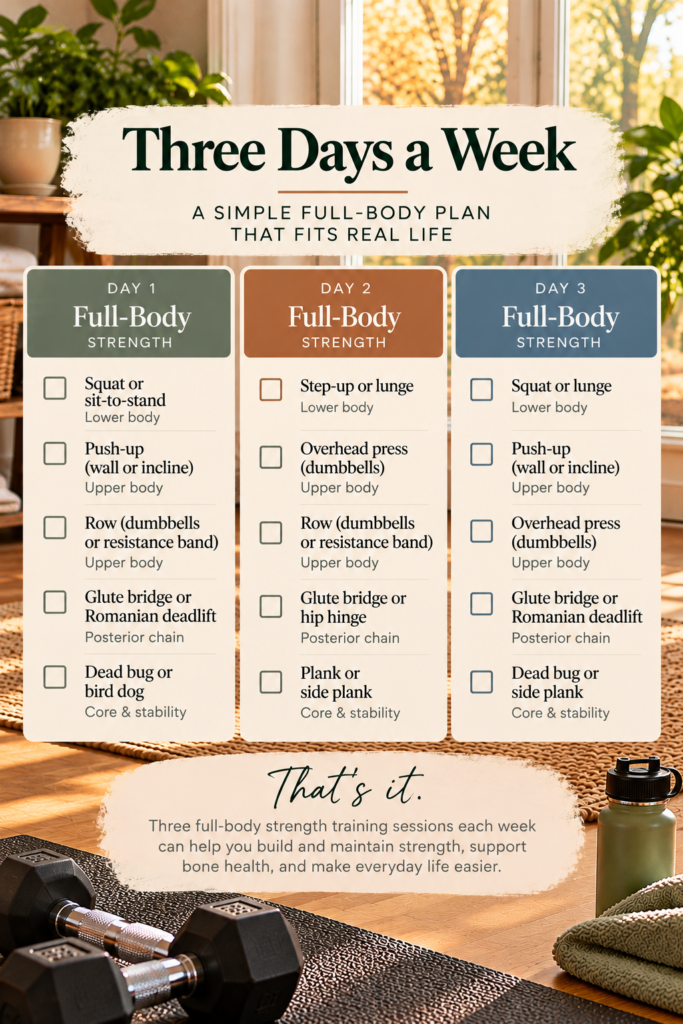
If you train twice a week, you could repeat a similar routine on Monday and Thursday. With three weekly sessions, you might alternate between two slightly different full-body workouts to provide variety while continuing to practice the same fundamental movements.
This approach has several advantages for beginners. It gives you regular opportunities to practice each exercise, makes it easier to train your major muscle groups without spending five days a week working out, and allows you to build familiarity with a relatively small collection of movements.
It also makes missed workouts less disruptive. If you normally train on Monday and Thursday but life gets in the way on Thursday, you’ve still challenged your major muscle groups earlier that week. You haven’t missed the only day you planned to train your legs or back.
For women returning to exercise after a long break, full-body training can also be a practical way to rebuild confidence. Instead of learning an entirely different routine every day, you can become comfortable with a handful of movements, gradually improve your technique, and increase the challenge as your strength develops.
Split Routines: Another Way to Organize Your Training
A split routine divides exercises or muscle groups across different training days. Someone might train their upper body on Monday, lower body on Tuesday, rest on Wednesday, and repeat that pattern later in the week. Other routines divide training into pushing exercises, pulling exercises, and leg exercises.
There’s nothing inherently wrong with this approach, and it can be particularly useful as your training becomes more demanding or you want to dedicate additional time to specific muscle groups.
Splits can allow you to perform more exercises for a particular area without making every workout excessively long. They can also help distribute training volume across the week while giving individual muscle groups time to recover.
But they aren’t automatically more effective simply because they look more sophisticated.
When the overall amount of training is comparable, both full-body and split routines can produce meaningful improvements in strength and muscle development. The best choice depends on your goals, experience, available time, and how much training you’re trying to accomplish.
A four-day upper/lower split may fit someone who enjoys frequent workouts and wants more training volume. For someone with two available workout days, however, dividing those days into separate upper- and lower-body sessions may mean each major muscle group gets trained only once that week. A full-body approach could provide more frequent practice with those movements.
You Don’t Have to Choose One Forever
Your training schedule can change as your life and abilities change.
You might begin with two full-body workouts each week, move to three as your routine becomes established, and eventually experiment with an upper/lower split if you enjoy training more frequently. Or you might discover that two full-body sessions fit your life beautifully and continue using that approach for years.
Neither path represents a failure to progress.
Progress comes from providing an appropriate training challenge over time, not from graduating to the most complicated workout schedule you can find.
If you’re just getting started, I’d encourage you to keep the structure simple. Choose a few exercises that cover the major movement patterns, give yourself time to learn them, and focus on becoming comfortable with regular strength training.
You can find individual movements, instructions, and START/FINISH demonstrations in our Exercise Library. And if you’d rather have the exercises organized into a ready-to-follow routine, our Beginner Workouts page is designed to help you get started without having to build a program from scratch.
The best workout structure is one that gives your muscles a reason to adapt while fitting comfortably enough into your life that you can keep showing up.

What Could a Realistic Weekly Strength Training Schedule Look Like?
Knowing that two or three strength workouts a week can be effective is one thing. Figuring out where those workouts belong in an already busy life is another.
The good news is that strength training doesn’t have to dominate your weekly calendar. You don’t need to exercise at the same time every day, and you don’t need to reserve every available afternoon for a workout. A realistic schedule simply gives you regular opportunities to challenge your muscles while leaving enough room for recovery and the other activities you enjoy.
Here are a few ways that might look.
Option One: Two Strength Training Days Per Week
For someone beginning strength training, returning after a long break, or balancing an especially busy schedule, two full-body workouts can provide a manageable foundation.
| Day | Activity |
|---|---|
| Monday | Full-body strength workout |
| Tuesday | Walking or comfortable movement |
| Wednesday | Rest or everyday activities |
| Thursday | Full-body strength workout |
| Friday | Walking or other enjoyable activity |
| Saturday | Hiking, gardening, cycling, or whatever you enjoy |
| Sunday | Rest or gentle movement |
This schedule gives you several days between challenging full-body sessions without requiring you to be inactive on the days in between.
Your workouts might last 20 to 40 minutes, depending on the number of exercises, sets, and rest periods you include. If you’re brand-new to strength training, even a shorter session focused on learning a few movements can be worthwhile.
Notice, too, that the weekend isn’t reserved exclusively for exercise. A hike with friends, an afternoon working in the garden, or a walk with the dog can remain part of your life without needing to become another structured workout.
Two strength sessions can be enough to begin building meaningful strength. You don’t need to add more days simply because someone else’s routine looks busier.
Option Two: Three Strength Training Days Per Week
If you have a little more time, enjoy the routine, and are recovering comfortably between sessions, three weekly workouts may be a good fit.
| Day | Activity |
|---|---|
| Monday | Full-body strength workout |
| Tuesday | Walking or other comfortable activity |
| Wednesday | Full-body strength workout |
| Thursday | Recovery or gentle movement |
| Friday | Full-body strength workout |
| Saturday | Outdoor activity or whatever sounds enjoyable |
| Sunday | Rest |
With this approach, you might alternate between two different full-body workouts rather than repeating the exact same exercises three times.
For example, one workout could emphasize squats, rows, and core stability, while another includes hip hinges, pushing movements, and a different core exercise. Both sessions can still involve your whole body, but the variety allows you to practice different movements and distribute the workload.
Three days aren’t necessarily better than two for every person. They simply provide another opportunity to train, which can be useful when your goals, recovery, and schedule support it.
Option Three: A Flexible Schedule for Unpredictable Weeks
Not everyone’s calendar follows a predictable Monday-through-Friday pattern. Work schedules change, children get sick, appointments appear, and sometimes a day that looked completely open becomes anything but.
If that’s familiar, it may help to think in terms of weekly training goals rather than fixed workout days.
Instead of deciding that you must strength train every Monday and Thursday, you might aim to complete two full-body sessions during the week, preferably with at least a day between them.
One week, those sessions might happen on Tuesday and Friday. The next, Wednesday and Saturday. If Monday gets away from you, you haven’t ruined the plan. You simply look for the next reasonable opportunity.
This approach can be particularly helpful when you’re trying to build a lasting habit. A schedule that allows some flexibility is often easier to maintain than one that treats every unexpected interruption as a failure.
Of course, flexibility doesn’t mean ignoring recovery. If your two available workout days happen to fall back-to-back, you might adjust the exercises or intensity rather than performing two demanding full-body sessions in a row.
The purpose of a schedule is to support your training, not create another source of stress.
Where Does Walking Fit?
Walking, hiking, cycling, swimming, and other activities can complement strength training beautifully. They provide opportunities for cardiovascular activity, enjoyment, and everyday movement without requiring you to choose between being active outdoors and building strength.
For general health, the U.S. Physical Activity Guidelines recommend that adults aim for at least 150 minutes of moderate-intensity aerobic activity each week, along with muscle-strengthening activities on at least two days. Those aerobic minutes can be accumulated across the week rather than completed in a single session.
You don’t need to meet every recommendation immediately, especially if you’re beginning from a relatively inactive starting point. Building gradually toward a combination of strength training and aerobic activity is a reasonable approach.
And remember that activities don’t always fit neatly into separate categories. Hiking uphill, carrying groceries, working in the yard, and climbing stairs all place physical demands on your body, even if they don’t replace a well-rounded resistance-training program.
Your weekly movement can include both structured exercise and the ordinary activities that make life enjoyable.
The Best Schedule Is One You Can Repeat
It’s easy to design an ambitious workout calendar when you’re feeling motivated. The harder question is whether that schedule will still make sense three weeks from now, when you’re tired, the laundry is piling up, and something unexpected has landed on your calendar.
That’s why I would encourage you to begin with the smallest schedule that provides a meaningful training opportunity and feels genuinely manageable.
If two days work, start there. If three days feel comfortable, that’s an option too. You can always adjust as you learn more about how your body responds.
A sustainable routine doesn’t have to look impressive on paper. It needs to give you enough consistency to make progress while leaving room for the rest of your life.
How Do You Know When You’re Ready to Train More Often?
Once you’ve established a regular strength training routine, you may begin wondering whether it’s time to add another workout day. Perhaps your original sessions feel easier than they did a few weeks ago, you’re enjoying the process more than you expected, or you’ve started noticing improvements in your strength and everyday activities.
Those are encouraging developments. But they don’t necessarily mean you need to spend more days exercising.
Before adding another session to your calendar, it’s worth considering what you’re hoping to accomplish and whether increasing your training frequency is actually the most useful next step.
First, Look at What You’re Already Doing
If you’re consistently completing two full-body workouts each week, recovering comfortably, and gradually becoming stronger, your current schedule may be working exactly as intended.
You don’t need to change something simply because it’s becoming familiar.
Instead, consider whether there’s room to progress within the workouts you’re already doing. You might increase the resistance for an exercise that’s become too easy, add a few repetitions, or eventually perform an additional set. These are all ways to provide your muscles with a greater challenge without adding another training day.
For example, suppose you’ve been performing two sets of 10 dumbbell rows with a weight that initially felt challenging. Several weeks later, you can complete both sets comfortably while maintaining good technique, and you feel capable of doing several more repetitions.
That may be an opportunity to increase the weight slightly or adjust the number of repetitions or sets, rather than immediately scheduling a third workout.
This gradual increase in training demands is known as progressive overload, and it’s one of the fundamental principles behind building strength.
If you’re unsure whether your current weights are still appropriate, our article How Heavy Should My Weights Be? walks through how to recognize the right level of challenge and when to increase resistance.
Signs You May Be Ready for Another Training Day
Adding another strength session can make sense when your existing routine is well established and you have a reason to increase your overall training opportunities.
You might consider it if you’re recovering well between workouts, maintaining good exercise technique, and consistently completing your current sessions without feeling unusually fatigued or overwhelmed. You may also have specific strength goals that would benefit from additional training volume, or simply enjoy strength training enough that you’d like to make more room for it.
Your schedule matters, too. If adding a third workout means sacrificing sleep, rushing through meals, or turning an already demanding week into a logistical puzzle, the additional session may not be worth the trade-off.
It’s also important to recognize that adding a training day doesn’t mean you need to duplicate your existing workload. If you currently complete two longer full-body workouts, you might distribute some of that work across three shorter sessions rather than dramatically increasing the total amount you’re doing.
Training frequency and total training volume are related, but they aren’t the same thing. More days can give you additional opportunities to exercise without necessarily requiring a large increase in overall workload.
When Staying With Your Current Schedule Makes More Sense
There are also times when maintaining your existing routine—or temporarily reducing it—is the more productive choice.
If you’re regularly carrying soreness into your next workout, noticing a decline in performance, struggling with persistent fatigue, or finding that exercise is interfering with your sleep or everyday responsibilities, adding more training may not be helpful.
The same applies during unusually demanding periods of life. A stressful workweek, several nights of poor sleep, illness, or an increase in other physical activities can all affect how much training you’re prepared to handle.
For women navigating perimenopause or menopause, changes in sleep, energy, and recovery can make it especially useful to pay attention to individual responses rather than follow a rigid training schedule. That doesn’t mean strength training should be avoided or that everyone needs less exercise during this stage of life. It means your training plan should be responsive to how you’re actually doing.
Some weeks, you’ll feel ready to challenge yourself. Other weeks, maintaining a familiar routine may be plenty.
Neither requires you to start over.
Progress Doesn’t Have to Mean More Days
One of the most useful things to understand about strength training is that progress can take several forms.
You might lift a heavier dumbbell, complete more repetitions with good technique, move through a greater comfortable range of motion, or perform an exercise with better balance and control. You might notice that your workouts feel more manageable or that you’re recovering more comfortably between sessions.
And sometimes the most meaningful improvement happens outside the workout itself. Carrying something heavy becomes easier. Getting up from the floor requires less effort. You feel more capable during activities that once left you tired or uncomfortable.
Those changes are part of what you’re training for.
If your current schedule is helping you become stronger, supporting your health, and fitting realistically into your life, you don’t need to add another day just to prove you’re taking exercise seriously.
More isn’t automatically better. Better is better.
The goal is to give your body an appropriate challenge, allow it to adapt, and adjust your training as your abilities and circumstances change.
What If You Miss a Workout—or an Entire Week?
At some point, your carefully planned strength training schedule is going to run into real life. A meeting will run late, someone in the family will get sick, you’ll have a particularly exhausting week, or you’ll simply wake up one morning and realize that the workout you intended to do yesterday never happened.
And sometimes, one missed session becomes several.
It’s easy to interpret those interruptions as evidence that you’re struggling with consistency. But missing a workout doesn’t erase the strength you’ve been building, and taking a week away from training doesn’t mean you’re back where you started.
Strength develops through repeated training over time. Your body doesn’t measure your commitment by whether you completed every session on a calendar.
One Missed Workout Doesn’t Require a Make-Up Workout
Suppose you normally strength train on Monday and Thursday, but Thursday becomes unexpectedly busy. You could move that workout to Friday or Saturday if your schedule allows, or you could simply resume your usual routine the following Monday.
Both are reasonable options.
What you don’t need to do is squeeze two demanding workouts into the next day, double your sets, or punish yourself with extra exercise to compensate for what you missed.
Training is a physical stimulus, not a debt that accumulates when you don’t complete it.
If moving a workout makes sense, move it. If it doesn’t, continue with the next available session. One missed opportunity is a very small part of a much larger training pattern.
What Happens If You Take a Week or Two Off?
A longer interruption can feel more significant, particularly when you’ve worked hard to establish a routine. You may worry that your muscles are disappearing or that the progress you’ve made is slipping away.
Fortunately, strength doesn’t vanish overnight.
The effects of taking time away from resistance training depend on several factors, including how long you’ve been training, your previous fitness level, how active you remain during the break, and how long the interruption lasts.
A week away from your usual workouts is unlikely to erase months of progress. Even after a longer break, previously developed strength and movement skills can often be regained more readily than they were built the first time.
You might notice that your first workout back feels harder than expected, particularly if you’ve been ill, inactive, or sleeping poorly. That doesn’t necessarily mean you’ve lost a substantial amount of muscle. Your energy, coordination, and familiarity with the movements can all influence how a workout feels after time away.
Rather than trying to determine exactly how much progress you’ve lost, focus on finding an appropriate place to begin again.
How to Return Without Overdoing It
If you’ve missed only one or two workouts and otherwise feel well, you may be able to return to your usual routine without making significant changes.
After a longer break, illness, or a period of reduced activity, it’s often sensible to ease back in. You might use slightly lighter weights, complete fewer sets, or leave a few additional repetitions in reserve while you see how your body responds.
For example, if you were previously completing three sets of 12 squats, your first session back might include two sets of eight or 10 repetitions. If that feels comfortable and your recovery goes well, you can gradually work toward your previous workload.
There’s no universal formula for returning after time away. A two-week vacation filled with walking and hiking is different from two weeks spent recovering from an illness. After significant illness, injury, or persistent symptoms, medical guidance may be appropriate before resuming demanding exercise.
The important thing is to let your current abilities guide the workout rather than expecting your body to perform exactly as it did before the interruption.
Consistency Is Bigger Than a Perfect Week
We often talk about consistency as though it means doing the same thing on the same days without exception. But over the course of months and years, very few people can maintain that kind of uninterrupted schedule.
A more useful definition of consistency is the ability to return to a helpful pattern, even when life occasionally pulls you away from it.
That might mean completing two workouts most weeks, three when you have the time and energy, and fewer during particularly demanding periods. It might mean shortening a session instead of skipping it, or accepting that some weeks are better suited to maintaining your routine than increasing the challenge.
None of those adjustments makes your efforts meaningless.
In fact, learning how to adapt your routine may be one of the most important skills you develop. A plan that can accommodate ordinary disruptions is much more likely to remain part of your life than one that works only when everything goes perfectly.
And when you do miss a workout, you don’t need a dramatic restart, a new program, or a promise that you’ll never let it happen again.
You simply need to find your next reasonable opportunity to train.
The workout that matters most after an interruption isn’t the one you missed. It’s the one you return to.

A Strength Training Schedule That Works for Your Life
By now, you may have noticed that there isn’t one perfect strength training schedule everyone should follow. Two days a week can be an excellent starting point. Three days may work beautifully when you have the time and are recovering comfortably. And as your strength, experience, and goals change, the way you organize your workouts can change with them.
What matters most isn’t how closely your calendar resembles someone else’s training program. It’s whether your routine provides a meaningful challenge, allows enough recovery, and fits into your life well enough that you can continue doing it.
For many women, especially those beginning or returning to strength training in their 40s, 50s, and beyond, that means keeping things relatively simple. A couple of full-body workouts, some walking or other enjoyable movement throughout the week, and enough flexibility to accommodate ordinary life can provide a strong foundation.
You don’t need to earn your recovery days. You don’t need to add another workout every time an exercise becomes easier. And you don’t need to treat a missed session as a reason to abandon everything you’ve been building.
Instead, pay attention to what your body is telling you. Notice when an exercise becomes more manageable, when you’re ready for a little more resistance, and when additional recovery would be useful. Give yourself opportunities to improve without expecting every workout to be harder than the last.
Over time, strength training becomes less about figuring out how to fit exercise into your life and more about recognizing what that exercise allows you to do within it.
Maybe that’s carrying a heavy bag without thinking twice. Getting up from the floor more easily. Feeling steadier on uneven ground. Or simply knowing that the physical demands of everyday life are becoming a little more manageable.
Those are meaningful reasons to keep showing up.
Start with a schedule you can manage. Challenge yourself appropriately. Make room for recovery. And give yourself time to become stronger.
Ready to Put Your Schedule Into Practice?
If you’re ready to begin, our Beginner Workouts page offers approachable, ready-to-follow routines that take the guesswork out of deciding what exercises to do.
You can also explore the Exercise Library for individual movements, START and FINISH demonstrations, and practical technique tips. And if you’re unsure how much resistance to use, How Heavy Should My Weights Be? will help you choose a starting weight and recognize when you’re ready to increase it.
You don’t need to have every detail figured out before your first workout. Choose a reasonable starting point, learn as you go, and build a routine that supports the life you want to keep living.
Sources
- U.S. Department of Health and Human Services (2018). Physical Activity Guidelines for Americans, Second Edition. National recommendations for weekly aerobic activity, muscle-strengthening exercise, and gradually increasing physical activity.
- American College of Sports Medicine (2026). Resistance Training Prescription for Muscle Function, Hypertrophy, and Physical Performance in Healthy Adults: An Overview of Reviews. Evidence-based recommendations covering resistance training frequency, progression, and physical function.
- Ramos-Campo et al. (2024). Efficacy of Split Versus Full-Body Resistance Training on Strength and Muscle Growth: A Systematic Review With Meta-Analysis. Research comparing full-body and split training approaches when overall training volume is similar.
- American College of Sports Medicine (2026). 5 Things to Know About Creating an Effective Resistance Training Plan. Practical guidance on creating a sustainable resistance training routine.