Movement Used to Be a Natural Part of the Day
There was a time when movement didn’t need its own appointment on the calendar. It was simply woven into the work of being alive.
That doesn’t mean everyone lived on a farm, spent their days doing hard physical labor, or somehow had a healthier and more virtuous relationship with movement. Life in the past came with plenty of hardship that we have no reason to romanticize. But for much of human history, ordinary life required more physical effort than it does for many of us today. Food had to be gathered, grown, carried, prepared, and cleaned up after. Homes, land, animals, tools, and belongings required hands-on work. Getting from one place to another often required more movement than walking from the front door to the car.
Then we got very good at making life easier.
Cars shortened the distance our feet had to travel. Elevators replaced stairs. Machines took over physically demanding household jobs. Shopping moved from walking through stores to tapping a screen. Food can arrive at the front door. Meetings happen from chairs. Messages travel across buildings—and across the world—without requiring us to move at all.
Those conveniences solved real problems. They saved time, reduced exhausting labor, increased accessibility, and made countless parts of life safer and easier. Convenience is not the enemy.
But convenience did quietly remove something along the way.
Movement.
And now many of us find ourselves trying to manufacture, in a thirty- or sixty-minute block called a workout, some of the physical activity that ordinary life used to require throughout the day.
That doesn’t mean we need to reject modern life, park three miles from the grocery store, churn our own butter, or start washing clothes against a rock. It simply gives us an interesting question to ask:
Where has convenience removed movement that I wouldn’t mind putting back?

The Movement That Doesn’t Look Like Exercise
When we think about physical activity, it is easy to picture the obvious things: a workout at the gym, a morning run, a fitness class, or a planned walk around the neighborhood. Those things count, of course. But they are only part of the movement that can happen across an ordinary day.
There is also the movement that barely registers as exercise at all. Walking through a parking lot. Taking the stairs. Carrying groceries into the house. Working in the garden. Walking the dog around one more block. Getting up to talk to someone instead of sending a message. Moving around the kitchen while making dinner. These moments may seem too ordinary to matter, particularly when we have been taught to think of physical activity as something that only “counts” when it is long enough, hard enough, or formally planned.
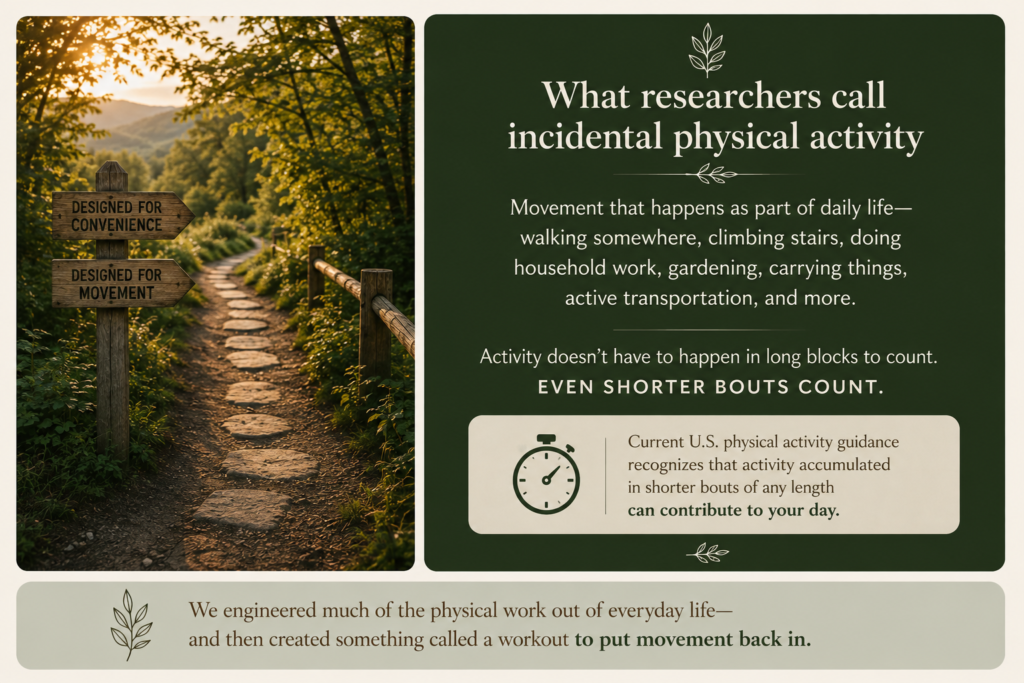
Researchers sometimes describe this kind of activity as incidental physical activity—movement that happens as part of daily living rather than as a structured exercise session. It can occur through household tasks, transportation, work, errands, gardening, walking, and countless other pieces of ordinary life. Importantly, current U.S. physical activity guidance no longer requires activity to happen in bouts of at least ten minutes in order to contribute to overall physical activity. Shorter periods of movement can count too.
That changes the way we can think about a day.
Five minutes walking while you’re waiting for your child isn’t a failed thirty-minute workout. It’s five minutes of movement. Carrying the groceries inside isn’t strength training, and taking the stairs isn’t the same thing as going for a run. They don’t need to be. The point isn’t to pretend every ordinary movement is a workout. The point is to stop dismissing movement simply because it isn’t one.
Movement is one of the signals we send to the body. It doesn’t have to arrive exclusively through formal exercise. It can also be woven through ordinary life.
We Built the Movement Out of Our Lives
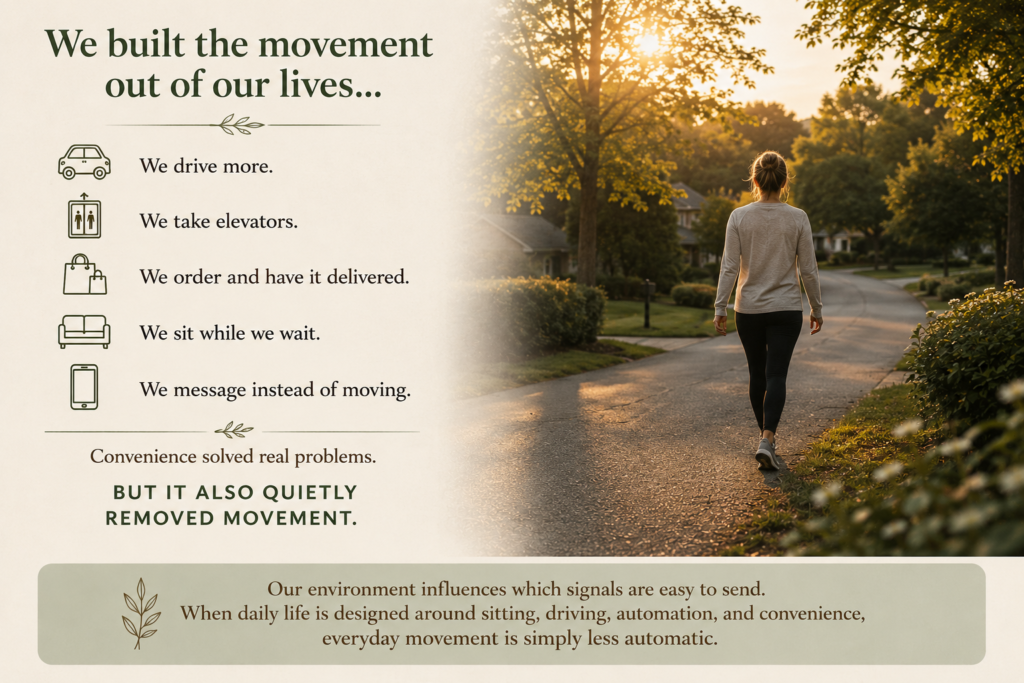
Most of us didn’t consciously decide to become less active. In many ways, the world around us simply became better at requiring less movement from us.
Think about how many everyday tasks can now be completed without getting out of a chair. We can work, shop, order dinner, pay bills, talk to friends, attend meetings, watch entertainment, and manage much of our lives through a screen. Even when we leave the house, our environments are often designed to minimize the distance we have to travel on foot. We drive close to entrances, take elevators between floors, use drive-throughs, and choose the shortest route because efficiency has become the default.
Again, none of this makes convenience bad. Many of these changes have made life enormously better, particularly for people for whom physical tasks are difficult, painful, unsafe, or simply impractical. The interesting part is not whether we should undo those advances. It is recognizing that when we removed physical effort from so many ordinary tasks, we also removed opportunities to move.
In a strange way, we engineered physical effort out of ordinary life—and then invented something called a workout to put some of it back.
That helps explain why everyday movement deserves its own place in the conversation. A formal workout can be tremendously valuable, but it occupies a relatively small portion of a twenty-four-hour day. What happens during the rest of those hours matters too. A day containing a workout followed by many hours of sitting is simply a different pattern of movement from a day in which someone also walks through errands, climbs stairs, works around the house, tends a garden, or regularly gets up and moves.
The environment helps determine which signals are easy to send. An environment organized around sitting, driving, delivery, automation, and convenience naturally makes everyday movement less automatic. That doesn’t mean we need more guilt or another set of rules. It means we can occasionally work with our environment differently.
Sometimes the easiest way to send a little more movement to the body isn’t to find more motivation for another workout.
Sometimes it’s simply to stop choosing the shortest path every single time.
Small Doesn’t Mean Meaningless
One reason everyday movement is so easy to dismiss is that each individual moment can look almost laughably small. An extra trip up the stairs. A few minutes walking while you wait. Carrying something instead of putting it in a cart. Parking a little farther from the door. None of those moments feels particularly impressive on its own.
But a day is made of small moments.
For years, physical activity advice reinforced the idea that movement needed to happen in sustained chunks before it really counted. That changed when the U.S. Physical Activity Guidelines removed the previous requirement that activity occur in bouts of at least ten minutes. The broader message is important: physical activity accumulated throughout the day can contribute to the total amount of movement we get, even when it doesn’t arrive neatly packaged as a workout.
That doesn’t mean every extra trip across the house creates some dramatic physiological transformation. It means we don’t need to dismiss those trips simply because they are small.
The more useful way to think about everyday movement is as a pattern. One longer route through the parking lot may add only a few minutes of walking. But choosing to walk a little farther here, take the stairs there, stand up more often, carry your own bags, wander through the garden, or take another lap around the block can gradually change what an ordinary day looks like.
That distinction matters because lasting change rarely comes from making one Tuesday extraordinarily active. It comes from changing what happens on Tuesdays—and Wednesdays, and Thursdays—often enough that the new pattern begins to feel normal.
This is where consistency becomes more useful than intensity. You don’t need to turn every opportunity into the hardest possible version of movement. You’re simply looking for places where a little more movement can fit without requiring your entire life to revolve around exercise.
Small movement doesn’t need to be impressive to be worth doing.

Start With Where You Are
Step counts can be useful because they give us something most of us are surprisingly bad at estimating: a picture of how much we actually move during an ordinary day.
That doesn’t mean everyone needs a smartwatch, fitness tracker, or phone permanently attached to a pocket. Plenty of people can build more movement into their lives without counting a single step. But if you already have access to a step count, it can be useful as an observation tool. Instead of immediately treating the number as a goal, spend some time noticing what your normal actually looks like.
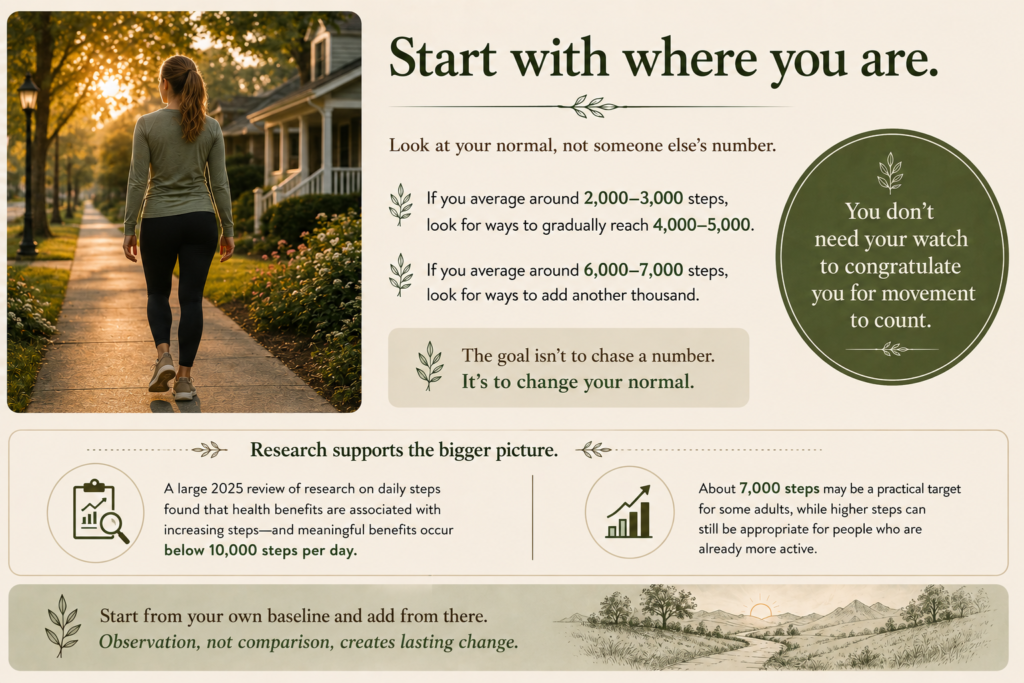
Maybe your typical day ends somewhere around 2,000 or 3,000 steps. Maybe it is closer to 6,000 or 7,000. Maybe your weekdays and weekends look completely different. The number itself isn’t a grade. It is simply information about your current pattern.
That matters because there is no reason your next step has to be somebody else’s 10,000-step goal.
Research looking at daily step counts and health outcomes has found meaningful associations at levels below 10,000 steps per day. A large 2025 systematic review and meta-analysis, for example, found that around 7,000 steps per day was associated with lower risk across several health outcomes compared with 2,000 steps per day. The researchers described 7,000 as a practical target for some people while also noting that higher targets such as 10,000 can remain appropriate for people who are already more active. Much of this research is observational, so it should not be interpreted as proof that one particular number guarantees a particular outcome.
For our purposes, the more interesting lesson is simpler: there is useful territory between barely moving and reaching 10,000 steps.
If your current average is around 2,000 or 3,000, you might experiment with what an ordinary day closer to 4,000 or 5,000 feels like. If you are usually around 6,000 or 7,000, perhaps you look for another thousand somewhere in your day. Those aren’t prescriptions or magic thresholds. They are examples of what gradual progression can look like when the starting point is your own life.
And if you don’t count steps at all? The same principle still works. Walk a little farther. Get up a little more often. Take one more trip instead of trying to carry everything at once. Add a few minutes to the dog walk. Notice where sitting has become automatic and where moving could be just as reasonable.
You don’t need your watch to congratulate you for movement to count.
The useful question isn’t, What number am I supposed to reach?
It’s:
What does my normal look like now—and where could I gently move it forward?
I Started With My Own Normal
I know how easy it is to look at someone who moves a lot now and assume she has probably always been that way. I wasn’t.
There was a time when my ordinary days regularly ended with fewer than 2,000 steps. I wasn’t deliberately choosing to be inactive. That was simply what my life had become. I could get through most of a day without needing to move very far, and because that pattern had become normal, I didn’t think much about it.
I didn’t wake up one morning, choose an impressive step goal, and suddenly become someone who moved all day. I started adding movement where I could. Then I kept doing it.
At first, some of those choices were deliberate. I had to think about moving more because moving more wasn’t yet my normal. I walked when I could have sat. I looked for opportunities to add a little distance. I began paying attention to how much of my day could pass without much movement at all, and I started changing some of those moments.
Over time, something shifted.

Movement became something I naturally looked for. Walking became part of my day rather than something I had to negotiate with myself about doing. What once required conscious effort gradually became part of the way I live.
That experience is also why I use my step count differently now. I do wear a smartwatch, and I like having that information. But the number is useful because it helps me see the pattern of my own activity—not because the watch gets to decide whether I had a good day.
More importantly, my number has nothing to do with what your number should be.
Your life is different. Your schedule is different. Your health, responsibilities, environment, physical capacity, and starting point may all be different. If your ordinary day currently contains very little movement, adding a little more is movement in the right direction. You don’t need to leap from where you are to where somebody else happens to be.
That’s why I’m much more interested in where you’re starting than whether you’re reaching somebody else’s number.
The goal isn’t to chase my number. It’s to change your normal.
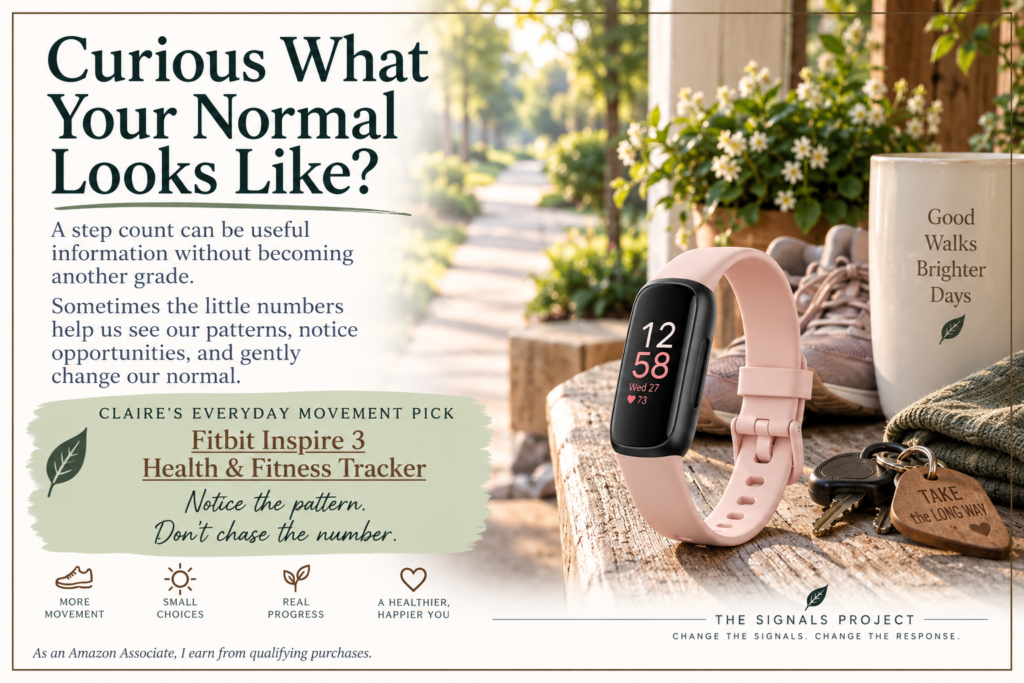
Affiliate link — I may earn a commission from qualifying purchases at no additional cost to you.
Where Is the Longer Way?
Once you start looking for everyday movement, you begin to see opportunities everywhere.
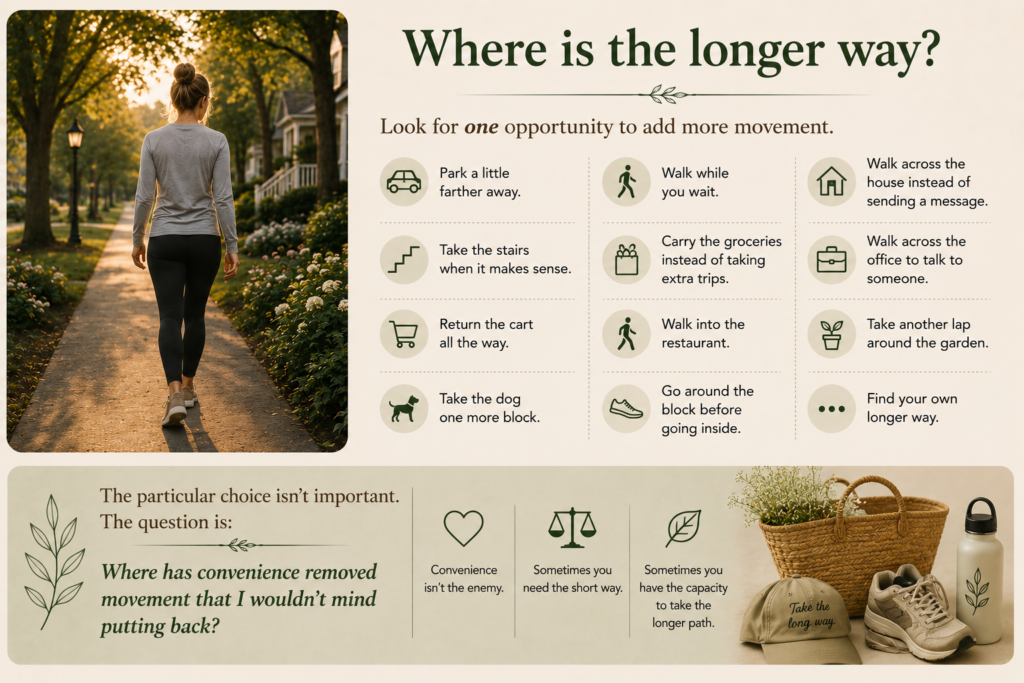
They aren’t usually dramatic. In fact, most of them are almost ridiculously ordinary. The farther parking space. The stairs instead of the elevator. Returning the shopping cart instead of leaving it in the corral beside your car. Walking into the restaurant instead of using the drive-through. Taking the dog around one more block. Walking across the house to talk to someone instead of calling or texting from another room.
The point is not to make your life unnecessarily difficult. Sometimes you are carrying three bags, it is pouring rain, your knee hurts, you are running late, or you simply need the closest parking space. Take the short way. Convenience exists for a reason, and there is no prize for making every task harder than it needs to be.
But there are also plenty of days when the longer way costs almost nothing.
You might park at the far end of the lot when you have time. Take the stairs for one floor. Carry the groceries inside instead of trying to make one heroic trip with fourteen bags hanging from your arms. Walk around the block before going back into the house. Wander through the garden while you drink your coffee. Walk while you wait for your child instead of sitting in the car. Take the long route through the office. Add another few minutes before turning toward home on your usual walk.
None of those choices needs to become a rule. They are simply opportunities.
And that may be the most useful way to approach everyday movement: not as another thing you have to do, but as something you can choose when the opportunity appears.
The environment around us constantly influences which signals are easiest to send. If the closest parking space, elevator, delivery button, chair, and shortest route are always the automatic choice, movement can quietly disappear from the day. Sometimes changing the movement signal is as simple as noticing that automatic choice and deciding, I have the capacity for the longer way today.
Not every time.
Not because the shorter way is wrong.
Just because sometimes, you can take the long way.
Don’t Turn This Into Another Rule
There is a trap hiding inside almost every conversation about health: the moment we learn that something may be useful, we turn it into something we are supposed to do perfectly.
Suddenly parking farther away isn’t an option; it’s a requirement. Taking the stairs becomes another box to check. A lower-step day feels like failure. The smartwatch starts handing out imaginary grades. Before long, something that was supposed to create more freedom and movement has become another way to judge ourselves.
That is not what I want you to take from this.
There will be days when you move more and days when you move less. There will be seasons of life when long walks fit easily and seasons when they don’t. Illness, injury, work, caregiving, travel, weather, exhaustion, and a hundred other realities can change what movement looks like from one day to the next.
Consistency does not require identical days. It comes from the patterns we repeat over time.
So use the elevator when you need the elevator. Take the close parking space when you need the close parking space. Sit down when your body needs rest. None of those choices erases the movement you did yesterday or determines what you will do tomorrow.
The goal is not to make life as inconvenient as possible.
The goal is to notice that convenience has made movement optional in places where it once happened automatically—and then decide whether there are a few places where you would actually enjoy putting some of it back.
That is a very different question from How can I force myself to move more?
It is curious rather than punitive. Flexible rather than rigid. And it leaves room for something that matters enormously when we are trying to create lasting change:
Real life.
Try This Tomorrow: Find One Longer Way
Tomorrow, don’t try to overhaul your entire day.
Just notice it.
Notice where you automatically choose the closest, quickest, easiest option. Notice when you sit because sitting is simply what you always do. Notice the moments when a few extra minutes of movement would be completely reasonable—and then choose one.
Park a little farther away. Take the stairs. Walk while you wait. Carry something yourself. Go around the block before heading inside. Take the dog a little farther than usual. Walk across the house instead of sending the text.
It doesn’t really matter which one you choose.
You are not trying to burn a certain number of calories or earn enough steps to make the day count. You are experimenting with the environment around you and changing one small part of your usual pattern.
Then notice what happens.
Maybe it feels good. Maybe you barely notice the difference. Maybe you discover an opportunity you could easily repeat. Maybe that particular longer way is annoying and you never choose it again.
That’s useful information too.
Because this isn’t about finding the right longer way.
It’s about discovering which kinds of movement can become a natural part of your life.

Ordinary Movement Is Still Movement
It is easy to underestimate movement when it doesn’t look like exercise.
A walk through the parking lot doesn’t come with a warm-up. Carrying groceries doesn’t appear on a training plan. Taking the stairs doesn’t earn you a certificate, and nobody is standing at the top waiting to hand you a medal. Most everyday movement is so ordinary that we barely notice we are doing it.
But ordinary doesn’t mean irrelevant.
Formal exercise has an important place. Strength training can challenge muscle in ways carrying laundry cannot. A purposeful walking workout can challenge your pace, endurance, or cardiovascular fitness in ways wandering through the grocery store probably won’t. Different kinds of movement create different demands, and we don’t need to pretend they are interchangeable in order to recognize that they can all have a place in an active life.
That is why the goal of everyday movement isn’t to replace exercise.
It is to expand our idea of where movement belongs.
Maybe you have a day when you head outside for a more challenging walking workout. Maybe after dinner you take a short walk because it fits naturally into the evening. And maybe on another day, there is no planned walk at all—but you take the stairs, park farther away, work in the garden, carry groceries, wander through a store, and get up from your desk more often.
Those days do not have to look identical to be part of a life that includes movement.
This is especially important if formal exercise has started to feel like the only movement worth counting. When the standard becomes Did I work out today?, an enormous amount of ordinary activity can disappear from our awareness. A better question might be, How did I move today?
That question leaves room for the workout.
And the stairs.
And the dog walk.
And the groceries.
And the five minutes you walked while waiting for your child.
Movement is one of the signals we send to the body, and those signals are created across the conditions and choices of an entire day. Some will be deliberate and challenging. Others will be small enough that nobody else ever notices them.
They still happened.
And when those small choices become part of the way you regularly live, something much more interesting than a perfect step count can begin to change:
your normal.

Take the Long Way
We have become very good at making life efficient. Most of the time, that is a wonderful thing.
But efficiency does not have to make every decision for us.
There will still be days when the closest parking space makes sense, the elevator is exactly what you need, dinner arrives at the front door, and the shortest route is the right route. Taking the long way is not a rule, and choosing convenience is not a failure.
It is simply an invitation to notice.
To notice the places where movement has quietly disappeared from ordinary life. To notice the moments when you have the time, energy, and capacity to put a little of it back. And to recognize that those choices do not have to be dramatic before they become meaningful parts of the way you live.
You don’t have to overhaul your life.
You don’t have to chase somebody else’s number.
You don’t even have to reject convenience.
Sometimes you can simply notice what convenience quietly removed—
and take the long way.
Change the Signals. Change the Response.
Sources
Ding D, Nguyen B, Nau T, et al. Daily steps and health outcomes in adults: a systematic review and dose-response meta-analysis. The Lancet Public Health. 2025;10(8):e668–e681. doi:10.1016/S2468-2667(25)00164-1.
PubMed
Reyes-Molina D, Zapata-Lamana R, Nazar G, et al. Conceptual and Evidence Update on Incidental Physical Activity: A Scoping Review of Experimental and Observational Studies. Scandinavian Journal of Medicine & Science in Sports. 2025;35(1):e70015. doi:10.1111/sms.70015.
PubMed
U.S. Department of Health and Human Services, Office of Disease Prevention and Health Promotion. Physical Activity Guidelines for Americans, 2nd edition and accompanying guidance. The updated guidelines removed the previous requirement that physical activity occur in bouts of at least 10 minutes and emphasize moving more and sitting less throughout the day.
Physical Activity Guidelines Q&A