There’s a particular kind of courage required to begin something when you’re old enough to know how many ways it could go wrong.
When we’re young, starting over can feel almost inevitable. We expect to move, change jobs, meet new people, make mistakes, and try again. The future stretches out in front of us, full of possibilities we haven’t yet learned to question. Even our uncertainty has a certain excitement to it.
But somewhere along the way, beginnings start to feel more complicated.
We build lives. We develop routines, responsibilities, relationships, and expectations. We become people who know how things work, at least within the familiar boundaries of our own little worlds. There’s comfort in that. There’s pride in it, too. We’ve worked hard to get here.
And then, sometimes, something changes.
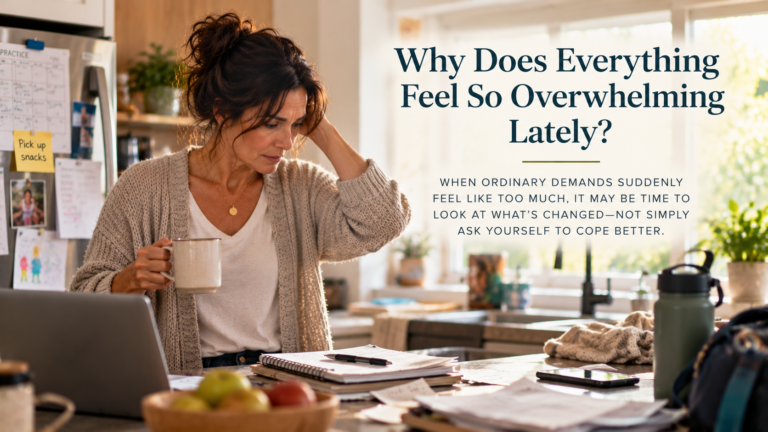
Maybe it’s a relationship that no longer looks the way it once did. A career that has stopped feeling meaningful. Children growing older and needing us differently. A body that seems to be rewriting its own rules. Or perhaps nothing dramatic happens at all. We simply wake up one day and realize that something we’ve been doing for years doesn’t feel quite right anymore.
The unsettling part is that we may not know what should come next.
When the Old Life Still Fits on Paper
One of the strangest things about outgrowing a chapter of life is that it doesn’t always look like anything is wrong.
From the outside, everything may appear perfectly reasonable. The routines are established. The responsibilities are being handled. The life we’ve built makes sense to everyone who can see it.
It may even be a life we once wanted very much.
That’s what makes the questions difficult. How do you explain wanting something different when you can’t point to a disaster? How do you admit that a dream has changed without feeling ungrateful for having reached it?
I think we sometimes imagine that change requires a sufficiently dramatic reason. Something that makes the decision obvious, understandable, and easy to defend. But people change even when their circumstances don’t. Our priorities shift. Our interests deepen or disappear. Experiences teach us things we couldn’t have known when we made earlier decisions.
A choice can have been right for the person we were then without being right for the person we’re becoming.
That doesn’t make the earlier choice a mistake.
It simply means we’re still growing.
The Grief That Can Come With a New Beginning
We don’t talk enough about how even welcome changes can carry a sense of loss.
Starting something new often means leaving something familiar behind. Sometimes that’s a place or a person. Other times it’s an identity we’ve carried for so long that we barely recognize it as one.
The capable employee. The mother who knows exactly what everyone needs. The friend who always says yes. The person with a plan. The person who never changes her mind.
There can be real sadness in loosening our grip on those versions of ourselves, even when we’re ready.
And when change arrives without our permission, the feelings become more complicated still. Not every new beginning is chosen. Some follow disappointment, illness, separation, financial hardship, or the loss of someone we love. Calling those experiences opportunities for growth too quickly can dismiss what they actually cost us.
Sometimes a beginning is simply what remains after something else has ended.
We don’t have to celebrate that before we’re ready. We don’t have to find a silver lining or turn every difficult experience into a lesson worth sharing.
We can miss what was and still make room for what comes next.
Both things can be true.
The Humbling Business of Being a Beginner Again
There’s another reason starting over can feel harder with age: we’ve gotten used to knowing what we’re doing.
By midlife, most of us have spent decades becoming competent at something. We’ve learned how to manage households, navigate workplaces, raise families, solve problems, and make decisions. We may not feel especially confident every day, but there’s a great deal we know how to do without thinking about it.
Then we try something unfamiliar.
Suddenly, we’re asking basic questions. Making clumsy attempts. Watching other people do effortlessly what takes us an hour to figure out. Wondering whether we’re too old, too late, or simply not cut out for it.
It’s uncomfortable to go from experienced to inexperienced.
And yet, there’s something quietly wonderful about being willing to do it.
Think about how much of childhood is spent learning in public. Children fall while learning to walk. They stumble through new words, draw lopsided pictures, and ask questions without knowing whether they’re supposed to know the answers already.
Somewhere along the way, many of us become less willing to be seen learning.
We begin to confuse being inexperienced with being incapable.
But those are very different things.
Not knowing how to do something yet isn’t evidence that we shouldn’t try. It’s simply where learning begins.
And perhaps one of the gifts of getting older is realizing that we no longer need to be impressive at everything we attempt.
We’re allowed to be beginners. We’re allowed to be bad at something for a while. We’re even allowed to discover that we don’t particularly enjoy it and try something else.
Imagine that.
Not Every Beginning Needs an Announcement
When we hear stories about people starting over, they often involve sweeping changes. Someone quits a career, moves across the country, opens a business, or finally pursues a lifelong dream.
Those stories can be inspiring. But they can also make ordinary beginnings seem insignificant by comparison.
Most change doesn’t arrive with a dramatic soundtrack.
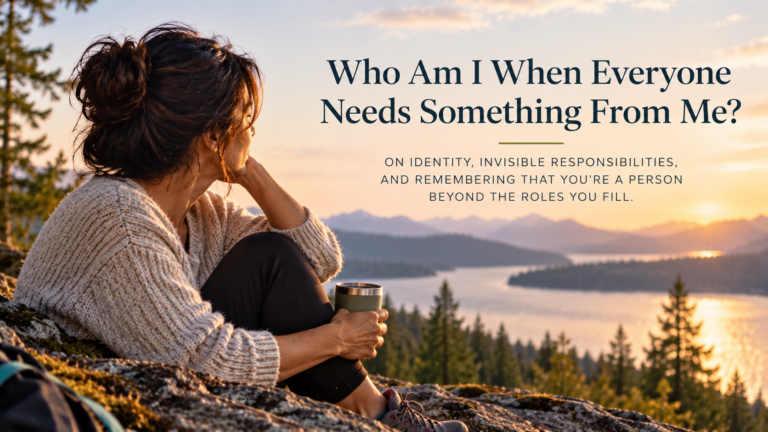
Sometimes it begins with signing up for a class. Making a phone call we’ve been avoiding. Taking a walk alone because we’ve forgotten what it feels like to have an hour that belongs entirely to us.
Sometimes it means setting a boundary, asking for help, returning to an old interest, or admitting that a familiar way of doing things isn’t working anymore.
And sometimes the beginning is so small that nobody else notices.
We simply stop telling ourselves that it’s too late.
That may not look particularly courageous from the outside. There are no packed suitcases or grand announcements. Nothing to photograph. Nothing to celebrate publicly.
But the person making that decision knows what it took.
A beginning doesn’t have to be visible to be meaningful.
We Don’t Have to Become Someone Else
There’s a great deal of pressure surrounding the idea of reinvention, especially for women in midlife.
We’re encouraged to become stronger, healthier, more adventurous, more confident, more organized, more fulfilled. There’s always another version of ourselves waiting somewhere just beyond the next improvement.
And while there’s nothing wrong with wanting to grow, I sometimes wonder whether all that emphasis on becoming someone new makes us overlook something important.
What if starting over isn’t about replacing ourselves?
What if it’s about making room for parts of ourselves that haven’t had much attention lately?
The curiosity we set aside when life got busy. The interests that didn’t seem practical. The opinions we softened to keep the peace. The ambitions we postponed. The simple pleasures we stopped making time for.
Maybe we don’t need an entirely new identity.
Maybe we need permission to stop fitting ourselves into an old one.
There’s a difference between changing because we believe we’re inadequate and changing because we’re still interested in living.
One begins with the assumption that something about us needs fixing. The other begins with curiosity about what might still be possible.
I know which one I’d rather carry into the next chapter.
The Courage to Begin Without Knowing the Ending
Perhaps the hardest part of starting over is accepting that we cannot know in advance how things will turn out.
Experience has taught us to recognize risks. We’ve seen plans unravel. We’ve watched good intentions meet complicated realities. We know that effort doesn’t guarantee success and that even carefully considered decisions can lead somewhere unexpected.
That knowledge can make us cautious.
But it can also make us wiser.
We don’t have to approach new beginnings with the blind confidence of someone who has never been disappointed. We can bring our experience with us. We can ask better questions, make more thoughtful choices, and recognize when something needs adjusting.
We can be hopeful without being certain.
And we can be afraid without allowing fear to make every decision.
I don’t think courage always feels like confidence. Sometimes it feels like uncertainty accompanied by a willingness to take one reasonable step anyway.
To send the application. Start the conversation. Walk through the door. Try the thing we’ve been quietly thinking about for years.
Not because we know it will work.
Because we’d like to find out.
There’s No Expiration Date on Becoming
I wonder how many things people never attempt because they’ve decided the appropriate time has already passed.
We tell ourselves we should have started ten years ago. That other people have a head start. That we ought to be settled by now.
And perhaps some opportunities really do have practical limits. It’s reasonable to acknowledge that. Our circumstances matter, and not every dream can be pursued in exactly the form we first imagined.
But there’s an enormous difference between recognizing a genuine limitation and assuming that age itself has made curiosity irrelevant.
We’re not required to stop learning because we’ve accumulated birthdays.
We’re not obligated to remain the person we were at thirty because other people have grown comfortable with her.
And we’re certainly not finished becoming simply because we’ve reached a stage of life that once seemed impossibly far away.
Maybe the strangest courage of starting over is accepting that we can be grateful for the life behind us, uncertain about the life ahead, and still willing to begin.
Not from scratch. We bring everything we’ve learned, loved, survived, and discovered along the way.
We’re not starting with nothing.
We’re starting from here.
And that seems like a perfectly good place to begin.