Walking doesn’t need an upgrade to count.
A slow walk around the neighborhood counts. Walking the dog counts. Wandering through the woods counts. The ten minutes you squeeze in before dinner count. So does the walk you take simply because the sun came out and you wanted to be outside. Not every walk needs to become a workout, but sometimes you want more.
Maybe you have twenty minutes and want to challenge yourself. Maybe the route you’ve been walking feels easier than it used to. Maybe you want your heart beating a little faster, your legs working a little harder, or simply something different from your usual loop. You don’t necessarily need another piece of equipment or an entirely new exercise program. You can change the walk.
Change Your Pace
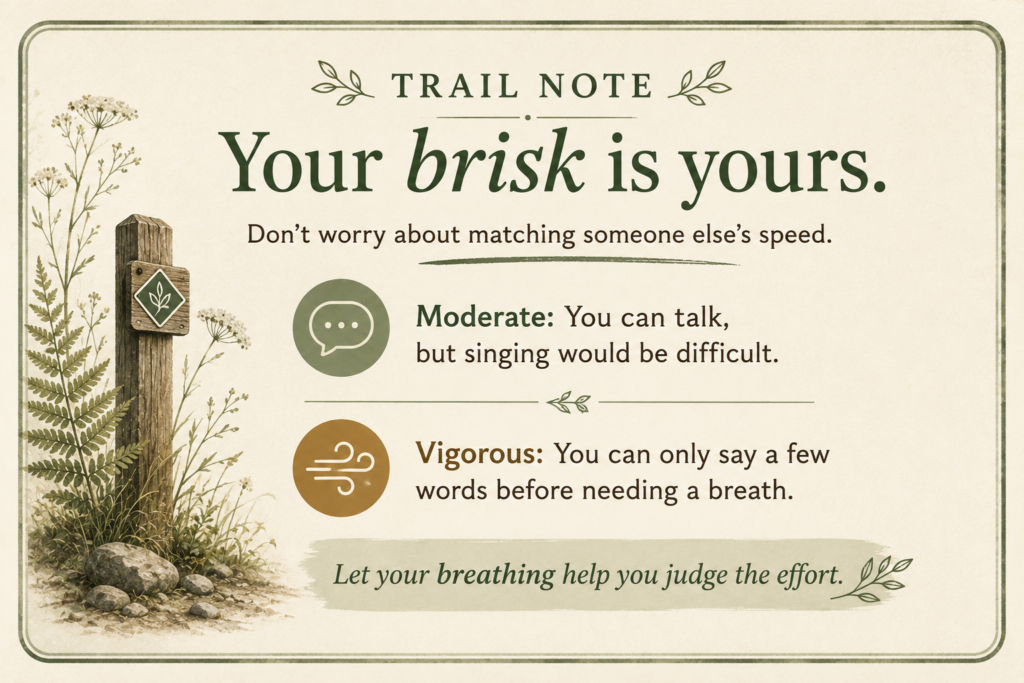
One of the simplest ways to change a walk is to change how quickly you’re moving, and you don’t need a stopwatch to do it. Walk at your comfortable pace for a while. Then choose something ahead of you—a mailbox, a tree, the end of the block, a bend in the trail—and pick up your pace until you reach it.
Settle back into your comfortable pace. When you’re ready, choose another landmark and do it again. The faster portions don’t need to be a sprint, and “brisk” won’t look the same for everyone. You’re simply asking a little more of yourself for a short stretch before easing off again.
Find a Hill
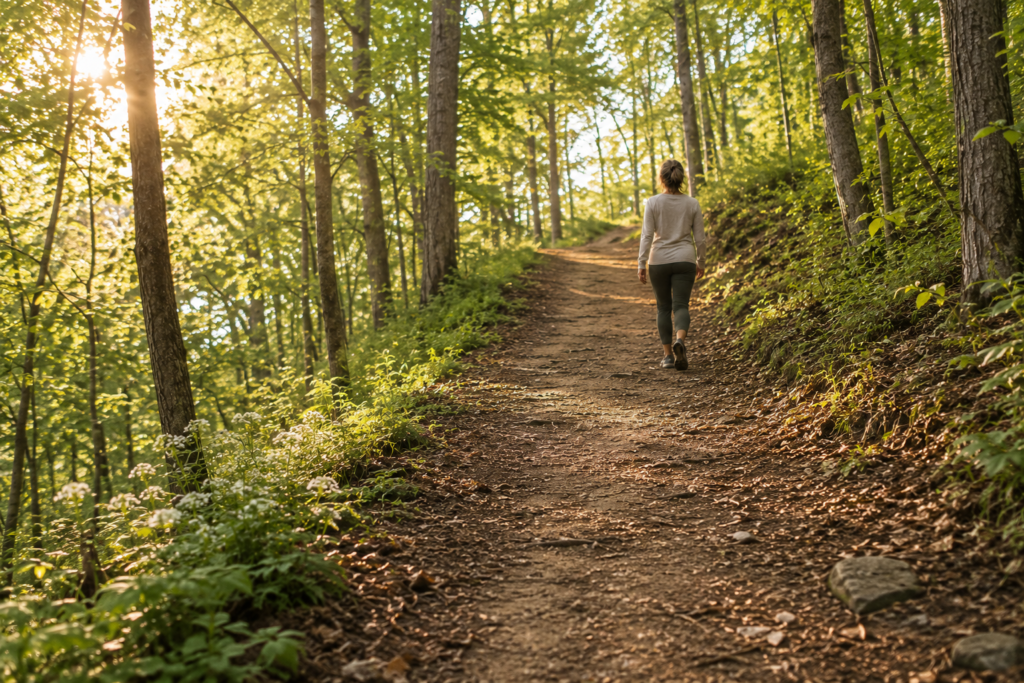
Please do not read the word hill and immediately picture yourself marching up the side of a mountain. We’re not training for Everest here. A hill can be the street that gradually rises on the way home, a sloped driveway, a rolling section of trail, or the little incline you’ve been avoiding because the flat route looked friendlier.
Walking uphill asks more of your body than walking on level ground. Your legs have to work differently against gravity, and your breathing may pick up even if your actual walking speed slows down. Start with the hills you already have. As they become more manageable, you can choose a slightly longer hill, a steeper one, or simply walk your familiar hill a little more confidently. The hill doesn’t have to look impressive. It only has to be uphill.
Try Structured Intervals
There’s a difference between casually changing your pace and deliberately training with intervals. The first can happen whenever you feel like it: speed up to that tree, slow down, and pick it up again later. Interval walking gives those changes some structure.
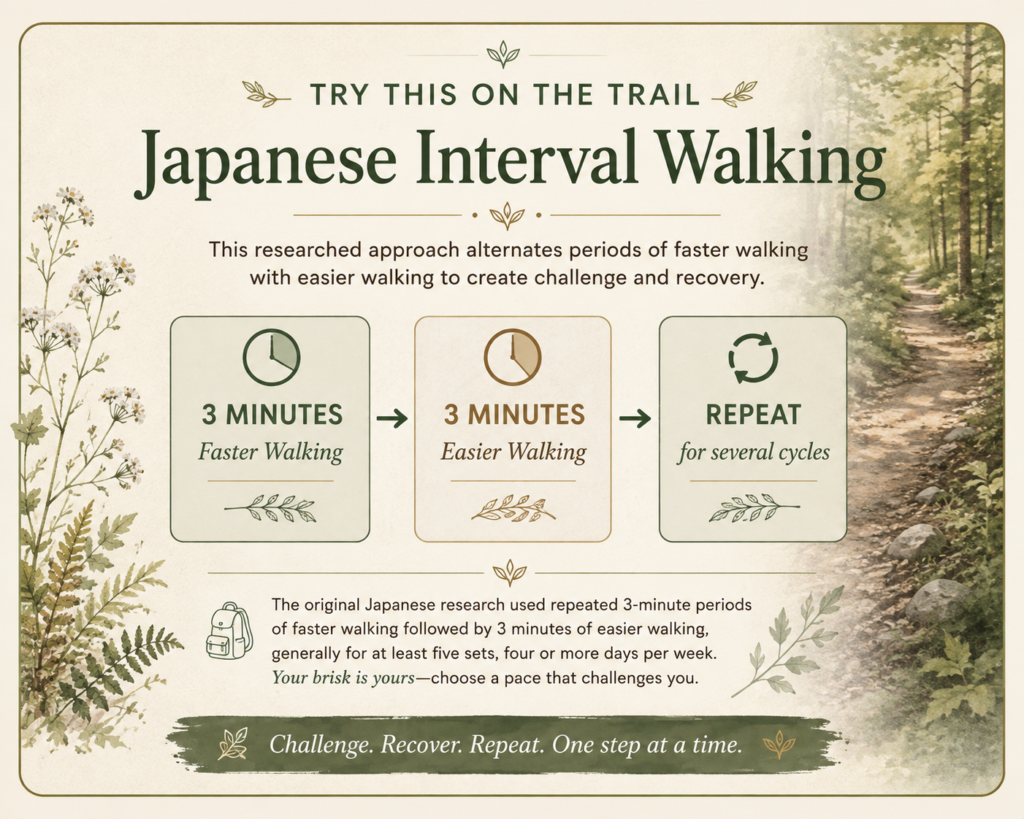
One method that has received a lot of attention is Japanese interval walking, developed and studied by researchers in Japan. The studied approach alternates repeated periods of faster and slower walking rather than maintaining one pace for the entire session. The harder periods create a different physical demand, while the easier periods give you a chance to recover before asking for more again. If you’re new to interval walking, you don’t have to begin with a long or punishing session. The goal isn’t to finish flattened on the sidewalk. It’s to create a challenge you can recover from—and repeat.
Take the Longer Route
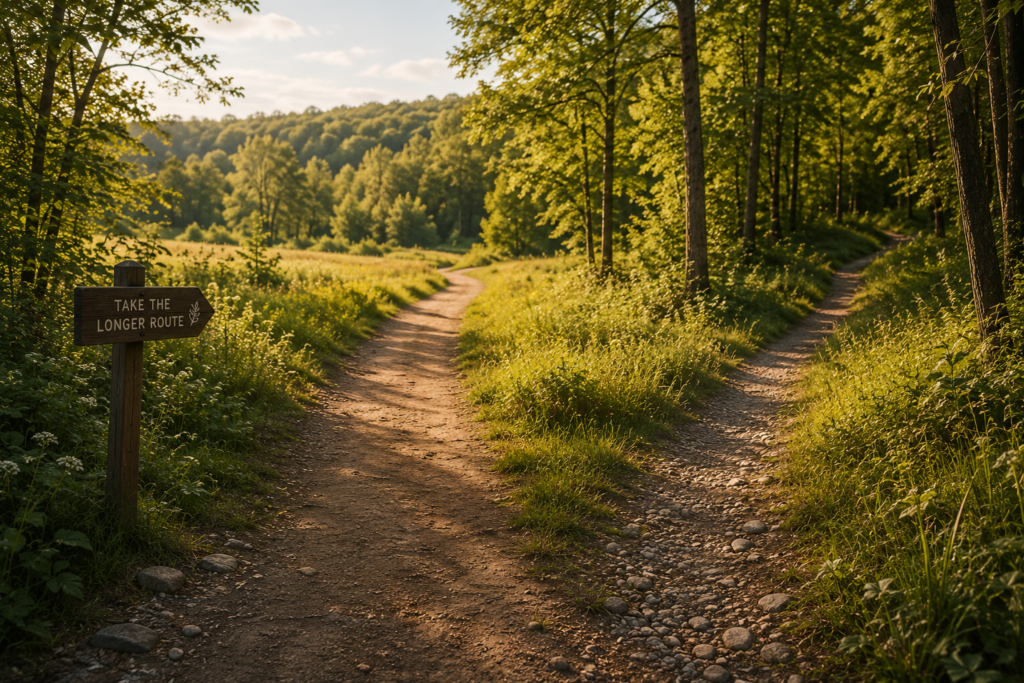
Challenge doesn’t always have to mean faster. Sometimes it simply means a little more. Walk one extra block before turning toward home. Take the longer loop through the park. Park once and walk between the places you need to go instead of moving the car. Choose the scenic route. Walk past your usual turnaround point and see what’s around the next corner.
Adding a little time or distance changes the amount of movement you’re accumulating without requiring you to turn the entire walk into an intense workout. And there is something I particularly like about this kind of progression: it lets your world get bigger. You start with the route you know. Then one day, you go a little farther.
Let the Terrain Do Some of the Work
A mile isn’t always the same mile. Walking on a smooth sidewalk feels different from walking across grass. Gravel feels different from packed dirt. A wooded trail asks something different of your feet and legs than a perfectly level treadmill. Research backs up what you can feel for yourself: changing the surface you’re walking on can change the way your body moves and the physical demands of the walk.
That doesn’t mean you should hunt down the most unstable ground you can find. It simply means terrain is another variable you can change. Try a maintained trail instead of the sidewalk. Walk across the grass at the park. Take the gravel path. Visit the beach and notice how different sand feels under your feet. And when the ground becomes uneven, slow down enough to pay attention. Roots, rocks, loose gravel, wet leaves, and holes don’t care how committed you are to today’s workout.
Add a Little More Challenge
Your walk can also become a place to add small doses of strength. A sturdy park bench might become a place for a few sit-to-stands. A safe step can become a few controlled step-ups. You might stop for calf raises or a small set of bodyweight squats before continuing down the trail. You don’t need to turn the park into a gym. A few intentional movements can simply add another kind of physical challenge to the walk.

Affiliate link — I may earn a commission from qualifying purchases at no additional cost to you.
A weighted vest is another option some people use to increase the load of a familiar walk. Adding weight means your body has more weight to move and manage, and weighted exercise has been studied in relation to musculoskeletal and bone health, particularly as we age. But a weighted vest isn’t a magic bone-building shortcut or a replacement for progressive resistance training. If you choose to use one, more weight isn’t automatically better. Fit, load, balance, joint comfort, existing injuries, and your current fitness level all matter. If carrying additional weight isn’t appropriate for you, leave the vest at home. There are plenty of other ways to challenge a walk.
Or Don’t Make It Harder at All
Once we learn that something can be progressed, it’s very easy to start believing that it must be progressed. It doesn’t. Yesterday’s walk may have included hills and intervals. Today’s might be twenty gentle minutes because the air feels good and you want to see what’s blooming. That doesn’t make today’s walk less valuable.
You send your body different signals through the conditions and choices you create. A more physically demanding walk is one option. Ordinary everyday movement is another. You don’t have to make every walk harder in order for movement to matter. You can understand what you’re choosing, observe how your body responds, and choose differently when you need or want something different.
Take This Walk
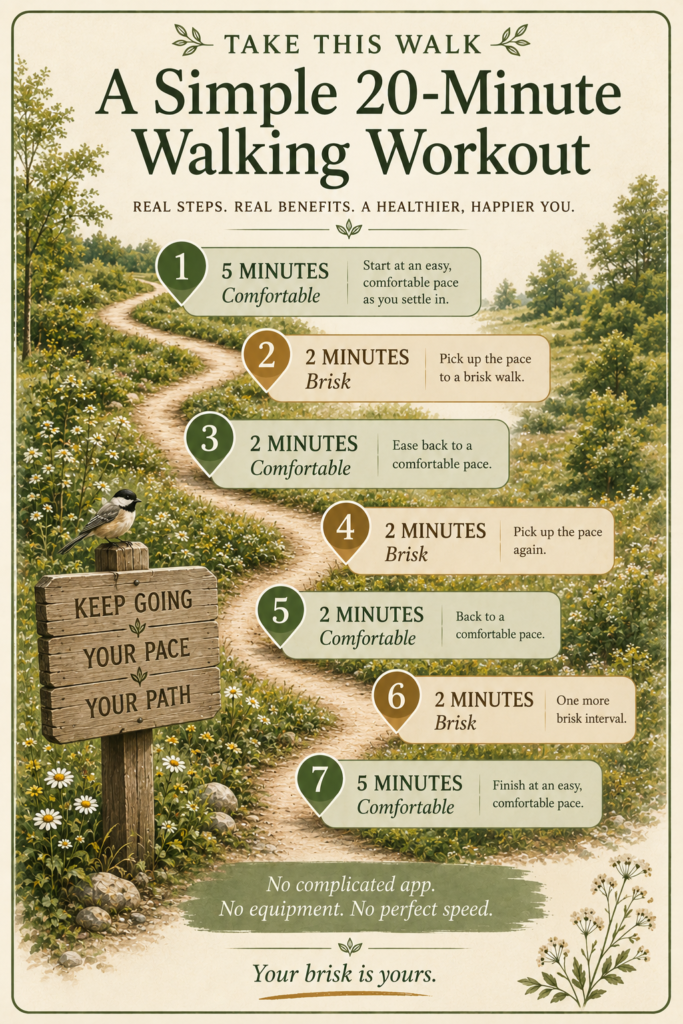
Want something simple you can use today? This 20-minute walk alternates comfortable and brisk periods, giving you a little more challenge without requiring complicated equipment, an app, or a particular walking speed.
Your Walk Doesn’t Have to Prove Anything
You don’t have to turn every walk into a workout. But when you want to challenge yourself, walking gives you plenty of ways to do it. Walk faster or farther. Find a hill. Change the terrain. Try intervals. Add some load. Choose the longer route. There are plenty of ways to ask a little more of a familiar walk without turning movement into punishment.
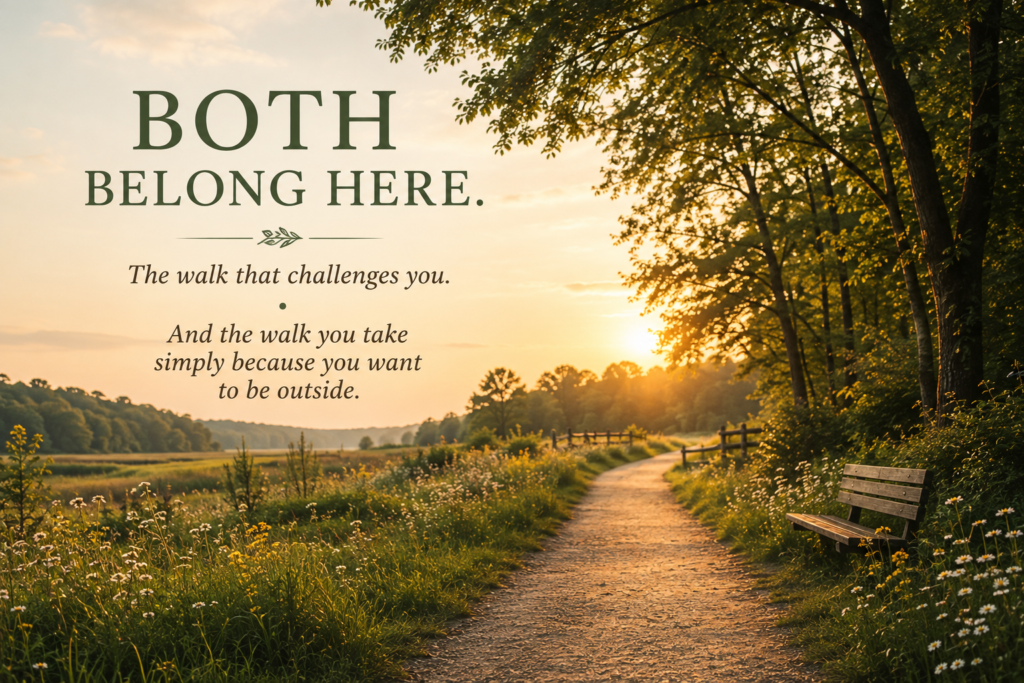
Or take the exact same gentle walk you took yesterday because the sun is shining and you want to be outside. Movement doesn’t have to be harder today than it was yesterday to matter. Some walks can challenge you. Some can simply carry you through your neighborhood, around the block, down a familiar path, or out the front door and back again. Both belong here.
A Note Before You Go
Choose walking routes, surfaces, intensity, and added resistance appropriate for your abilities and health. If you have a health condition, injury, balance concern, or questions about whether higher-intensity or loaded walking is appropriate for you, talk with a qualified healthcare professional.
Sources & Further Reading
Interval Walking Training
Nemoto K, Gen-no H, Masuki S, Okazaki K, Nose H. Effects of high-intensity interval walking training on physical fitness and blood pressure in middle-aged and older people. Mayo Clinic Proceedings, 2007. The study tested repeated three-minute lower- and higher-intensity walking intervals in middle-aged and older adults.
View the study on PubMed
Walking Intensity & the Talk Test
Centers for Disease Control and Prevention. How to Measure Physical Activity Intensity. The CDC’s talk test describes moderate activity as an intensity where you can talk but not sing; during vigorous activity, only a few words can generally be spoken without pausing for breath.
Read the CDC guidance
Walking on Uneven Terrain
Voloshina AS, Kuo AD, Daley MA, Ferris DP. Biomechanics and energetics of walking on uneven terrain. Journal of Experimental Biology, 2013. In a controlled study, uneven terrain altered walking mechanics and muscle activity and increased metabolic demand compared with smooth terrain.
View the study on PubMed
Incline Walking
Silder A, Besier T, Delp SL. Predicting the metabolic cost of incline walking from muscle activity and walking mechanics. Journal of Biomechanics, 2012. Researchers comparing level walking with 5% and 10% inclines found that incline was strongly associated with increased metabolic demand.
View the study on PubMed
Weighted Vests & Bone Health
A 2026 systematic review and meta-analysis of nine randomized controlled trials found that weighted-vest exercise improved bone mineral density compared with usual activity, but adding a vest to exercise has not yet shown a confirmed additional bone-density benefit over exercise alone. That’s exactly why our article treats the vest as one possible way to add load—not a magic bone-building tool.
View the review on PubMed