There was a time when making friends seemed to happen almost accidentally.
You sat beside someone in class. Worked the same shift. Lived down the hall. Had children the same age who ended up on the same playground or sports team.
You saw each other regularly, conversations developed, and eventually someone became part of your life.
You didn’t necessarily have to schedule friendship. It happened in the spaces where your lives naturally overlapped.
And then, somewhere along the way, those spaces changed.
People moved. Children grew older. Jobs became demanding. Parents needed care. Everyone seemed to have schedules that required three weeks of coordination just to arrange lunch.
You may still have people you care about. You may have a family, coworkers, neighbors, and acquaintances you speak with regularly.
But perhaps you’ve noticed that you don’t have many people you can call simply because you want to talk.
Or maybe you have friends you’ve known for years but rarely see.
And the thought of making new ones feels strangely intimidating.
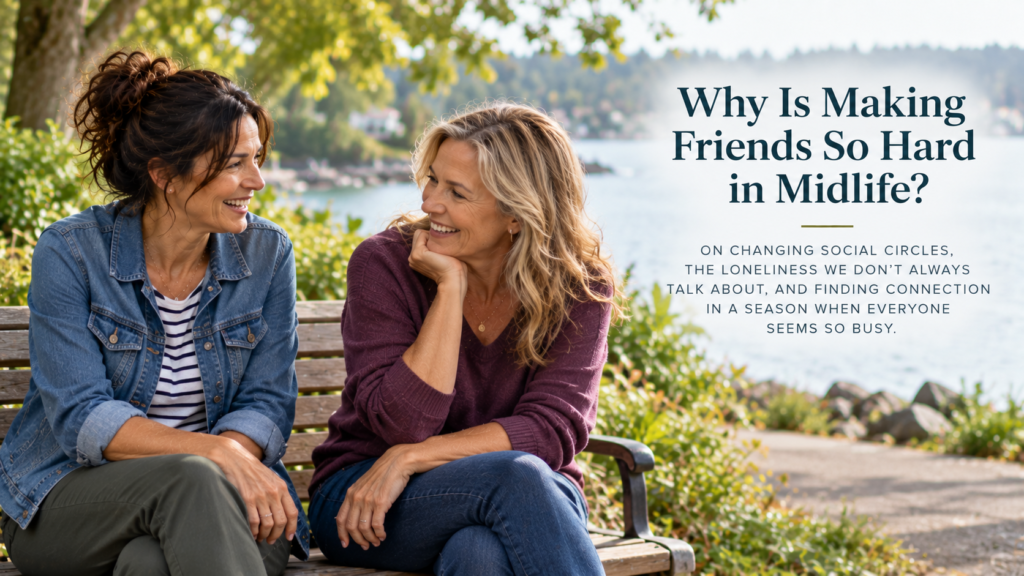
How do you even begin making friends when you’re forty-five, fifty-five, or sixty-five?
Friendship Needs Something Midlife Often Doesn’t Offer: Repeated Time Together
One reason friendships can feel easier earlier in life is that many of us spend extended periods around the same people.
School, shared housing, workplaces, and parenting activities create opportunities for repeated contact.
You don’t need to decide whether someone is friendship material during your first conversation. You simply see them again.
You learn what makes them laugh. You discover shared interests. You gradually become comfortable enough to talk about things beyond the weather or the next meeting.
In midlife, those opportunities may be less frequent.
You may work remotely, have a smaller social circle, or spend most of your free time managing household responsibilities. If your children are older, the activities that once brought you into regular contact with other parents may have disappeared.
And if you’re caring for aging relatives or managing health concerns, there may be even less room for social activities.
The difficulty isn’t necessarily that you’ve forgotten how to make friends.
You may simply have fewer opportunities for the kind of repeated, unhurried contact that helps friendships develop.
Recognizing that changes the problem.
Instead of asking why you’re not naturally meeting new people, you can begin thinking about where regular connection might fit into your life.
Being Surrounded by People Isn’t the Same as Feeling Connected
Loneliness doesn’t always mean being physically alone.
You can live in a busy household, spend your day communicating with coworkers, and have a calendar full of family responsibilities while still feeling that something is missing.
Perhaps most of your conversations are practical.
Who’s picking someone up? What needs to be purchased? When is the next appointment? Did anyone remember to pay that bill?
You may spend an entire day speaking with people without having a conversation that feels particularly personal.
Or perhaps you’re surrounded by people who know you primarily through your responsibilities.
They know you as a mother, partner, employee, caregiver, or the person who always organizes everything.
But you miss having someone who knows your interests, your humor, your history, and the things you’re thinking about when you’re not managing everyone else’s needs.
Researchers distinguish between social isolation and loneliness.
Social isolation generally refers to having relatively few social connections or interactions. Loneliness is the subjective feeling that your relationships aren’t providing the connection you want.
A person can experience one without the other.
That distinction matters because adding more social activities isn’t always the same as developing meaningful relationships.
Sometimes what you’re missing isn’t more people.
It’s a different kind of connection.
When Old Friendships Don’t Fit the Same Way
Longstanding friendships can be some of the most meaningful relationships in our lives.
They hold memories of who we were before careers, children, marriages, losses, and responsibilities changed our circumstances.
But those circumstances can also make friendship harder to maintain.
One woman may have young children while another is adjusting to an empty nest. Someone may be caring for a parent, navigating divorce, managing illness, or rebuilding life after a major loss.
You may still care deeply about each other while finding fewer opportunities to spend time together.
And sometimes your interests or values change.
A friendship built around a shared workplace may feel different after one person leaves. A relationship centered on parenting may require a new foundation once the children grow older.
This doesn’t mean either person has done something wrong.
Friendships can evolve, become less frequent, or change shape without losing their significance.
You might discover that a friend you once saw weekly becomes someone you speak with a few times a year—and that those conversations still matter enormously.
Or you may realize that a friendship has become one-sided and that you’ve been doing most of the work to maintain it.
Both experiences deserve consideration.
The goal isn’t to preserve every friendship exactly as it once existed.
It’s to make room for relationships that remain meaningful and reciprocal.
Why Reaching Out Can Feel Surprisingly Vulnerable
Making friends as an adult requires something many of us haven’t practiced in years: openly expressing interest in another person.
You meet someone you enjoy talking with. You have a few things in common. You think it might be nice to see her again.
And then comes the awkward part.
Do you ask for her number? Suggest coffee? Invite her for a walk?
What if she’s too busy? What if she isn’t interested? What if you’ve misunderstood the connection?
These concerns can feel almost adolescent, which may make them even more uncomfortable.
But there’s nothing immature about wanting friendship.
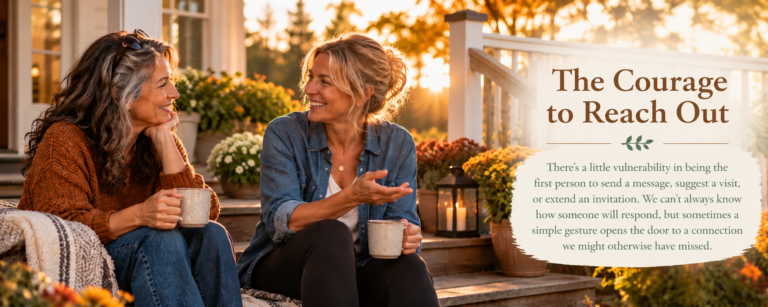
Reaching out involves a degree of vulnerability at any age.
And a declined invitation doesn’t necessarily mean rejection. People may be overwhelmed, unavailable, or managing circumstances you know nothing about.
Sometimes the simplest approach works best.
“I really enjoyed talking with you. Would you want to go for a walk sometime?”
Or:
“I’ve been thinking about trying that class again next week. Would you like to join me?”
You don’t need a clever explanation.
You can simply let someone know you enjoyed their company and would like to spend time together again.
Connection Often Begins With Showing Up More Than Once
If you’re hoping to build new friendships, recurring activities can be more useful than one-time social events.
A weekly walking group, regular volunteer shift, book club, community class, or hobby group gives you the opportunity to see familiar faces repeatedly.
And because you’re doing something together, conversation has a natural starting point.
You don’t have to walk into a room and immediately begin sharing your life story.
You can begin with the activity.
Over time, you may discover that you enjoy someone’s sense of humor, share similar interests, or simply feel comfortable in her company.
Not every connection will become a close friendship.
That’s normal.
The purpose isn’t to collect new friends as quickly as possible.
It’s to create opportunities for relationships to develop naturally.
And if a particular activity doesn’t feel like a good fit, that doesn’t mean you’ve failed.
You can try something else.
You Don’t Need to Become More Extroverted
Sometimes advice about making friends seems designed for people who already enjoy walking into rooms full of strangers.
Join a club. Attend networking events. Start conversations everywhere you go.
Those suggestions can be useful for some people.
But if you’re naturally quieter, prefer smaller groups, or feel drained by too much social activity, you don’t need to reinvent your personality.
Friendship doesn’t require being the loudest person in the room.
You may feel more comfortable connecting one-on-one, participating in activities with a clear purpose, or spending time outdoors where conversation can unfold without constant eye contact or pressure.
A walk with one person can be just as meaningful as a large social gathering.
So can a regular phone call, a shared project, or an occasional afternoon together.
The important question isn’t how many social events you’re attending.
It’s whether you’re developing connections that feel supportive, enjoyable, and sustainable for you.
When You’re the One Who Always Reaches Out
There’s another side of midlife friendship that can be painful.
You may have people you genuinely enjoy, but you’re always the one making plans.
You send the messages. You suggest getting together. You remember birthdays. You check in when someone is having a difficult time.
And eventually you begin wondering whether those friendships would continue if you stopped initiating contact.
It’s reasonable to want reciprocity.
But reciprocity doesn’t always look identical.
One person may be better at initiating plans while another consistently shows up, listens, and offers support when it matters. Someone going through a difficult season may have less capacity to maintain contact.
Rather than measuring friendship entirely by who sent the last message, consider the broader pattern.
Do you feel valued? Does the other person show interest in your life? Is there room for your needs as well as theirs? Does the relationship generally leave you feeling connected rather than depleted?
If the answer is consistently no, it may be worth having an honest conversation or adjusting how much energy you invest.
Friendship shouldn’t require one person to carry the entire relationship indefinitely.
Sometimes You Need to Make Space for Friendship
One of the more uncomfortable realities of midlife is that relationships need time.
And time is often the thing women feel they have least available.
You may tell yourself that you’ll make plans when work settles down, when the children are less busy, when caregiving becomes easier, or when you’ve finally caught up on everything at home.
But those quieter seasons don’t always arrive on schedule.
Sometimes friendship requires treating connection as something that deserves space before every other responsibility has been completed.
That doesn’t mean filling your calendar with social obligations.
It might mean scheduling a monthly walk with a friend, arranging a phone call during a commute, or choosing one recurring activity that gives you a chance to connect with others.
And sometimes it means letting something else wait.
Not everything on your to-do list is more important than the relationships that help make your life meaningful.
Of course, some women face significant barriers to social connection, including financial pressures, disability, transportation limitations, caregiving demands, or a lack of accessible community spaces.
Those challenges aren’t solved by simply deciding to socialize more.
In those circumstances, online communities, telephone connections, local support organizations, or accessible community programs may provide useful alternatives.
Connection should fit the realities of your life, not become another standard you’re expected to meet.
Friendship Is Part of Health, Too
Social connection isn’t merely a pleasant extra.
Research has linked loneliness and social isolation with poorer physical and mental health outcomes, including increased risks for depression and certain cardiovascular and cognitive health concerns.
These findings don’t mean that every lonely person will develop health problems or that friendship can replace medical care.
They do suggest that social relationships deserve attention as part of overall well-being.
And meaningful connection can take many forms.
Close friends, family relationships, community groups, neighbors, and supportive social networks can all contribute to a sense of belonging.
You don’t need a large circle or a constantly full calendar.
The quality of your relationships matters.
For some women, a handful of dependable connections may be far more satisfying than a wide network of acquaintances.
What If You’ve Been Lonely for a Long Time?
If you’ve been feeling disconnected for months or years, reaching out may feel difficult.
You might worry that everyone else already has enough friends or that you’ve somehow missed the stage of life when new relationships are supposed to form.
But friendship isn’t reserved for the young.
People form meaningful relationships after moving, changing careers, retiring, experiencing loss, or simply deciding they’d like more connection in their lives.
It may take time.
You may meet people you like but don’t become particularly close to. You may try activities that don’t suit you. You may need to initiate more than one invitation before a new connection develops.
None of that means you’re doing something wrong.
If loneliness is accompanied by persistent sadness, anxiety, withdrawal, or a loss of interest in activities you previously enjoyed, a qualified mental health professional may also be helpful.
Sometimes emotional distress makes connection harder, and addressing that distress can be part of finding your way back to relationships.
You don’t have to solve everything on your own before seeking companionship.
There Is Still Time to Find Your People
Midlife can bring an unexpected awareness of how much our relationships have changed.
Some people who once occupied a large part of your life may now be distant. Others may be navigating circumstances that make regular contact difficult. You may be discovering interests that the people around you don’t share.
And you may find yourself wishing for a kind of friendship you haven’t had in a while.
Someone to laugh with.
Someone who understands the season of life you’re in.
Someone who wants to take a walk, try something new, or simply talk about something other than appointments, responsibilities, and what needs to happen next.
That desire isn’t frivolous.
It’s human.
And you don’t have to wait until your life is less complicated to begin making room for it.
Maybe you start by reaching out to someone you’ve missed.
Maybe you return to an activity you enjoy.
Maybe you introduce yourself to someone you keep seeing on the same walking path.
Or maybe you simply acknowledge that connection matters to you and deserves a place in your life.
You haven’t aged out of friendship. You haven’t missed your chance. And you don’t need to become someone else to find people who enjoy the person you are now.
Sometimes it begins with one conversation.
And then another.
Sources
National Institute on Aging — Loneliness and Social Isolation: Tips for Staying Connected
Information about social connection, loneliness, and practical ways to maintain relationships.
https://www.nia.nih.gov/health/loneliness-and-social-isolation/loneliness-and-social-isolation-tips-staying-connected
U.S. Surgeon General — Our Epidemic of Loneliness and Isolation (2023)
An advisory examining the importance of social connection and its relationship to health.
https://www.hhs.gov/sites/default/files/surgeon-general-social-connection-advisory.pdf
Centers for Disease Control and Prevention — Social Connection
Public health information about the role of social relationships in well-being.
https://www.cdc.gov/social-connectedness/
American Psychological Association — Relationships
Educational resources about friendship, connection, and healthy relationships.
https://www.apa.org/topics/relationships
This article is for educational purposes and does not replace individualized medical or mental health advice.