One of the first questions people ask when they begin strength training is also one of the hardest to answer with a single number: How heavy should my weights be?
Walk into a store or scroll through a beginner workout, and you’ll find dumbbells in every size imaginable. Two pounds, five pounds, ten pounds, twenty pounds. Some workouts tell you to grab a light pair. Others say to choose something challenging. Neither instruction is particularly helpful when you’re still trying to figure out what those words mean for you.
The good news is that you don’t need to know your perfect starting weight before you begin. In fact, there isn’t one perfect weight. The right amount of resistance depends on the exercise, your current strength, how many repetitions you’re doing, and how comfortably you can control the movement.
What matters isn’t choosing an impressive number. It’s choosing enough resistance to give your muscles a reason to adapt, while still being able to move well.
And there’s a surprisingly straightforward way to figure that out.
The Short Answer: Choose a Weight That Challenges You Without Taking Away Your Control
The right weight is one that makes your muscles work while still allowing you to perform the exercise with good technique. That sounds simple enough, but the important part is understanding what challenging actually feels like.
Imagine you’re doing a set of ten dumbbell rows. The first few repetitions might feel relatively easy. As you continue, you begin to notice the effort increasing. By the eighth or ninth repetition, your muscles are working noticeably harder, but you can still move the weights smoothly, maintain your position, and finish without swinging or twisting your body to get the dumbbells up.
That’s the kind of challenge we’re looking for.
You don’t need to reach the point where you physically cannot complete another repetition. Especially when you’re learning a new movement, it’s often more useful to finish a set feeling as though you could have performed another two or three repetitions with good technique. This gives you room to practice the movement while still providing a meaningful strength-training stimulus.
On the other hand, if you finish ten repetitions and feel as though you could comfortably do twenty more, the weight may be too light for your current goal. You’re still moving, and that isn’t worthless, but your muscles may need more resistance to continue getting stronger.
The key is that effort and control need to exist together. A weight that forces you to abandon your technique isn’t automatically better because it’s heavier. And a weight that never challenges you won’t necessarily keep producing the adaptations you’re looking for.
Your starting point is simply the place where those two things meet: enough resistance to make the work meaningful, and enough control to perform it well.
How to Tell If Your Weights Are Too Light, Too Heavy, or Just Right
Once you begin paying attention to how an exercise feels, choosing a weight becomes much less mysterious. Your body gives you useful information throughout a set—not just when you finish it. The trick is learning to recognize the difference between productive effort and a weight that’s making the movement harder to control.
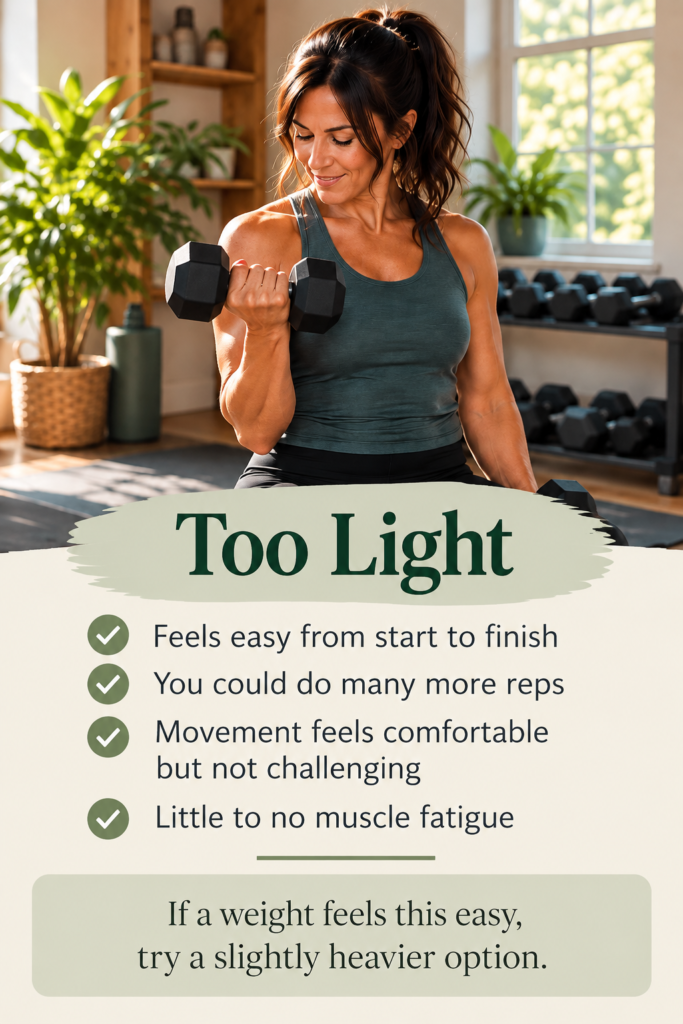
Your Weights May Be Too Light If…
You finish your planned repetitions without feeling much effort in the muscles you’re trying to train. The movement stays easy from beginning to end, and you could comfortably continue for many more repetitions without slowing down or feeling particularly challenged.
For example, imagine doing twelve biceps curls with five-pound dumbbells. If you reach the twelfth repetition and feel like you could easily complete another fifteen, those weights are probably lighter than you need for that particular exercise and repetition range.
That doesn’t mean the set was wasted. Lighter weights can be useful when learning technique, warming up, returning after time away, or working around certain limitations. But if your goal is to build strength, you’ll generally want to reach a point where the resistance requires meaningful effort.
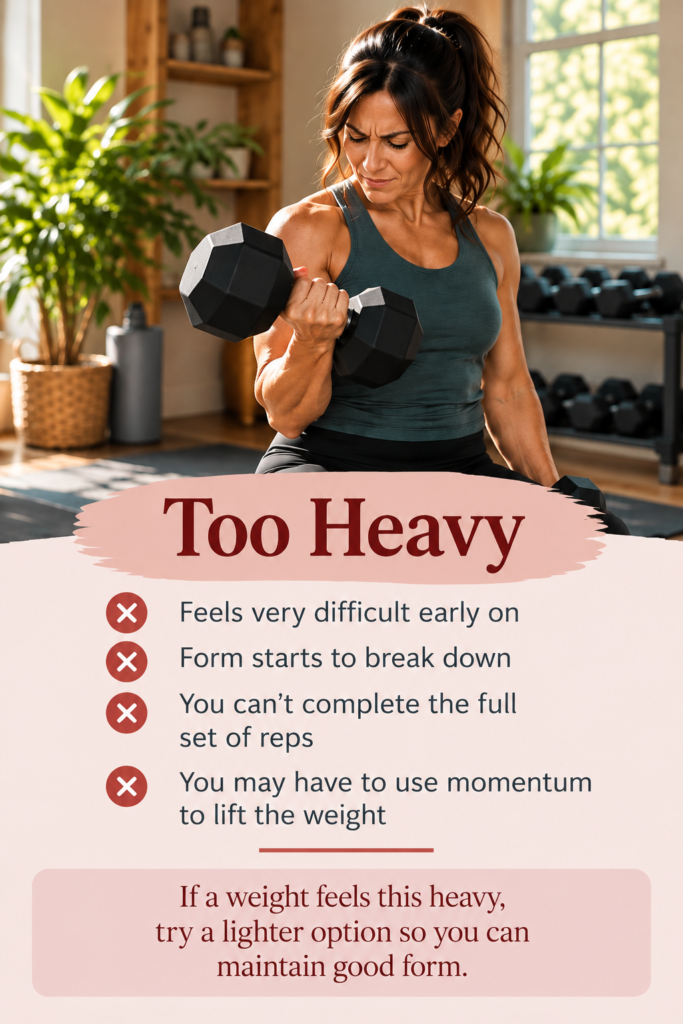
Your Weights May Be Too Heavy If…
You struggle to control the movement from the beginning, or your technique starts changing substantially before you reach your intended number of repetitions. You might find yourself swinging the weights, holding your breath excessively, leaning backward, shortening the movement, or relying on momentum to finish.
Consider a standing dumbbell overhead press. If you have to arch your lower back dramatically or push the weights upward with your whole body just to complete a few repetitions, the dumbbells may be too heavy for a controlled standing press right now.
Some slowing and increased effort near the end of a challenging set are normal. What we’re watching for is the point where you can no longer perform the movement with reasonable control. Sharp pain, dizziness, or unusual symptoms are reasons to stop rather than push through.
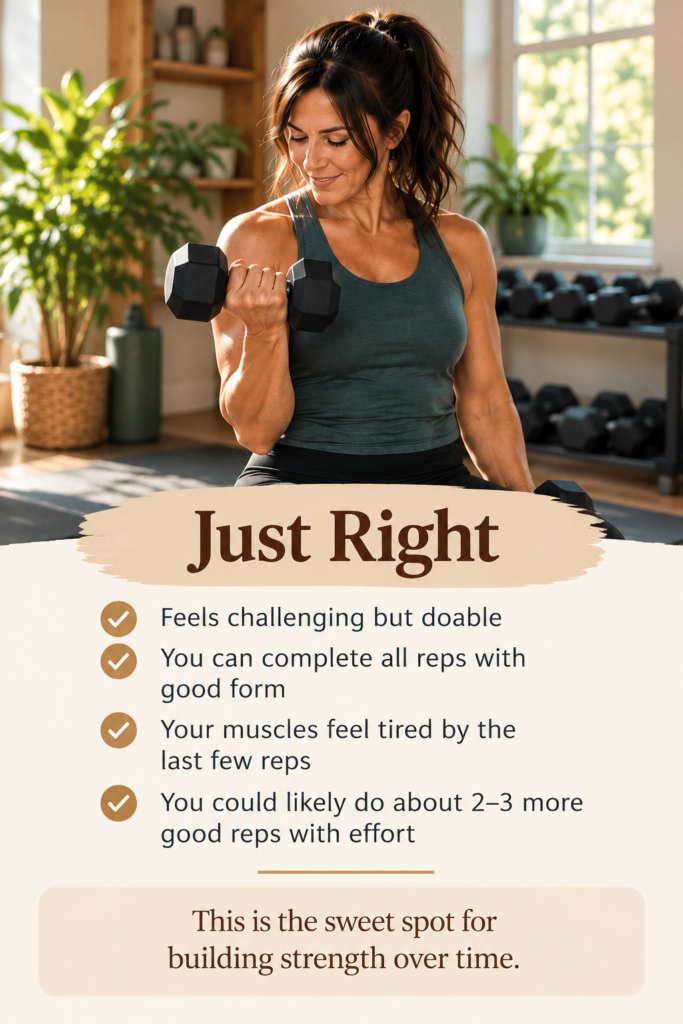
Your Weights Are Probably About Right If…
The first several repetitions feel manageable, but the exercise becomes noticeably more challenging as the set continues. By the final few repetitions, you’re concentrating on the effort, yet you’re still able to maintain your position and move through a comfortable range of motion.
When you finish, you feel as though you could complete approximately two or three more repetitions with good technique, but not another ten or fifteen. That isn’t a strict rule for every workout, but it’s a useful starting point for many beginners.
For instance, if you’re performing ten dumbbell rows and finish the tenth repetition feeling that you could manage another two controlled repetitions, you’ve probably found a reasonable working weight for that exercise.
Remember that the right weight is specific to the movement and to you. What feels challenging for one exercise may feel easy for another, and what works today may change as your strength improves.
A Simple Way to Find Your Starting Weight
You don’t need a complicated strength assessment or a collection of every dumbbell size to figure out where to begin. One of the simplest approaches is to choose an exercise, try a manageable weight, and pay attention to how the repetitions feel. From there, you can make small adjustments until you find a level of resistance that challenges you without compromising your technique.
Let’s use a standing dumbbell row as an example. If you’re unfamiliar with the movement, you can find a visual demonstration and instructions in our Exercise Library. Before adding much resistance, take a few moments to practice the movement itself. Get comfortable with the position, the direction you’re pulling, and what it feels like to move through a controlled range of motion.
Step 1: Choose a Manageable Weight
Start with a pair of dumbbells you feel confident you can control. If you’re completely new to strength training, it’s perfectly reasonable to begin with a very light pair while you learn the movement. The purpose of this first attempt isn’t to prove how much you can lift. It’s to establish a starting point.
Step 2: Try 8–12 Repetitions
Perform the exercise slowly enough to stay in control, aiming for somewhere between eight and twelve repetitions. Pay attention to how the effort changes as you move through the set. Are the first few repetitions comfortable? Does the exercise become noticeably more challenging toward the end? Can you maintain your position without swinging the weights or rushing?
The 8–12 repetition range is a practical starting point for this example, not a requirement for every exercise or every training goal.
Step 3: Ask Yourself One Question
When you finish the set, ask yourself:
“How many more repetitions could I have completed with good technique?”
If your answer is ten or fifteen, the weight is probably too light to provide much challenge at that repetition range. If you barely completed four or five repetitions before losing control, it’s likely too heavy for where you’re starting.
If you could have completed another two or three controlled repetitions, you’ve probably found a reasonable working weight.
Step 4: Adjust and Try Again
If the weight felt too light, try the next available dumbbell size. If it felt too heavy, choose something lighter. Give yourself a short rest before testing again so fatigue from the previous attempt doesn’t distort the result.
You don’t have to find the perfect weight in a single session. In fact, it’s completely normal to experiment a little, particularly when you’re learning a new exercise. The goal is to find a useful starting point, not to establish a permanent number.
Step 5: Remember What You Learned
Once you’ve found a weight that feels appropriately challenging, make a quick note of it. You might write something as simple as “Dumbbell row — 10 pounds each — 10 repetitions — felt challenging but controlled.”
That gives you something to refer to the next time you perform the exercise. Over time, those small notes can help you recognize when a weight that once felt challenging has become easier.
You may also notice that the same weight feels different from one workout to another. Sleep, recovery, stress, and accumulated fatigue can all influence how an exercise feels on a particular day. That’s normal. Your working weight is a tool you can adjust, not a number you’re obligated to lift every time.
The important thing is to begin with a weight you can control, pay attention to the effort, and let what you learn guide your next choice.
Different Exercises Need Different Weights
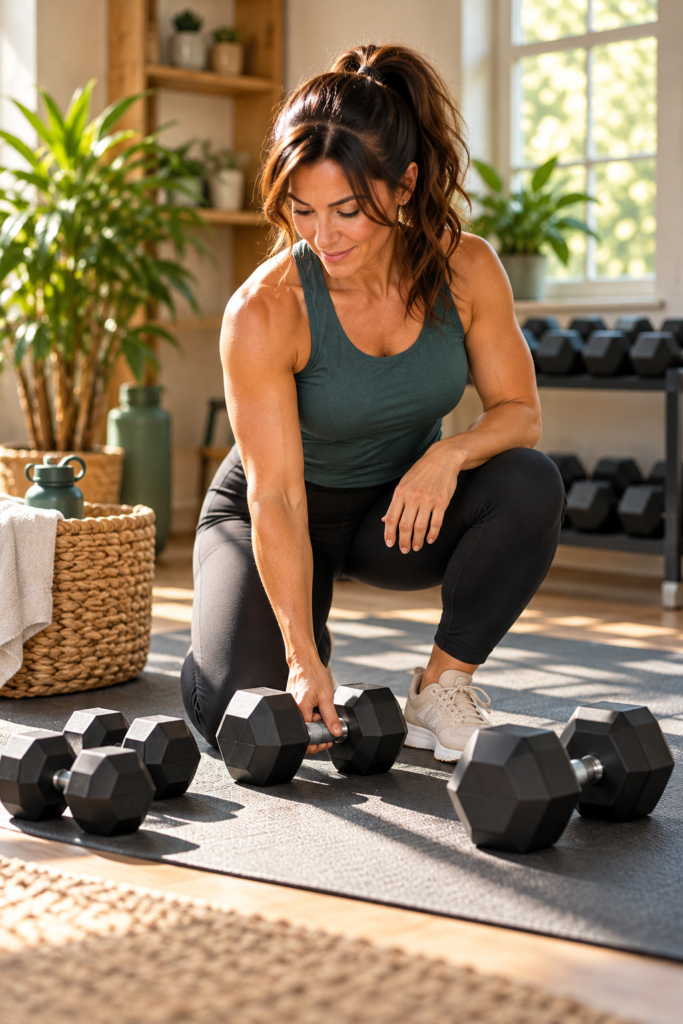
One of the most common misconceptions about strength training is that you should be able to use the same pair of dumbbells for every exercise. It’s an understandable assumption, especially when you’re just getting started and don’t want to buy an entire collection of equipment. But different movements ask different muscles to do different amounts of work, and the weight that’s appropriate for one exercise may be completely wrong for another.
Think about the difference between a dumbbell Romanian deadlift and a standing overhead press. During a Romanian deadlift, you’re using large, powerful muscles around your hips and legs to move the weight. During an overhead press, your shoulders and arms are doing much more of the work. It’s entirely reasonable to use substantially heavier dumbbells for the first exercise than for the second.
Even exercises that seem similar can require different weights. A dumbbell row and a biceps curl both involve your arms, but a row also recruits larger muscles through your back and shoulders. You may find that you can row a weight comfortably that would be far too challenging to curl with good technique.
This is why generic recommendations such as “women should start with five-pound dumbbells” aren’t particularly helpful. Five pounds might be a reasonable starting point for one exercise, unnecessarily light for another, and too heavy for someone who is still learning a particular movement. Your age, height, or gender alone cannot tell you which weight is right.
What If You Only Have One Pair of Dumbbells?
You can absolutely begin strength training with a single pair of dumbbells. You simply need to recognize that the same weight won’t provide the same challenge for every exercise.
For movements where your dumbbells feel too light, you may be able to increase the challenge by performing additional controlled repetitions, slowing the lowering portion of the movement, or choosing a more demanding variation. For exercises where the weights are too heavy, you might reduce the resistance by using one dumbbell with both hands when appropriate, choose a simpler variation, or practice the movement without added weight.
Those adjustments have limits, of course. Slowing down a movement doesn’t make an extremely light weight equivalent to a much heavier one, and performing endless repetitions isn’t always a practical way to build strength. But these options can help you get started while you gradually figure out which equipment would be most useful.
If you’re eventually able to add a second pair of dumbbells, choosing a lighter and a heavier option can make your workouts considerably more flexible. Adjustable dumbbells are another possibility, particularly when storage space is limited. There’s no need to purchase everything at once.
Let the Exercise Determine the Weight
Rather than deciding that you’re a ten-pound dumbbell person or a twenty-pound dumbbell person, think of resistance as something you choose separately for each movement.
You might use lighter weights for overhead presses, moderate weights for rows, and heavier weights for Romanian deadlifts or farmer carries. Those differences don’t mean one part of your body is failing to keep up with another. They reflect the different demands of the exercises.
And as you get stronger, those choices will change.
The goal isn’t to work toward using the same weight everywhere. It’s to give each movement an appropriate challenge, so the muscles involved have a reason to adapt.
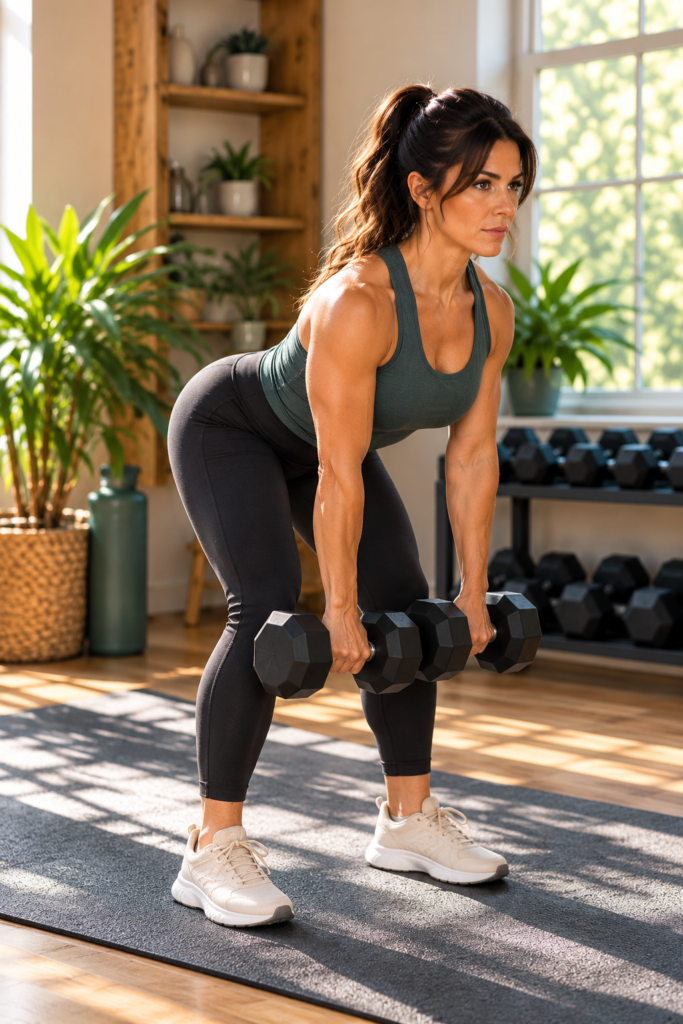
When Should You Increase the Weight?
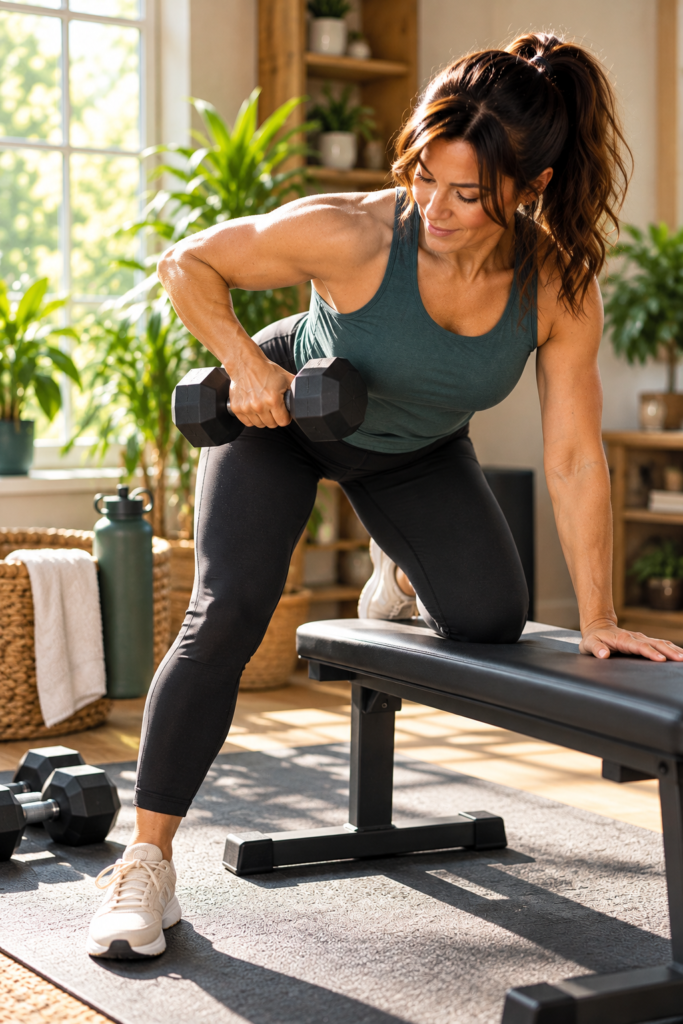
At some point, a weight that once felt challenging will begin to feel easier. You might notice that the final repetitions no longer require as much effort, that you can complete more repetitions than you could a few weeks ago, or that you’re moving through the exercise with greater confidence and control.
That’s a good thing. It’s evidence that your body is adapting to the demands you’ve been placing on it.
But it also raises another question: If the weight feels easier now, should I go heavier?
Often, yes. If your goal is to continue building strength, your muscles need an appropriate challenge as your abilities improve. Gradually increasing that challenge is one way to practice progressive overload, a fundamental principle of strength training.
Despite the technical-sounding name, the idea is straightforward: as your body becomes capable of doing more, you gradually ask it to do a little more.
Look for Consistency Before Increasing
You don’t need to increase your weights simply because one workout felt easier than expected. Instead, look for a pattern across several sessions.
Let’s say you’ve been performing dumbbell rows with ten-pound weights, aiming for three sets of eight to twelve repetitions. When you began, ten repetitions felt challenging, and you probably couldn’t have completed many more with good technique.
After several weeks, you’re consistently completing all three sets of twelve repetitions. Your technique remains controlled, and you finish each set feeling as though you could comfortably continue.
That’s a reasonable sign that you may be ready to try a heavier pair.
The important word is consistently. One unusually energetic day doesn’t necessarily mean you need to change your weights. But when the same exercise repeatedly feels easier at the same resistance, it’s worth considering whether you’re ready for a new challenge.
Increase in Small Steps
When you decide to increase the weight, choose the smallest practical jump available. Moving from ten-pound dumbbells to twelve-pound dumbbells, for example, may be more manageable than jumping straight to fifteen.
The size of the increase matters. Adding five pounds to a ten-pound dumbbell represents a much larger relative increase than adding five pounds to a forty-pound dumbbell. That’s one reason smaller weight increments can be particularly useful for upper-body exercises.
When you try the heavier weight, you may find that you can’t immediately complete as many repetitions as you could with the lighter pair. That’s perfectly reasonable.
For example, you might move from three sets of twelve repetitions with ten-pound dumbbells to three sets of eight with twelve-pound dumbbells. As long as the heavier weight allows you to maintain good technique and the effort is appropriate, you can gradually work toward twelve repetitions again.
There’s no need to rush that process.
Adding Weight Isn’t the Only Way to Progress
Although increasing resistance is an important part of getting stronger, it isn’t the only way to make an exercise more challenging.
You might progress by performing more repetitions with the same weight, adding a set when appropriate, improving your range of motion, or moving from a supported variation to one that requires more balance and control. Sometimes progress simply means performing the same exercise with better technique and less effort than before.
For someone who begins with wall push-ups, moving their feet slightly farther from the wall can increase the challenge without adding any equipment. Eventually, they might progress to push-ups against a sturdy countertop or another lower, stable surface.
The key is to make changes deliberately rather than increasing everything at once. Adding weight, repetitions, sets, and difficulty simultaneously can make it harder to recognize what your body is responding to and whether you’re recovering adequately.
You Don’t Have to Increase Every Workout
Progressive overload doesn’t mean every workout must be harder than the last.
Some weeks you’ll feel stronger. Other weeks, maintaining your usual weights and repetitions may be plenty. Poor sleep, demanding schedules, illness, and accumulated fatigue can all affect how much you’re comfortably able to do.
Strength develops through a combination of training and recovery, not through constantly pushing harder regardless of how you’re feeling.
If a weight that normally feels manageable suddenly feels unusually difficult, it’s reasonable to adjust. You can use lighter weights, perform fewer repetitions, or give yourself additional recovery time when needed.
The goal is progress over time, not a personal record every Tuesday.
And remember that increasing your weights is only meaningful if you can still perform the exercise well. There’s no prize for lifting a heavier dumbbell by swinging, twisting, or struggling through a movement you’ve lost control of.
Let your growing strength guide the next challenge—not the number printed on the weight.
What If You Don’t Own Any Weights?
One of the nicest things about beginning strength training is that you don’t necessarily need to buy anything before you start. Your muscles respond to resistance, and dumbbells are only one way to provide it. Depending on the exercise and your current strength, your own body weight may offer plenty of challenge.
Think about a chair squat. You’re lowering and lifting much of your body weight using the muscles in your legs and hips. A wall push-up asks your upper body to work against a portion of your body weight. Glute bridges, bird dogs, and other bodyweight movements can also help you begin developing strength, coordination, and control without purchasing equipment.
If those movements are challenging for you right now, that’s a perfectly legitimate starting point. You don’t need to add dumbbells just because someone else’s workout includes them.
Start With the Resistance You Already Have
Bodyweight exercises can be adjusted to match different ability levels. A chair squat might begin with sitting down and standing up from a sturdy chair, using your hands for assistance if needed. As that becomes easier, you might use less assistance, lower yourself more slowly, or eventually move toward a squat without the chair.
A wall push-up can become more challenging by moving your feet farther from the wall while maintaining a controlled body position. A glute bridge might progress from learning to lift your hips comfortably to performing additional repetitions or holding the top position briefly.
These changes give your muscles new challenges without requiring heavier equipment. And because many bodyweight exercises also involve balance, coordination, and control, they can be particularly useful while you’re learning how different movements should feel.
Our Exercise Library includes several bodyweight movements with start-and-finish visuals and practical instructions, so you can explore exercises before deciding whether you need additional resistance.
Can You Use Things Around the House?
Sometimes. A filled water bottle, a small container of laundry detergent, or a backpack loaded with a few books can provide resistance for certain exercises. These aren’t perfect substitutes for dumbbells, but they can help you experiment with adding a little weight before making a purchase.
The important consideration is whether the object is safe to hold and move. It should have a secure grip, a predictable weight, and no loose contents that shift unexpectedly. Avoid fragile containers, awkwardly shaped objects, or anything that could spill, break, or slip from your hands.
Household objects are also less suitable for some movements than others. A securely loaded backpack might work for a controlled carry, for example, but an awkward detergent bottle isn’t necessarily a good choice for an overhead press.
Use what makes sense, and don’t force an object into an exercise simply because it happens to be heavy.
When Is It Worth Buying Dumbbells?
If you enjoy strength training and want to continue progressing, having access to a few appropriate weights can make things easier. Dumbbells allow you to adjust resistance more predictably, train different muscle groups, and increase the challenge as your strength improves.
But you don’t need a complete home gym.
For many beginners, a lighter and a heavier pair of dumbbells can provide a useful starting collection. Adjustable dumbbells may offer more flexibility if your budget and space allow. Resistance bands are another option, although they create a different resistance experience and aren’t interchangeable with dumbbells for every exercise.
Before buying anything, consider which exercises you actually plan to do. If you’re primarily practicing bodyweight squats, wall push-ups, and glute bridges, you may not need equipment immediately. If you want to include rows, presses, and loaded carries, access to appropriate resistance will become more useful.
And remember that the right equipment is the equipment you’ll actually use. An expensive set of adjustable dumbbells doesn’t offer much benefit if it stays tucked away in a closet.
You Can Begin Before You’re Fully Equipped
It’s easy to turn equipment shopping into another reason to postpone getting started. You might feel as though you need the right dumbbells, the right mat, the right bench, and a dedicated workout space before your first session can count.
You don’t.
You can begin by learning a few movements, practicing them with control, and paying attention to what feels appropriately challenging. As you become more comfortable, you’ll have a better idea of which equipment would genuinely help you progress.
You need a body. Everything else is optional equipment.
That doesn’t mean equipment is never useful. It means you don’t have to own it before you can begin.
Adjustable Dumbbells Worth Exploring
If you’re ready to add dumbbells to your home workouts, adjustable sets can offer several weight options without requiring an entire rack of equipment. Here are a few options to explore, depending on your budget, available space, and the range of weights you need.
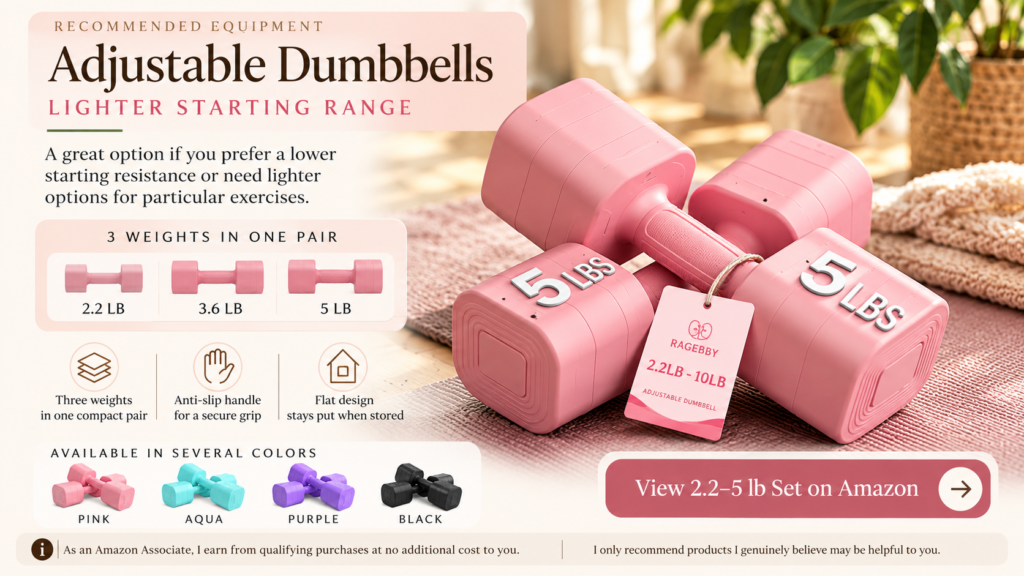
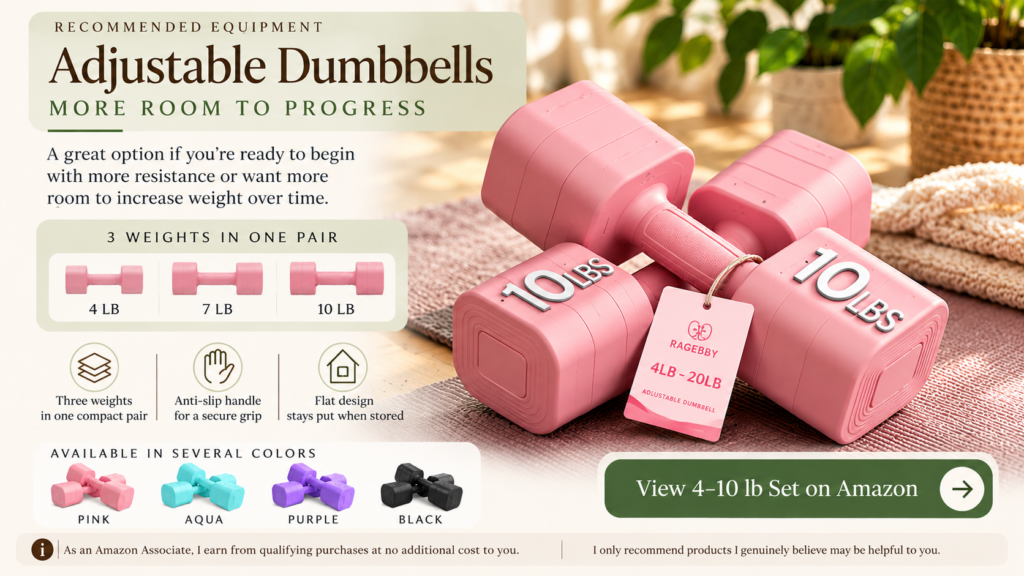
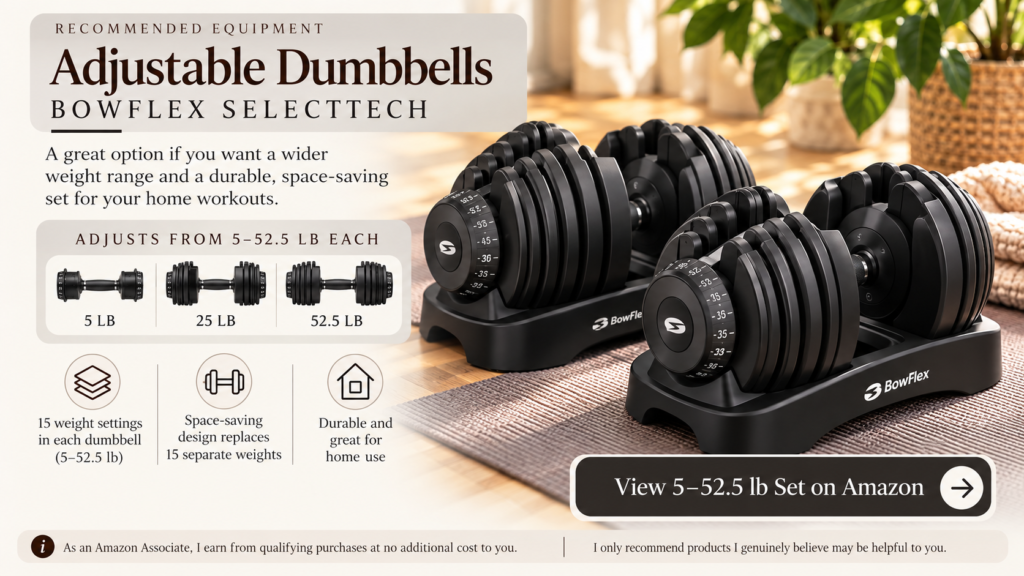
Product images are illustrative. See the Amazon listing for exact product details and available weight settings.
As an Amazon Associate, I earn from qualifying purchases.
A Few Things Worth Remembering
Choosing the right weight is something you learn through experience, not something you’re expected to know before your first workout. The more time you spend practicing different movements, the easier it becomes to recognize what an appropriate challenge feels like. You’ll begin to notice which exercises require more resistance, when a weight is becoming easier to manage, and when your body might benefit from a little less.
Remember, too, that strength training isn’t simply about moving the heaviest weight possible. The resistance you choose is only one part of the picture. How you perform the movement, how consistently you train, and whether you give your body enough time to recover all influence the adaptations you’re working toward.
And those adaptations don’t always announce themselves with a heavier dumbbell.
Sometimes progress looks like completing an exercise with better control. Sometimes it’s carrying the groceries without needing to set them down halfway to the kitchen, getting up from the floor more comfortably, or realizing that something you used to find difficult no longer requires quite so much effort.
Those changes matter because strength training isn’t really about the equipment. The equipment is simply one way to give your body information about what you’re asking it to become better at doing.
You don’t need to begin with the perfect weights. You don’t need to increase them every week, and you certainly don’t need to compare the numbers on your dumbbells with anyone else’s.
You need a starting point, a manageable challenge, and the willingness to adjust as you learn.
Choose a weight you can control. Give your muscles a reason to adapt. And let getting stronger be something you build, one workout at a time.
Ready to Try a Few Movements?
If you’re still figuring out where to begin, visit our Exercise Library in the Morning Room. You’ll find individual strength exercises organized by body area, with clear START and FINISH visuals, simple instructions, and practical form tips to help you get comfortable with each movement.
Start with one that interests you. Practice the movement, see how it feels, and build from there.
And if you’d rather follow a simple routine than choose individual exercises yourself, explore our Beginner Workouts page for approachable, ready-to-follow strength workouts that help you put those movements together.
Sources
- American College of Sports Medicine (2026). Resistance Training Prescription for Muscle Function, Hypertrophy, and Physical Performance in Healthy Adults. An updated evidence review covering training resistance, progression, muscle strength, and physical function.
- American College of Sports Medicine (2009). Progression Models in Resistance Training for Healthy Adults. Guidance on resistance training progression, repetition ranges, and gradually increasing resistance.
- National Strength and Conditioning Association (2023). Progressive Strategies for Teaching Fundamental Resistance Training Movement Patterns. Practical guidance on learning movement patterns and progressing exercises appropriately.
- U.S. Department of Health and Human Services. Physical Activity Guidelines for Americans, Second Edition. National recommendations for physical activity, including muscle-strengthening exercise.