
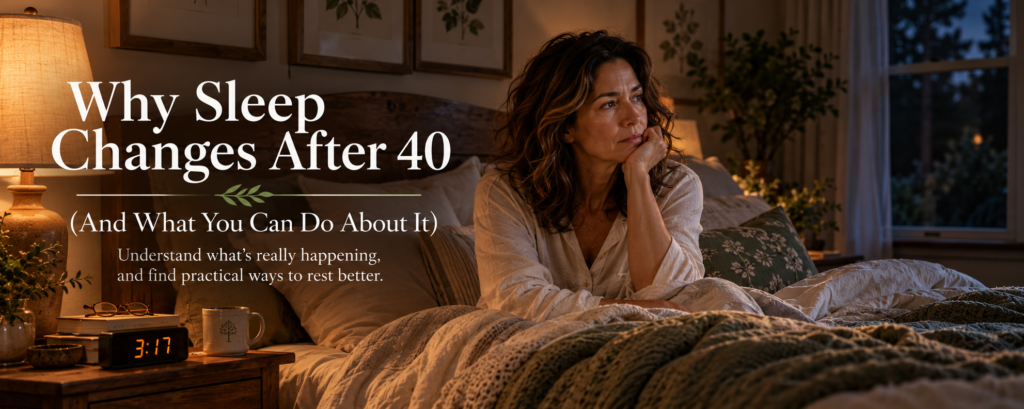
There is a particular kind of frustration that comes with being wide awake at 3:17 in the morning.
The house is quiet. Everyone else seems to be sleeping. You’ve already turned your pillow over, adjusted the blankets, and tried not to look at the clock. But your mind has started calculating how many hours are left before morning, and suddenly the pressure to fall asleep is making sleep feel even farther away.
Maybe falling asleep isn’t the problem. Maybe you’re exhausted by nine o’clock, only to find yourself wide awake when you finally get into bed. Or perhaps you fall asleep easily enough, only to wake several times throughout the night. Sometimes you’re hot. Sometimes you’re restless. Sometimes there’s no obvious reason at all.
And then morning comes, whether you’re ready for it or not.
For many women, sleep becomes one of the more frustrating parts of perimenopause and menopause. Something that used to happen without much thought suddenly seems to require an entire strategy. You start paying attention to bedtime, room temperature, caffeine, supplements, and every other piece of advice you come across. And somehow, the more you think about sleep, the harder it can become.
The frustrating part is that there are real reasons this happens. Your body is going through changes that can affect how easily you fall asleep, how often you wake, and how rested you feel in the morning.
But those changes aren’t always what you think, and they don’t necessarily mean you’re destined to spend the next decade staring at the ceiling.
Understanding what’s happening is a much better place to start than collecting another list of things you’re supposed to do before bed.
So let’s talk about what may actually be keeping you awake.
What’s Actually Changing?
Sleep might feel like the simplest thing your body does. You get tired, you close your eyes, and eventually you wake up again.
Except there’s quite a lot happening behind the scenes.
Your brain keeps track of when it’s time to sleep and when it’s time to be awake. Your body temperature follows a daily rhythm. Your nervous system responds to what’s happening around you, and chemical messengers throughout your body help coordinate the whole process.
Most of the time, you don’t have to think about any of this. Your body handles it.
But during perimenopause, some of the systems involved in that process are changing. And when several things that influence sleep begin shifting at once, you may notice the difference long before you understand what’s causing it.
Hormones Are Part of the Story
You’ve probably heard that estrogen and progesterone decline during menopause. That’s true in the bigger picture, but it doesn’t quite describe what happens along the way.
During perimenopause, hormone levels can fluctuate considerably. Estrogen may rise and fall unpredictably, while progesterone patterns change as ovulation becomes less consistent. It’s not always a smooth transition from one level to another.
And these hormones do more than regulate your menstrual cycle.
Estrogen is involved in several systems that influence sleep, including temperature regulation and mood. Progesterone also has connections to the nervous system. One of the substances your body makes when it breaks down progesterone interacts with receptors involved in calming certain kinds of brain activity.
Researchers are still working out exactly how these changes affect sleep during perimenopause. The connection is interesting, but it doesn’t mean that a particular hormone level can tell you why you’re awake at three in the morning.
Your body isn’t changing one isolated system. Several connected systems are adjusting at the same time.
Why You Might Suddenly Be Throwing Off the Covers
If you’ve ever woken up feeling as though someone turned the heat up while you were sleeping, you already know how disruptive a nighttime hot flash can be.
What’s interesting is that the room itself may not have changed temperature at all.
Your brain helps regulate body temperature, keeping it within a range where you’re comfortable. During the menopausal transition, changes associated with declining estrogen can narrow that comfortable range. A relatively small increase in internal temperature may trigger a response that would normally help your body cool down.
Blood vessels near your skin widen. You feel a rush of heat. You may begin sweating.
And if this happens while you’re asleep, it can wake you.
Then comes the other half of the experience: you’ve kicked off the blankets, your skin is damp, and now you’re cold.
It’s not hard to see how repeating that process several times a night could leave you feeling exhausted by morning.
Researchers have found a strong connection between nighttime hot flashes and disrupted sleep. Sometimes a hot flash appears to trigger an awakening, although the relationship isn’t always that straightforward. What we do know is that women experiencing frequent night sweats may have a very real physical reason for sleeping poorly, and treating those symptoms can help.
But here’s something worth knowing: you can have disrupted sleep during perimenopause without having noticeable night sweats. Hot flashes explain some sleep problems, not all of them.
Sleep Has Other Moving Parts, Too
Hormones aren’t the only things changing as we move through adulthood.
Sleep itself can shift with age. We may spend less time in certain stages of deep sleep, wake more easily, or notice changes in when we naturally feel sleepy. These patterns vary from person to person, and they don’t automatically mean something is wrong.
Then there’s everything else happening in life.
Maybe you’re managing a demanding job, caring for children or aging parents, or trying to keep up with responsibilities that don’t disappear just because you didn’t sleep well. Maybe an aching shoulder wakes you when you roll over. Maybe anxiety has become louder at night, when the house finally gets quiet.
And sometimes poor sleep makes those very things harder to manage the following day.
This is one reason sleep problems can become so frustrating. The same woman might wake because of a hot flash one night, lie awake worrying about tomorrow on another, and have no idea why she slept poorly the night after that.
The result may feel the same, but the reasons can be different.
Why This Matters
When sleep becomes difficult, it’s natural to look for something you can fix. A supplement. A new bedtime routine. A different pillow. Maybe the one trick everyone on the internet seems convinced will change your life.
Some adjustments really can help. But the most useful approach depends on what’s interfering with your sleep.
If you’re waking repeatedly because of night sweats, that calls for a different conversation than lying awake for hours despite feeling exhausted. And both deserve a different approach from sleep that’s being interrupted by a breathing problem or another medical condition.
You don’t need to become a sleep scientist to figure this out. But understanding a little about how sleep works can help you ask better questions, recognize patterns, and spend less time chasing solutions that were never designed for the problem you’re experiencing.
Which brings us to something that doesn’t get nearly enough attention: some sleep problems that show up during midlife aren’t caused by menopause at all.

Not Every Sleep Problem Is Hormonal
When sleep starts changing around the same time as your periods, your temperature regulation, and seemingly everything else, it’s understandable to connect the dots and assume menopause is responsible.
Sometimes it is. But sometimes menopause is only part of the picture, and sometimes something else entirely is interfering with your sleep.
This matters because there are sleep disorders and other health conditions that become more common or more noticeable during midlife. Some are surprisingly easy to overlook, especially when the symptoms don’t look the way we’ve been taught to expect.
Sleep Apnea Doesn’t Always Look Like You Think
When most people picture sleep apnea, they imagine someone snoring loudly enough to shake the walls. And while loud snoring can certainly be a clue, it isn’t the whole story.
Obstructive sleep apnea happens when the muscles and tissues around your upper airway relax enough during sleep to repeatedly narrow or block your breathing. Your brain responds to those interruptions, often briefly waking you just enough to restore airflow. You might not remember waking at all, but your sleep has been interrupted.
Now imagine that happening over and over throughout the night.
You could spend eight hours in bed and still wake up feeling as though you barely slept.
Sleep apnea becomes more common in women after menopause, and it doesn’t always announce itself with obvious symptoms. Some women report fatigue, insomnia, morning headaches, or waking frequently during the night rather than the dramatic snoring and gasping people usually associate with the condition.
If you regularly wake feeling unrefreshed, struggle with significant daytime sleepiness, or have been told that you snore or stop breathing during sleep, it’s worth discussing with a healthcare professional. A sleep study can help determine whether breathing interruptions are part of the problem.
And importantly, sleep apnea isn’t something you can fix simply by creating a more relaxing bedtime routine.
When Your Legs Won’t Let You Settle
There’s another sleep condition that can be particularly frustrating because it often shows up right when you’re finally ready to rest.
Restless legs syndrome causes an uncomfortable urge to move your legs, usually when you’re sitting or lying still. People describe the sensation in different ways: crawling, pulling, tingling, aching, or simply feeling unable to keep their legs quiet.
The defining pattern is that the sensation tends to become worse during rest, is usually more noticeable in the evening or at night, and improves at least temporarily when you move.
If you’ve ever found yourself getting out of bed to walk around because your legs simply wouldn’t settle, you can imagine how difficult falling asleep might become.
Restless legs syndrome can have several contributing factors, including problems with iron availability in the body. It isn’t necessarily caused by menopause, even if you first notice it during midlife.
If the pattern sounds familiar, mention it to your healthcare professional rather than assuming it’s ordinary nighttime restlessness. An evaluation may include blood tests to check iron stores, because iron availability can play a role in restless legs syndrome. But that doesn’t mean you should start taking iron on your own. Whether iron treatment is appropriate depends on your test results and medical circumstances.If the pattern sounds familiar, mention it to your healthcare professional rather than assuming it’s ordinary nighttime restlessness. Evaluation may include checking iron stores, and treatment depends on the underlying circumstances.
When Your Brain Starts Associating Bed With Being Awake
Sometimes the original reason for poor sleep is no longer the only thing keeping it going.
Imagine you’ve had several weeks of interrupted sleep because of night sweats, stress, or a difficult stretch of life. You begin dreading bedtime because you know how the night might go. You start watching the clock, worrying about tomorrow, and trying harder to make yourself fall asleep.
Eventually, getting into bed can become a signal for frustration and alertness instead of rest.
This is one way chronic insomnia can develop or continue, even when the problem that first disrupted your sleep has improved.
Insomnia isn’t simply having an occasional bad night. It involves ongoing difficulty falling asleep, staying asleep, or returning to sleep, despite having a reasonable opportunity to sleep, along with consequences during the day. When those difficulties occur at least three nights a week for three months or longer, they may meet the criteria for chronic insomnia disorder.
And this is where a particularly important treatment comes in: cognitive behavioral therapy for insomnia, usually called CBT-I.
Despite its name, CBT-I isn’t simply talking about your feelings or learning to think positively. It’s a structured treatment that helps change the patterns of behavior, expectations, and sleep timing that can keep insomnia going. It may include strategies for rebuilding the association between bed and sleep, adjusting time spent in bed, and reducing the pressure that develops around falling asleep.
CBT-I is recommended as a first-line treatment for chronic insomnia. We’ll explore what that actually involves in the next section, because it deserves more than a passing mention.
Sometimes the Clue Is Somewhere Else
Sleep can also be interrupted by things that don’t initially seem connected to sleep at all.
Pain, frequent nighttime urination, reflux, certain medications, alcohol, anxiety, and depression can all affect how well you rest. Some medications can make it harder to fall asleep, while others may contribute to nighttime waking or daytime drowsiness.
That doesn’t mean every restless night requires an investigation. Everyone sleeps poorly sometimes.
But if your sleep has changed significantly, especially if it’s affecting your ability to function during the day, it’s worth looking at the bigger picture instead of automatically blaming hormones.
You might discover that menopause is contributing to the problem. You might discover something else needs attention. Or you might find that several smaller issues are working together.
The important thing is that you don’t have to guess forever.
Understanding what might be happening gives you a better starting point for finding something that actually helps.

What Actually Helps (And Why)
By now, you may be wondering what you’re supposed to do with all this information.
It’s one thing to understand why sleep can become complicated during midlife. It’s another to be lying awake at two in the morning, knowing you have to get up in four hours, and wondering what might actually make a difference.
The good news is that there are approaches that help. Some involve fairly simple changes to your daily routine. Others are treatments designed for specific sleep problems. And knowing the difference can save you a great deal of time, money, and frustration.
Let’s start with the things you can influence yourself, then talk about what to do when those aren’t enough.
Give Your Body a Reliable Sense of Time
Your body has an internal clock that helps coordinate when you feel alert and when you feel sleepy. Scientists call this your circadian rhythm, but you can think of it as your body’s daily schedule.
Light is one of the strongest signals that helps keep that clock on time.
When light reaches your eyes, it sends information to the part of your brain responsible for coordinating your daily rhythms. Morning daylight helps reinforce that daytime has begun, while the gradual reduction in light toward evening helps prepare your body for nighttime.
This is one reason spending time outdoors earlier in the day can be useful, even when the sky is cloudy. You don’t need to stare at the sun, buy a special lamp, or turn your morning into an elaborate wellness routine. Stepping outside for a little daylight is a reasonable place to begin.
A fairly consistent wake-up time can help, too. If your body receives roughly the same morning signals each day, it has a more predictable schedule to work with.
That doesn’t mean you must wake at 5 a.m. or follow someone else’s ideal routine. The best schedule is one that gives you enough opportunity for sleep and fits the life you’re actually living.
And if you work nights or rotating shifts, your situation deserves its own approach. The usual advice about morning sunlight and nighttime darkness isn’t always practical when your schedule runs differently.
Pay Attention to What’s Still in Your System at Bedtime
There’s a reason that afternoon coffee sometimes seems perfectly harmless and sometimes comes back to haunt you at midnight.
Caffeine doesn’t disappear when you stop feeling its immediate effects.
It works partly by blocking the action of adenosine, a chemical that builds up while you’re awake and contributes to your growing need for sleep. Caffeine can make you feel more alert even while that need for sleep continues to accumulate.
And because caffeine takes hours to clear from your system, some of what you drank earlier in the day may still be affecting you when you’re ready for bed.
People vary in how quickly they process caffeine, so there isn’t one cutoff time that works for everyone. If you’re having trouble sleeping, experimenting with an earlier last cup may be more useful than assuming caffeine doesn’t affect you because you can drink coffee and still fall asleep.
Alcohol deserves a mention here, too.
It can make you feel sleepy at first, which is why an evening drink sometimes seems to help. But alcohol can disrupt sleep later in the night, contributing to lighter, more fragmented rest.
In other words, falling asleep more easily and sleeping well aren’t necessarily the same thing.
You don’t have to make a long list of forbidden foods and drinks. The useful question is whether something in your routine may be affecting the sleep you’re trying to protect.
Make Your Bedroom Work for You
Your bedroom doesn’t need to look like a luxury hotel or a photograph from a decorating magazine. But the conditions around you can make sleep easier or harder.
Temperature is an obvious place to start, particularly if night sweats have become part of your life. A comfortably cool room, breathable bedding, and layers you can adjust may make it easier to manage changes in temperature during the night.
Light and noise matter, too. Streetlights coming through the curtains, a television playing in another room, or a partner’s snoring can all interfere with sleep.
Some solutions are simple. Closing the curtains more effectively, moving a noisy device, adjusting the thermostat, or choosing bedding that doesn’t leave you overheated may be enough to make the room more comfortable.
And sometimes a tool is genuinely useful. Blackout curtains, a fan, or earplugs may help with a particular problem.
But there’s an important distinction here. Making your room cooler or more comfortable may help you sleep, but it isn’t an established treatment for the hot flashes themselves. And a perfectly arranged bedroom won’t treat sleep apnea or chronic insomnia.
Think of your sleep environment as something that supports rest, rather than something that has to be perfected before rest becomes possible.
Movement Helps, Even When It Isn’t a Workout
Your body was built to move, and regular physical activity is associated with better sleep.
That doesn’t mean you need to exhaust yourself to earn a good night’s rest.
Walking, strength training, cycling, swimming, gardening, and other forms of movement can all contribute to your overall health and may support sleep. The important part is finding ways to move regularly, at a level that works for you.
Timing can matter for some people. If an intense evening workout leaves you feeling wide awake, moving that session earlier may help. But you don’t need to assume that every bit of movement after dinner will interfere with sleep. An evening walk or gentle stretching may fit perfectly well into your routine.
And while regular exercise has many benefits, it shouldn’t be presented as a proven treatment for menopausal hot flashes. The evidence for reducing those symptoms is different from the evidence supporting physical activity for general health and sleep.
Both things can be true.
When Better Sleep Habits Aren’t Enough
Here’s where I want to make a distinction that often gets lost in conversations about sleep.
Good sleep habits can help create conditions that support rest. But if you’ve developed chronic insomnia, improving those habits alone may not resolve it.
You can avoid afternoon caffeine, keep your room dark, go outside every morning, and still find yourself lying awake night after night.
That’s where cognitive behavioral therapy for insomnia, or CBT-I, comes in.
CBT-I is a structured treatment that addresses the patterns that can keep insomnia going. Rather than focusing only on relaxation, it works with the relationship between your sleep schedule, your habits, your expectations, and the way your brain has learned to respond to bedtime.
For example, someone who has spent months lying awake in bed may begin associating the bed itself with frustration and alertness. Part of CBT-I helps rebuild the connection between getting into bed and actually sleeping.
Treatment may also involve carefully adjusting the amount of time spent in bed, keeping a consistent wake time, and changing the thoughts and behaviors that increase pressure around sleep.
Some of these techniques can sound counterintuitive at first. If you’re exhausted, why would anyone suggest changing the amount of time you spend in bed?
Because spending extra hours in bed trying to make up for lost sleep can sometimes reinforce the very pattern that’s keeping insomnia going. CBT-I approaches this systematically, using your sleep history and progress to guide adjustments.
This isn’t something you need to improvise from a few tips on social media. Certain components, particularly those that limit time in bed, require additional care for people with conditions such as seizure disorders, bipolar disorder, or significant daytime sleepiness.
CBT-I is recommended as a first-line treatment for chronic insomnia because research shows that it can improve sleep. It may be offered by trained clinicians or through structured programs.
And if your sleep difficulties are persistent, asking about CBT-I is a reasonable next step, even if you’ve already tried every sleep tip you can think of.
Treat the Thing That’s Interrupting Your Sleep
Sometimes the most helpful sleep strategy isn’t really a sleep strategy at all.
If you’re repeatedly waking because of hot flashes and night sweats, treating those symptoms may improve your sleep. Menopausal hormone therapy is the most effective treatment for hot flashes and night sweats for many eligible women, although whether it’s appropriate depends on individual health history, risks, and preferences. That doesn’t mean hormone therapy is a general treatment for every kind of insomnia. The benefit is clearest when menopausal symptoms themselves are interfering with rest.
There are also evidence-supported nonhormonal treatments, including certain prescription medications and behavioral approaches. A healthcare professional can help you understand the available options and which might be appropriate for you.
It’s worth being careful with the word natural here. Supplements and herbal products are often marketed as gentler solutions for menopause-related sleep problems, but natural doesn’t automatically mean effective or safe. Many products have limited evidence, and some can interact with medications.
And if sleep apnea, restless legs syndrome, pain, or another condition is interfering with your rest, addressing that condition may make a greater difference than adding another bedtime ritual.
The goal isn’t to do everything on a sleep checklist. It’s to figure out which part of the picture needs attention.
Start With One Useful Change
After reading about all the things that can influence sleep, you might be tempted to overhaul your entire routine tonight.
I’d encourage you to resist that urge.
Choose one thing that makes sense for your circumstances. Maybe it’s getting outside after breakfast, moving your last coffee a little earlier, or finding a way to make your bedroom more comfortable.
Pay attention to what happens over time, rather than judging the experiment by a single night. Sleep naturally varies, and one restless night doesn’t necessarily mean something isn’t working.
If you’re dealing with persistent insomnia, significant daytime exhaustion, or symptoms that suggest another sleep disorder, don’t make lifestyle experiments a reason to postpone getting help.
You deserve more than an endless collection of things to try.
Sometimes the most useful change is a small adjustment to your environment or routine. Sometimes it’s recognizing that the problem needs a different kind of support.
Both are ways of responding to what your body is telling you.

When to Get More Support
There’s a difference between having a few difficult nights and spending weeks or months wondering whether you’ll ever feel rested again.
Everyone has nights when sleep doesn’t cooperate. A stressful day, an unfamiliar hotel room, an illness, or a change in routine can throw things off temporarily. Usually, sleep finds its way back toward normal.
But when poor sleep becomes a regular part of your life, especially when it begins affecting how you feel and function during the day, it’s worth taking seriously.
And no, you don’t have to wait until you’re completely exhausted to ask for help.
You Don’t Have to Prove You’re Tired Enough
Women can become remarkably good at functioning while exhausted.
You get up, make breakfast, go to work, take care of the people who depend on you, and somehow keep the day moving. You might feel foggy, irritable, or forgetful, but you tell yourself you’ll catch up on sleep over the weekend.
Then the weekend comes, and the sleep doesn’t necessarily follow.
If difficulty falling asleep, staying asleep, or waking too early has become a regular pattern, it’s reasonable to bring it up with your healthcare professional. The same goes for feeling persistently unrefreshed despite spending enough time in bed.
Pay particular attention if poor sleep is affecting your concentration, mood, energy, or ability to manage ordinary activities.
And remember those other symptoms we talked about earlier. Loud snoring, witnessed pauses in breathing, waking up gasping, significant daytime sleepiness, or uncomfortable leg sensations that worsen at rest can all be clues worth investigating.
You don’t need to figure out which condition you might have before making an appointment. That’s what the evaluation is for.
If you’re struggling to stay awake while driving, don’t try to push through it. Avoid driving while sleepy and seek prompt medical advice. Repeated choking or gasping during sleep also warrants timely evaluation.
A Little Information Can Make the Conversation Easier
You don’t need an elaborate sleep-tracking system to explain what’s happening.
In fact, sometimes the most useful information is surprisingly simple.
For a week or two, consider keeping a brief record of when you go to bed, approximately how long it takes to fall asleep, when you wake during the night, and how you feel the next morning.
You might also note whether you’re experiencing night sweats, taking medications, drinking caffeine later in the day, or noticing anything else that seems connected to your sleep.
The goal isn’t to grade yourself or create another thing to worry about. It’s to give you and your healthcare professional a clearer picture of the pattern.
And if tracking your sleep makes you more anxious about it, that’s worth recognizing, too. You can describe what you’ve noticed without documenting every minute.
Ask About the Problem, Not Just a Sleeping Pill
When you’re exhausted, it’s understandable to want something that will help you sleep tonight.
But it’s worth having a conversation about what’s causing the difficulty, especially if it’s been going on for a while.
If you suspect night sweats are interrupting your sleep, ask about treatments for those symptoms. If you regularly wake feeling unrefreshed or have signs of breathing interruptions, ask whether an evaluation for sleep apnea makes sense.
If insomnia has become persistent, ask about CBT-I and whether a structured treatment program is available.
Sleep medications may have a role in some circumstances, but they aren’t all the same, and they don’t address every underlying cause. Their benefits and risks depend on the medication, your health history, and how they’re used.
You deserve a conversation that considers the whole picture rather than simply adding another temporary solution.
You Are Allowed to Take Your Sleep Seriously
There’s a tendency to treat poor sleep as one of those things women are simply supposed to tolerate during midlife.
But common doesn’t mean inevitable, and it certainly doesn’t mean unimportant.
Sleep affects how you feel, think, move, and manage the demands of everyday life. Persistent sleep difficulties deserve attention, whether they’re related to menopause, another health condition, or several things happening at once.
You don’t have to arrive at an appointment with a diagnosis or a perfect explanation.
Sometimes the most useful place to begin is simply saying, “My sleep has changed, and it’s affecting my life. I’d like to understand why.”
That’s a perfectly reasonable thing to ask.
Working With Your Body, Not Against It
Remember that woman lying awake at 3:17 in the morning, calculating how much sleep she has left before the alarm goes off?
Maybe you’ve been her. Maybe you were her last night.
And maybe, somewhere along the way, you started feeling as though you were doing something wrong. You went to bed at a reasonable hour. You stopped drinking coffee after lunch. You bought the comfortable pillows, tried the breathing exercises, and followed the advice. You did everything you were supposed to do.
So why are you still awake?
I think one of the most frustrating things about changes in our bodies is how quickly we turn them into judgments about ourselves. When something that used to come easily becomes difficult, we assume we must be missing something, doing something incorrectly, or simply not trying hard enough.
But sleep isn’t a test of discipline. You can’t force your brain to switch off through sheer determination, and lying awake isn’t evidence that you’ve failed at taking care of yourself.
Your body is responding to something. The challenge is understanding what.
Sometimes that something is a shift in hormones that makes nighttime temperature regulation less predictable. Sometimes it’s stress, pain, or a sleep schedule that’s gotten out of sync. Sometimes it’s a medical condition that deserves attention. And sometimes it’s several things happening together.
That’s why I believe understanding your body matters so much more than collecting rules about what you should and shouldn’t do.
When you begin to recognize the signals, you can start asking different questions.
Instead of wondering why you can’t seem to get sleep right, you might notice that your worst nights follow evenings when you’re overheated. Or that you’re lying awake long after the caffeine should have worn off. Or that you’re getting plenty of time in bed but never waking up refreshed.
Those observations won’t necessarily give you an immediate answer. But they can help you recognize patterns, make useful adjustments, and know when it’s time to ask for help.
And sometimes the answer won’t be another change you make yourself. Sometimes it will be a conversation with a healthcare professional, a treatment for night sweats, or proper care for a sleep disorder. That’s part of listening to your body, too.
I also want you to remember that sleep doesn’t have to be perfect to be worthwhile. Even people who generally sleep well have restless nights. One difficult night doesn’t erase the benefits of the good ones, and it doesn’t mean every choice you made that day was wrong.
You can care about your sleep without turning it into another thing to monitor, measure, and worry about getting exactly right.
So tonight, whether you fall asleep easily or find yourself watching the clock again, I hope you’ll carry one thought with you.
You don’t have to win an argument with your body.
You can get curious about what it’s telling you. You can make changes where they make sense, ask questions when something doesn’t add up, and seek support when you need it.
And you can give yourself permission to be a human being whose body is changing, rather than a problem that needs to be solved.
Keep listening. Keep noticing. Keep learning your body’s language.
Because the more you understand the signals, the better equipped you become to respond to them.
And that’s a much better place to begin than another night spent wondering what you’re doing wrong.
Sources
The information in this article is informed by peer-reviewed research, clinical practice guidelines, and educational resources from organizations specializing in menopause, sleep medicine, and women’s health.
- Baker, F. C., et al. (2018). Sleep and Sleep Disorders in the Menopausal Transition. Sleep Medicine Clinics.
https://pmc.ncbi.nlm.nih.gov/articles/PMC6092036/ - The Menopause Society (2022). The Hormone Therapy Position Statement.
https://menopause.org/professional-resources/position-statements - The Menopause Society (2023). The Nonhormone Therapy Position Statement.
https://menopause.org/professional-resources/position-statements - Edinger, J. D., et al. (2021). Behavioral and Psychological Treatments for Chronic Insomnia Disorder in Adults: An American Academy of Sleep Medicine Clinical Practice Guideline. Journal of Clinical Sleep Medicine.
https://pmc.ncbi.nlm.nih.gov/articles/PMC7853203/ - Winkelman, J. W., et al. (2025). Treatment of Restless Legs Syndrome and Periodic Limb Movement Disorder: An American Academy of Sleep Medicine Clinical Practice Guideline. Journal of Clinical Sleep Medicine.
https://pmc.ncbi.nlm.nih.gov/articles/PMC11701286/ - National Heart, Lung, and Blood Institute (NIH). Sleep Apnea and Women.
https://www.nhlbi.nih.gov/health/sleep-apnea/women - National Heart, Lung, and Blood Institute (NIH). Insomnia: Diagnosis.
https://www.nhlbi.nih.gov/health/insomnia/diagnosis - National Heart, Lung, and Blood Institute (NIH). Insomnia: Treatment.
https://www.nhlbi.nih.gov/health/insomnia/treatment
This article is for educational purposes and is not a substitute for individualized medical advice, diagnosis, or treatment.