
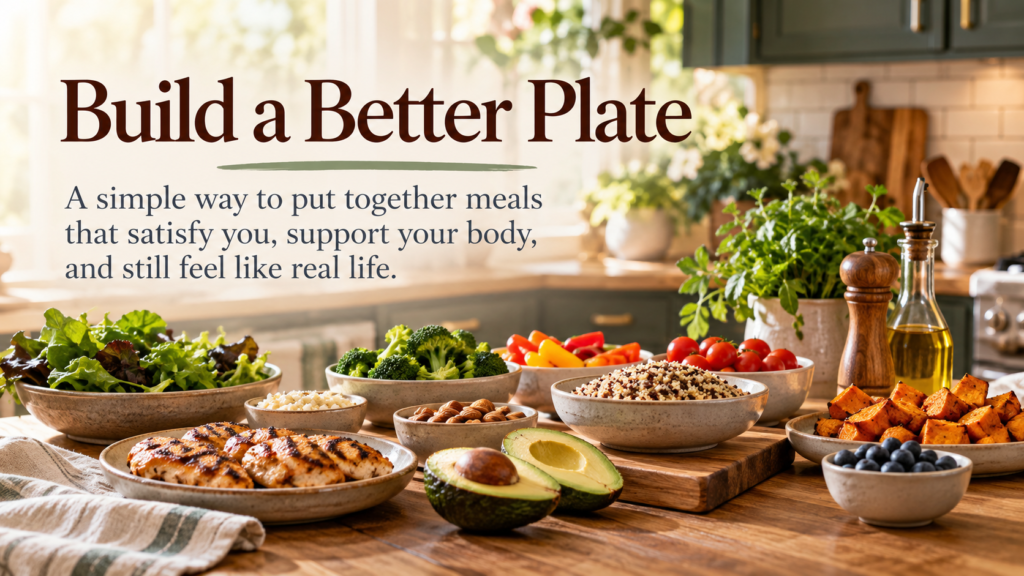
Putting together a meal should not require a nutrition degree.
And yet, somewhere along the way, eating well became surprisingly complicated. There are rules about what belongs on your plate, what should never be on your plate, what time you should eat it, how much of it you should have, and which foods are supposedly responsible for whatever your body is doing this week. By the time you have tried to remember all of it, making lunch can feel like an exam you forgot to study for.
It does not need to be that complicated.
Most meals can begin with a much simpler question: What can I give my body here?
Food is one of the signals your body receives every day. A meal brings in protein and amino acids, carbohydrate, fat, fiber, vitamins, minerals and energy that your body can use in different ways. What you eat is not a command that produces one guaranteed outcome, and a single meal does not determine your health. It is information and material your body receives, responds to and uses.
That becomes especially useful to understand in midlife, when preserving muscle matters, energy can feel less predictable, appetite may change, and the eating strategies that once seemed effortless may not feel quite as helpful anymore. The answer does not have to be tighter rules or a more perfect diet. Sometimes it is simply learning how to build a meal that gives your body more of what it needs.
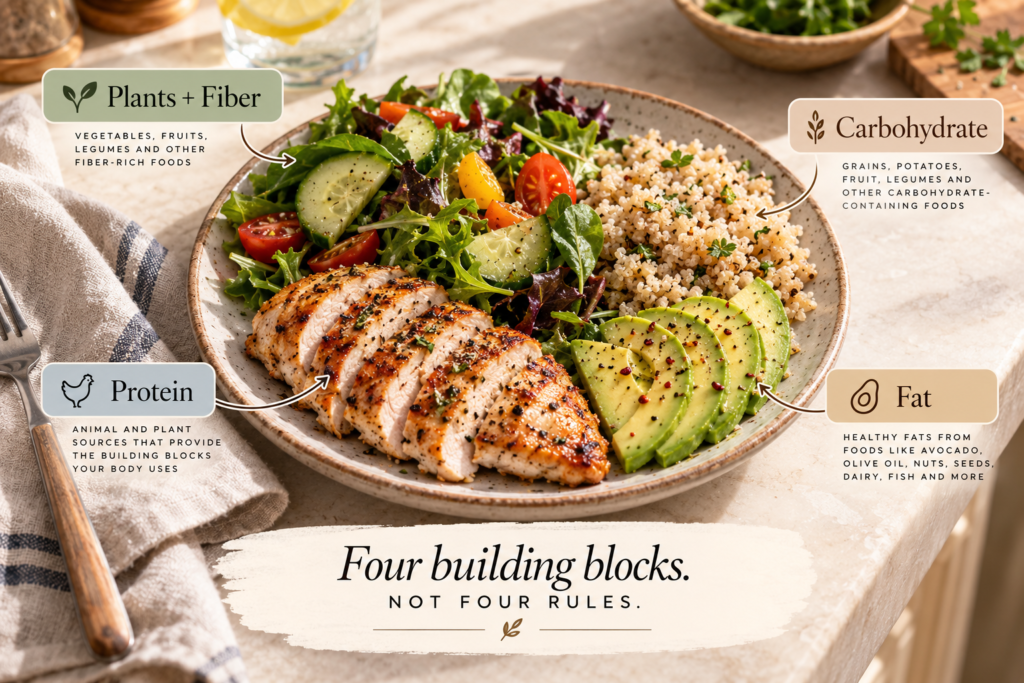
A useful place to begin is with four things: protein, plants and fiber, carbohydrate, and nourishing fat.
Not because every meal must contain four perfectly measured sections. Not because there is one ideal plate that every woman should eat. And certainly not because you need to start inspecting your dinner for nutritional compliance.
Think of them instead as building materials. Some foods will contribute to more than one category. Some meals will lean more heavily toward one than another. Your needs, preferences, appetite and circumstances will change. The goal is not to build a perfect plate.
The goal is to make a satisfying meal easier to build.
Start With Protein
If you are not sure how to build a meal, begin by choosing a source of protein.
Protein provides amino acids your body uses to build and repair tissues throughout the body, including muscle. That matters throughout life, but it becomes particularly relevant through midlife and beyond, when maintaining muscle becomes increasingly important for strength, physical function and the ability to keep doing the things you want to do.
That does not mean every meal needs to become a protein-maximizing project. It means that instead of letting protein be whatever happens to show up in your meal, it can help to choose a source intentionally and build from there.
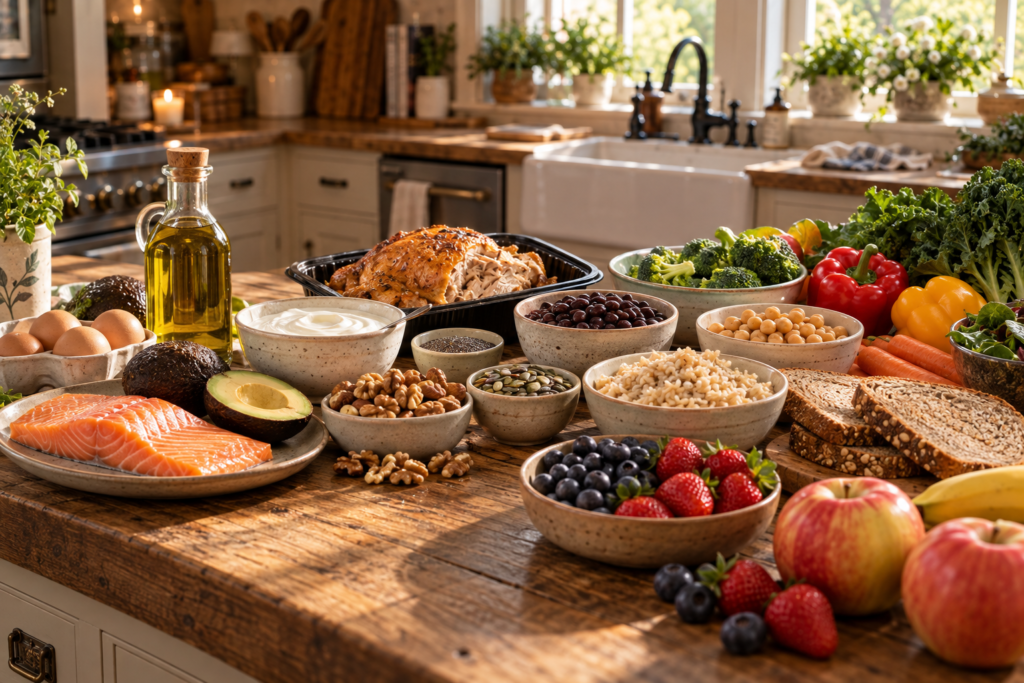
That source might be eggs at breakfast, Greek yogurt in a snack, chicken or tofu in a grain bowl, beans in a soup, tuna in a sandwich, lentils in a curry, cottage cheese with fruit, salmon with dinner, or leftover meat tucked into a quick lunch. There is no single “best” protein food, and your choices can reflect your preferences, budget, culture and the amount of time you actually have to cook.
Protein can also make meals feel more substantial and satisfying. Pairing it with the other pieces we are about to add—fiber-rich plant foods, carbohydrate and fat—helps turn an assortment of ingredients into a meal that has some staying power.
There is also a reason to think about protein across the day rather than letting most of it arrive at dinner. Your body is constantly turning proteins over, using amino acids for building, repair and other functions. Research on aging and muscle has also raised interest in whether distributing adequate protein across meals may better support muscle protein synthesis than concentrating most of the day’s protein in a single meal. Regularly including protein-containing foods gives your body repeated opportunities to receive the amino acids it needs.
You do not have to calculate the perfect amount before you can begin.
For now, ask one simple question when you look at a meal:
Where is my protein?
If you can answer that, you have your first building block.
Add Plants and Fiber
Once you have a source of protein, look for something from a plant.
That could mean vegetables, fruit, beans, lentils, whole grains, nuts, seeds—or several of them together. Plant foods bring an enormous variety of nutrients to the table, and many also provide fiber, something most of us could benefit from eating more regularly.
Fiber does several jobs. It adds bulk to food and helps support normal bowel function. Certain types of fiber are fermented by microbes in the gut, providing fuel for parts of the gut microbiome. Fiber-rich foods can also contribute to fullness after eating and are associated with cardiovascular and metabolic health as part of an overall eating pattern.
But “eat more plants” does not mean every meal needs to begin with an enormous salad.
Frozen broccoli counts. So do berries stirred into yogurt, peppers tossed into scrambled eggs, an apple beside a sandwich, canned beans added to soup, spinach folded into pasta, carrots dipped in hummus, frozen peas thrown into rice, or the bagged salad you opened because chopping six vegetables was absolutely not happening tonight.
Fresh, frozen, canned and dried foods can all have a place here. Convenience is not nutritional failure. In fact, if buying vegetables already washed, chopped or frozen means they actually make it onto your plate, convenience is doing exactly what you need it to do.
And variety does not have to happen in a single meal. You do not need seven different colors arranged beautifully on one plate. Think across your meals and across your week. Different plant foods bring different combinations of fiber, vitamins, minerals and other compounds, so allowing some variety over time is useful without turning dinner into a scavenger hunt.
There is also no need to treat vegetables as the virtuous part of the meal you must eat before earning everything else. Plants are simply another building material—one that can bring flavor, texture, color and nutrients along with them.
So once you have found your protein, ask:
What plant food could I add?
Sometimes the answer will be roasted vegetables and a big salad.
Sometimes it will be a handful of blueberries.
Both count.

Add Carbohydrate
Carbohydrate has spent enough time being treated like the part of the meal you need to justify.
Your body can use carbohydrate as a readily available source of energy, and carbohydrate-containing foods can bring much more than carbohydrate with them. Oats, potatoes, beans, fruit, whole grains, rice, pasta, bread and other foods can contribute fiber, vitamins, minerals and—in the case of foods like beans and lentils—protein as well.
How much carbohydrate feels right at a particular meal can vary. Your activity, appetite, preferences, the rest of the meal and what your day looks like all matter. A woman heading out for a long hike may build a different lunch than she would on a quiet afternoon at home. That is not inconsistency. It is responsiveness.
And carbohydrate does not have to arrive in its least processed possible form to count. Brown rice is food. White rice is food. A baked potato is food. Bread is food. Pasta is food. Fruit is food. You can choose more fiber-rich options often without turning every choice into a referendum on whether you are eating well enough.
This is also where rigid plate rules can become less useful than understanding what you are building. A bean-and-rice bowl, for example, does not divide neatly into separate protein, plant and carbohydrate boxes. Neither does lentil soup or a turkey sandwich on whole-grain bread. Foods overlap, and that is perfectly fine.
Once you have considered protein and plants, ask:
Would some carbohydrate make this meal more complete for me?
Sometimes the answer will be a generous scoop of rice, a potato, tortillas or pasta. Sometimes fruit or beans already contribute some of what you are looking for. Sometimes you simply are not particularly hungry for much more.
The framework is here to help you build the meal—not to overrule your appetite.
Include Some Fat
Fat is another part of food that has spent decades moving in and out of nutritional favor. Your body, fortunately, does not organize nutrients according to diet trends.
Dietary fat supplies essential fatty acids and helps your body absorb the fat-soluble vitamins A, D, E and K. It also brings flavor and texture to food, which matters more than nutrition conversations sometimes acknowledge. A meal can contain all the “right” ingredients and still be deeply unsatisfying if eating it feels like an obligation.
Fat may already be present in your meal without requiring a separate addition. Salmon, eggs, dairy foods, nuts, seeds, avocado, olives and many other foods contain it naturally. You might also cook with olive oil, add dressing to vegetables, spread peanut butter on toast, sprinkle seeds over yogurt, add cheese to a sandwich or finish a bowl with avocado.
This is another reason our four building blocks are not four isolated compartments. A handful of nuts contributes fat, protein, fiber and other nutrients. Beans contribute protein, carbohydrate and fiber. Yogurt can contribute protein, carbohydrate and fat depending on the type you choose. Food is considerably less interested in our categories than we are.
So rather than asking whether you have added the officially correct amount of fat, ask:
Is there some fat in this meal already—or would adding some make it more satisfying?
That is enough.
Put It Together
Now we can stop talking about individual nutrients and make lunch.
Start with protein. Add a plant or another fiber-containing food. Include carbohydrate according to your appetite and needs. Make sure there is some fat in the picture. Then season it, sauce it, toast it, roast it, wrap it, pile it into a bowl or eat it standing at the kitchen counter while someone asks you where their shoes are.
That last part is also real life.
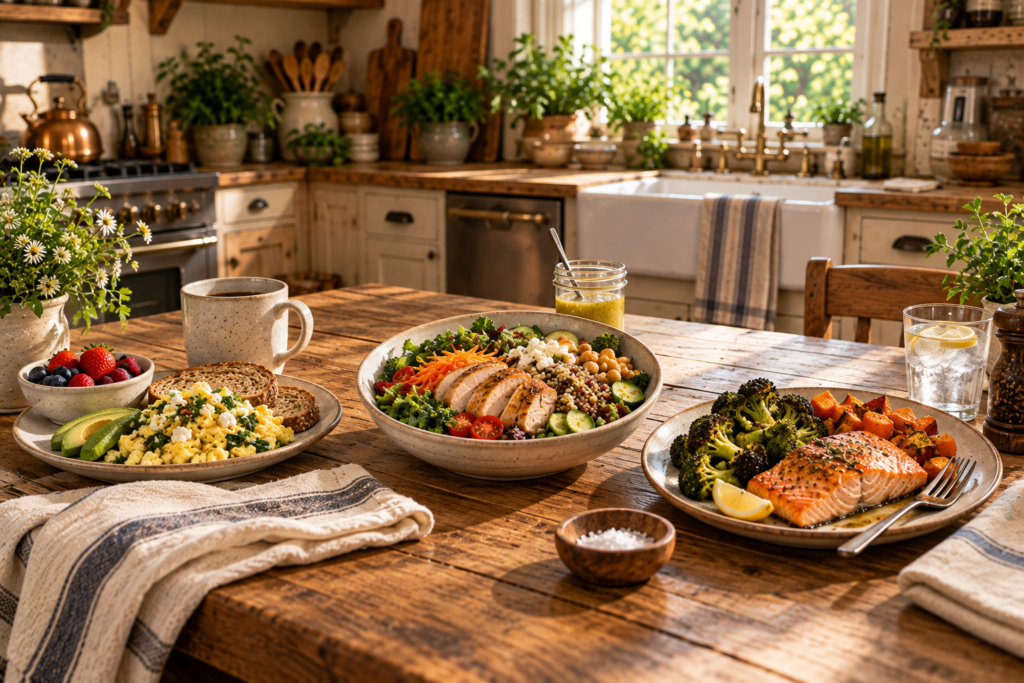
A plate might be grilled chicken, roasted potatoes, green beans and olive oil. But the same framework could be Greek yogurt with berries, oats and walnuts. It could be scrambled eggs with toast, avocado and fruit. It could be a turkey-and-cheese sandwich with lettuce and tomato and an apple beside it. It could be black beans, rice, salsa, avocado and shredded cabbage in a bowl. It could be pasta with chicken, spinach, tomatoes, Parmesan and olive oil.
Soup can fit. Sandwiches can fit. Breakfast can fit. Takeout can fit. Leftovers absolutely fit.
The point is not to make every meal look alike. It is to develop a way of looking at food that helps you notice what is there and what might be missing.
If lunch is an apple and crackers, you do not need to declare the day ruined. You might simply notice that adding cheese, Greek yogurt, nuts, hummus, tuna or another protein-containing food would make that lunch more substantial.
If dinner is pasta with tomato sauce, you might decide it would work better for you with meatballs, lentils, chicken or beans and a vegetable somewhere in the mix.
If breakfast is toast and coffee and you are hungry again forty-five minutes later, that is not evidence that you lack willpower. It is information. You can experiment with what happens when the toast has eggs beside it, peanut butter on it, or yogurt and fruit with it.
That is what this framework is for: not judging the meal you made, but helping you decide what you might add next time.
When the Meal Isn’t Perfect
Some days you will build the beautiful meal.
Other days dinner will come from the freezer.
You will eat in restaurants, order takeout, finish your kid’s leftover fries, discover that the produce you confidently bought six days ago has become an expensive science experiment, and occasionally realize at 7:30 p.m. that nobody made a plan for dinner.
None of this breaks the framework.
Nutrition happens through patterns repeated over time, not through one impeccably constructed plate. You can use these ideas when they are helpful and loosen your grip on them when circumstances require it.
Maybe the frozen pizza gets a bagged salad beside it. Maybe you add rotisserie chicken to something that needed protein. Maybe breakfast is yogurt, a banana and a handful of granola because that is what you can manage. Maybe tonight’s meal is takeout and you simply enjoy it.
There is no prize for making nourishment unnecessarily difficult.
A framework should reduce the amount of thinking required to feed yourself—not give you four new things to worry about.

Build From What You Have
The next time you open the refrigerator and have no idea what to make, you do not need to begin with a recipe.
Look at what is already there.
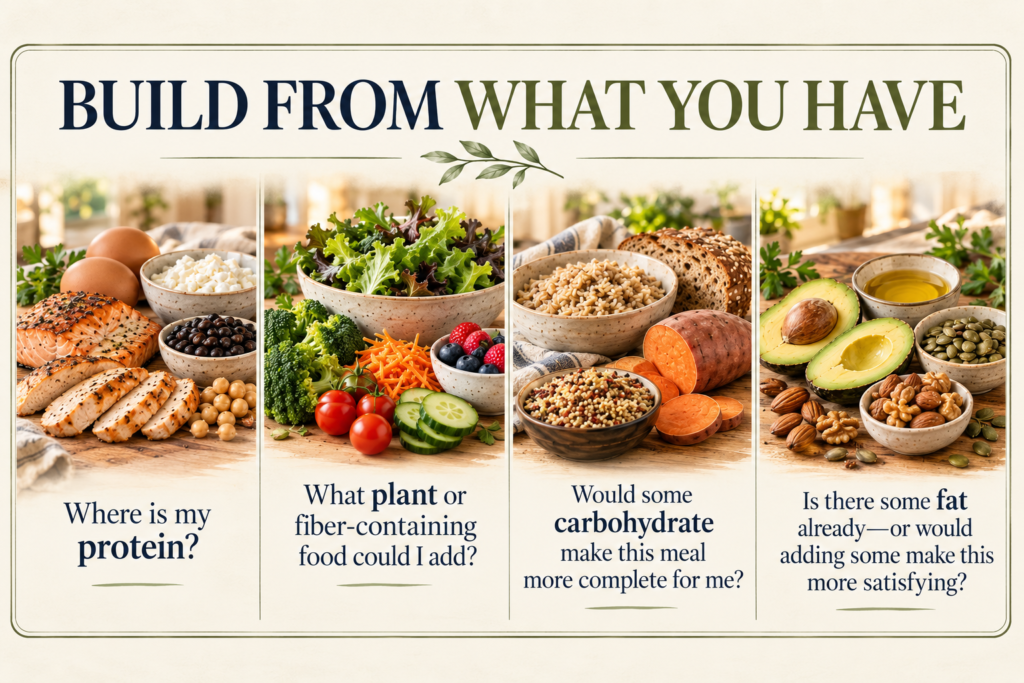
Where is my protein?
What plant or fiber-containing food could I add?
Would some carbohydrate make this meal more complete for me?
Is there some fat already—or would adding some make this more satisfying?
Then make the meal you can make.
Over time, those questions can become almost automatic. You begin to see that eggs, frozen spinach, toast and avocado can become dinner. Leftover chicken, microwave rice, frozen vegetables and a sauce can become a bowl. Greek yogurt, fruit, oats and nuts can become breakfast in about three minutes.
You are not trying to become better at following food rules.
You are learning how to look at what you have, understand what it can give your body, and build something useful from it.
Sources
National Library of Medicine, MedlinePlus — Carbohydrates. An overview of carbohydrates, including their role as an energy source and food sources of carbohydrate and fiber. MedlinePlus
MedlinePlus: Carbohydrates
U.S. Food & Drug Administration — Questions and Answers on Dietary Fiber. Information on dietary fiber and recognized physiological effects, including bowel function and effects on blood glucose and cholesterol. U.S. Food and Drug Administration
FDA: Questions and Answers on Dietary Fiber
Holscher HD. Dietary fiber and prebiotics and the gastrointestinal microbiota. Gut Microbes. Review of dietary fiber, microbial fermentation and interactions with the gastrointestinal microbiota. PubMed
PubMed: Dietary Fiber and the Gastrointestinal Microbiota
Layman DK. et al. Impacts of protein quantity and distribution on body composition. Frontiers in Nutrition. Review discussing dietary protein, muscle protein synthesis, aging and the still-evolving evidence around protein distribution across meals. PubMed
PubMed: Protein Quantity and Distribution
National Institutes of Health, Office of Dietary Supplements — Omega-3 Fatty Acids. Evidence-based information on essential fatty acids, food sources and fatty-acid metabolism. Office of Dietary Supplements
NIH ODS: Omega-3 Fatty Acids